


Bob Dylan.
A name you might not know.
Even the film's star initially knew little about him.
But you've likely read his lyrics in a book.
Or heard a melody drifting on the wind...
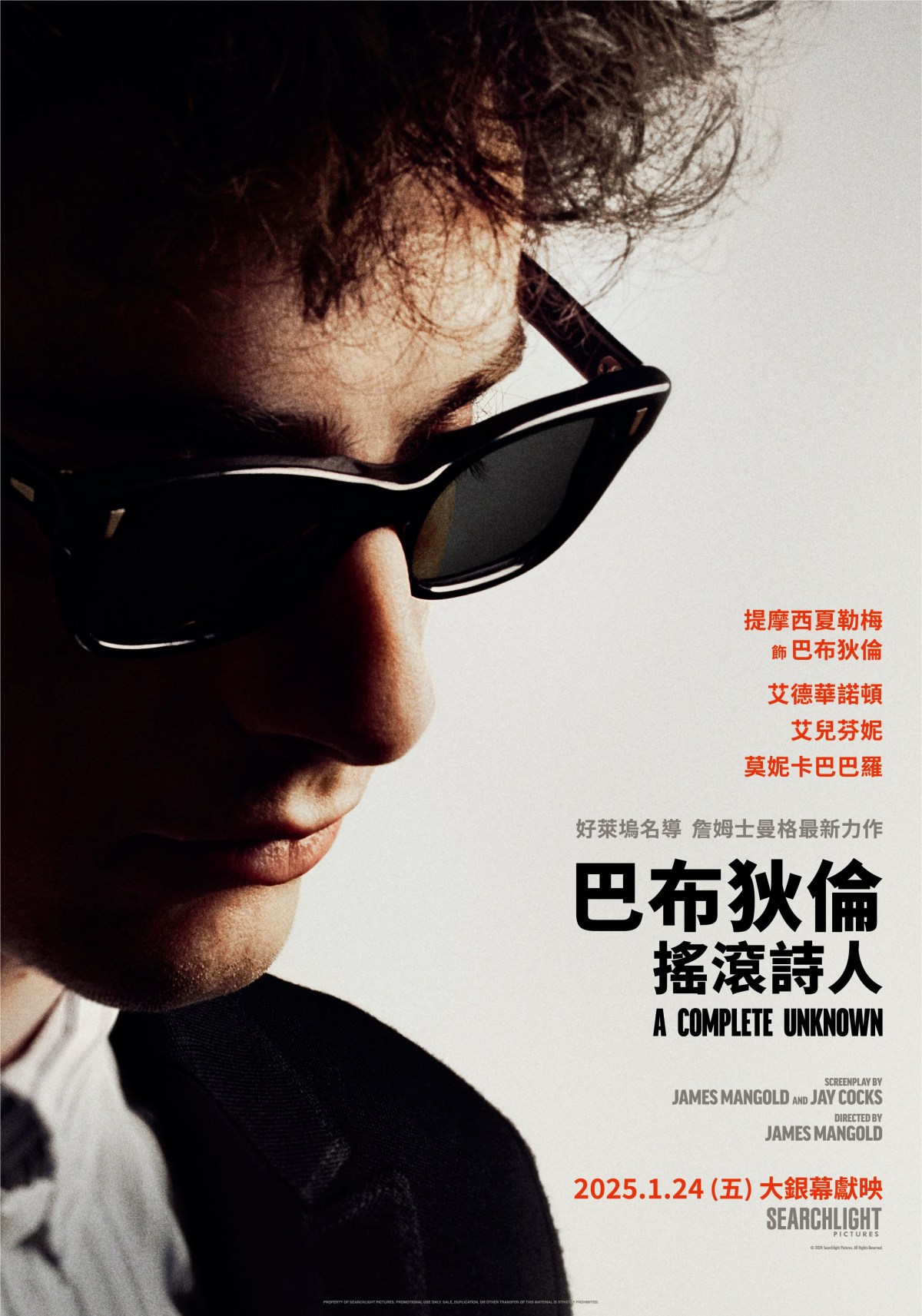
Set for release in late 2024, the biographical drama "A Complete Unknown" is already generating significant Oscar buzz for the following year. Directed by James Mangold, known for 2019's "Ford v Ferrari," the film stars Timothée Chalamet, acclaimed for his role as the "chosen one" in the "Dune" series. "A Complete Unknown" chronicles 1960s America, exploring the collision of folk and rock music, and the enduring legacy of an artist who continues to shine brightly.

Who's Bob Dylan?
So, who exactly is Bob Dylan? Born Robert Zimmerman in 1941 to a Jewish family in Duluth, Minnesota, he formed a band with friends in high school and immersed himself in folk music during college. However, he dropped out of the University of Minnesota after less than a year to pursue his passion. Influenced by Welsh poet Dylan Thomas, he began performing under the stage name Bob Dylan, embarking on an uninterrupted musical journey spanning over 60 years, during which he released more than 30 studio albums. In 2016, he was awarded the Nobel Prize in Literature "for having created new poetic expressions within the great American song tradition," becoming the first and only musician to receive the honor.

1. Bob Dylan (1961)
In 1961, a dusty Dylan arrived in New York, heading to the hospital to visit his idol, Woody Guthrie. The acclaimed folk singer, known for many popular songs, was in his middle age, ravaged by Huntington's disease, having lost his cognitive and self-care abilities, lying in bed like a flickering candle. Beside him sat the "Father of Folk Music," Pete Seeger. Despite the unexpected visit from a young stranger, Seeger warmly invited Dylan to sit by the bedside. Dylan then picked up his guitar and sang "Song to Woody," a song he had written for Guthrie.
As the young man strummed chords and murmured lyrics, Seeger and Guthrie listened intently to every flowing note and word, as if witnessing a new hope ignite within the folk music scene. That very night, Seeger invited the penniless Dylan to stay at his home to compose, and his family also highly praised Dylan's songs. Seeger then began taking Dylan to various folk music gatherings. At one small, private performance, Dylan first met the then-popular folk singer Joan Baez, who was already a star. Dylan took the stage after her, and by chance, record label manager Albert Grossman was also in attendance. Upon seeing Dylan perform, Grossman immediately decided to sign the rising star and helped him release his self-titled debut album. This initial foray primarily featured covers of other artists' songs, such as Eric Von Schmidt's pure lyrical piece "Baby, Let Me Follow You Down." However, in a few years, Dylan would "plug in" this song, transforming it beyond recognition.
2. "The Freewheelin' Bob Dylan" (1963)
After his debut album, however, Dylan's first record largely went unnoticed, with most customers at record stores inquiring about Joan Baez's albums. This left Dylan somewhat disheartened. Yet, during this period, Dylan met his muse, Sylvie Russo. The film adapted this character, whose real-life inspiration was Dylan's then-girlfriend, Suze Rotolo, who also famously appeared on the cover of his second album. In February 1963, on a biting cold New York street, Suze, bundled in a coat, embraced a cool-but-shivering Dylan, who wore only a jacket and hunched against the chill. Their intertwined figures, strolling through Greenwich Village, captured a pure moment from that tumultuous era.
Compared to the film's portrayal of Sylvie, the real Suze embodied more of the era's spirit. Hailing from a left-wing family, Suze endured persecution during the McCarthy era's anti-communist fervor, which propelled her into civil rights activism. This, in turn, influenced Dylan, exposing him to leftist thought and artistic works. During this period, he penned many enduring classics, including the iconic "Blowin' In The Wind" and "A Hard Rain's A-Gonna Fall." Dylan also channeled his deep feelings for Suze into a series of moving love songs, ultimately leading his all-original album to widespread public attention.
However, their relationship, under the spotlight, eventually fractured, though the exact reasons remain unknown. In the film's narrative, while Sylvie was on a short study trip to Europe, the Cuban Missile Crisis instilled a sense of impending doom in America. This context, coupled with Dylan's chance encounter with Joan Baez in a club, led them to embrace a carefree spirit. Their subsequent close collaborations at various concerts gradually deteriorated Dylan and Sylvie's relationship, culminating in their breakup. In reality, however, Dylan and Rotolo remained friends and both went on to find life partners and start families. Over forty years later, Bob Dylan recounted this fleeting romance in his autobiography, revealing his heartfelt sentiments about his first love with her. Sadly, Suze passed away in 2011 from lung cancer, leaving behind a legacy cherished by many.
3. "The Times They Are A-Changin'" (1964)
The timeline shifts back to 1963. That year, Dr. Martin Luther King Jr. delivered his iconic "I Have a Dream" speech at the Lincoln Memorial, advocating for racial peace and human rights. Yet, in the same year, President Kennedy was assassinated in Texas, shocking the world. Amidst this era of profound change, Dylan began to use his pen to craft lyrics that critiqued social injustice. For instance, in "The Lonesome Death Of Hattie Carroll," he recounted the story of a working-class woman senselessly murdered, only for the justice system to protect the privileged, resulting in a mere few months' sentence for the perpetrator—a poignant and tear-inducing satire.
Dylan's image at the time—harmonica around his neck, guitar on his back—saw him joining Peter and Joan in civil rights and anti-war movements. The public began to view him as the voice of a generation, with everyone hoping he would become their ideal "somebody." More and more labels were thrust upon him, but he consistently rejected these external titles. By the end of this album, Dylan seemed to uneasily hint at an impending departure...
4. Another Side of Bob Dylan (1964)
When public preconceptions are deeply entrenched, it's hard to break free from the mold people create for you. Bob Dylan's musical career was now at a crossroads. Mid-film, Dylan's appearance began to change; he donned sunglasses, black suits, high-heeled boots, and often had a cigarette dangling from his lips. During a joint concert with Joan, Dylan refused requests from both Baez and the audience to perform his classic hit Blowin' In The Wind. He turned and walked off stage, never looking back, just as he described in his autobiography: the folk music scene was a paradise he had to leave, much like Adam had to leave the Garden of Eden.
Ah, but I was so much older then, I'm younger than that now.
5. Bringing It All Back Home (1965)
At the 1964 Newport Folk Festival, Pete Seeger introduced Dylan, who, amidst a cheering crowd, took the stage to perform his brand-new composition, "Mr. Tambourine Man," signaling the dawn of a new era. Watching the 60-year-old black-and-white footage, one can almost still hear the stirring winds of the live performance, with Seeger tapping his foot to the rhythm in the background. This song moved away from social commentary, embracing a more psychedelic tone. The poet Yu Kwang-chung once translated its obscure imagery into Chinese, and singer Wei Li-an (William Wei) offered his own interpretation with a different musical style in 2021. On the vast road of musical exploration, Dylan was now poised to speed off in a different, more challenging direction.
The following year, his fifth album, Bringing It All Back Home, exploded onto the scene. What shocked audiences was Dylan's departure from pure folk music. The album brazenly opened with "Subterranean Homesick Blues." One side of the vinyl record featured all-electric rock instrumentation, while the flip side contained only four songs accompanied by acoustic guitar and harmonica. Once hailed as the great hope for the folk revival and a voice of his generation, Dylan was now seen as a renegade by more traditional fans.
The album also featured a special love song, "Love Minus Zero/No Limit." It is widely believed to be written for his first wife, whom he married that same year—not the woman in red on the album cover, nor his collaborator Joan Baez, but Sara Lownds, who would be intertwined with him in a love-hate relationship for over a decade. This woman, who also profoundly influenced Dylan, did not appear in the film. However, amidst the rhythmic, beautiful lyrics, filled with imagery from the poetry of William Blake and Edgar Allan Poe, and accompanied by a light yet melancholic melody, it seemed to symbolize the end of a beautiful era: "It's all over now, Baby Blue."
6. Highway 61 Revisited (1965)
Transitioning from folk singer to rock superstar, Dylan rapidly ascended in the mid-1960s music scene, with fervent fans flocking to his every appearance. Following the critical success of his previous album, Dylan continued to forge an unprecedented path in his songwriting. A classic etched into the DNA of the Western Baby Boomer generation, and once topping Rolling Stone's 500 Greatest Songs of All Time, "Like a Rolling Stone" also inspired the original title of the upcoming film, A Complete Unknown.
How does it feel? How does it feel?
How does it feel?
To be on your own, with no direction home
Alone, with no direction home
A complete unknown, like a rolling stone
A complete unknown, like a rolling stone
While the song's title might seem to reference the adage "a rolling stone gathers no moss," the lyrics are a scathing indictment of a high-society woman's eventual downfall to the streets. This sardonic, counter-culture hippie style became a distinct rebellious element in Dylan's work. For instance, the film depicts how Dylan acquired a siren whistle from the street for the album's title track, Highway 61 Revisited, attaching it to his harmonica rack to produce a comical yet memorable melody.
The narrative then builds to its climax in 1965, when Dylan was invited to headline the Newport Folk Festival. Having fully embraced rock music, Dylan was naturally reluctant to perform only the traditional folk songs his audience expected. Despite persistent pleas from the festival committee and Pete Seeger to forgo an electric set, Dylan found himself at a crossroads. His kindred spirit and fellow performer, Johnny Cash, encouraged him to stay true to himself while under the influence. That night, a deafening sound ripped through the air, met by a mix of boos and applause from the crowd. Some audience members hurled insults, calling Dylan, who was Jewish, "Judas!" Objects began to fly onto the stage, and the committee members furiously clashed with Dylan's manager. Seeger, enraged, nearly took an axe to the amplifier cables. This, one of music history's most controversial electric performances, concluded amidst the shouts and uproar of the crowd. However, the aforementioned "Judas" incident actually occurred later during Dylan's London tour at the Royal Albert Hall. Faced with relentless abuse from fans, Dylan retorted by announcing his song I Don't Believe You and then turned to his band, instructing them, “Play it Fxcking Loud!” He used his music to respond to the era's bitter criticism regarding his perceived betrayal of the folk scene......
Postscript
While this film leans towards a biographical and realistic narrative, it still incorporates numerous adapted elements. Reportedly, Bob Dylan himself, now in his eighties, was involved in some script revisions. However, the most outstanding highlight of the film is undoubtedly Timothée Chalamet's portrayal of Dylan, meticulously capturing the artist's distinct vocal nuances and demeanor across different periods of his life. All songs in the movie are personally performed by Chalamet, offering a fresh perspective that allows each generation to find their own version of the iconic Bob Dylan.
The film concludes after Dylan's pivotal performance at the Newport Folk Festival, as he makes his final visit to Woody Guthrie in the hospital. No longer the unknown folk singer he once was, Dylan intends to return the repaired harmonica, but Guthrie ultimately entrusts it to him. Stepping out of the hospital, Dylan mounts his motorcycle, riding towards a world governed by neither God nor the devil, unaware of the seismic shifts that await him just a few years down the road...
Movie poster source: 20thcenturystudios