

"While not perfect, it is at the same time dazzling..."
"Perhaps it is a work like youth itself."—Makoto Shinkai
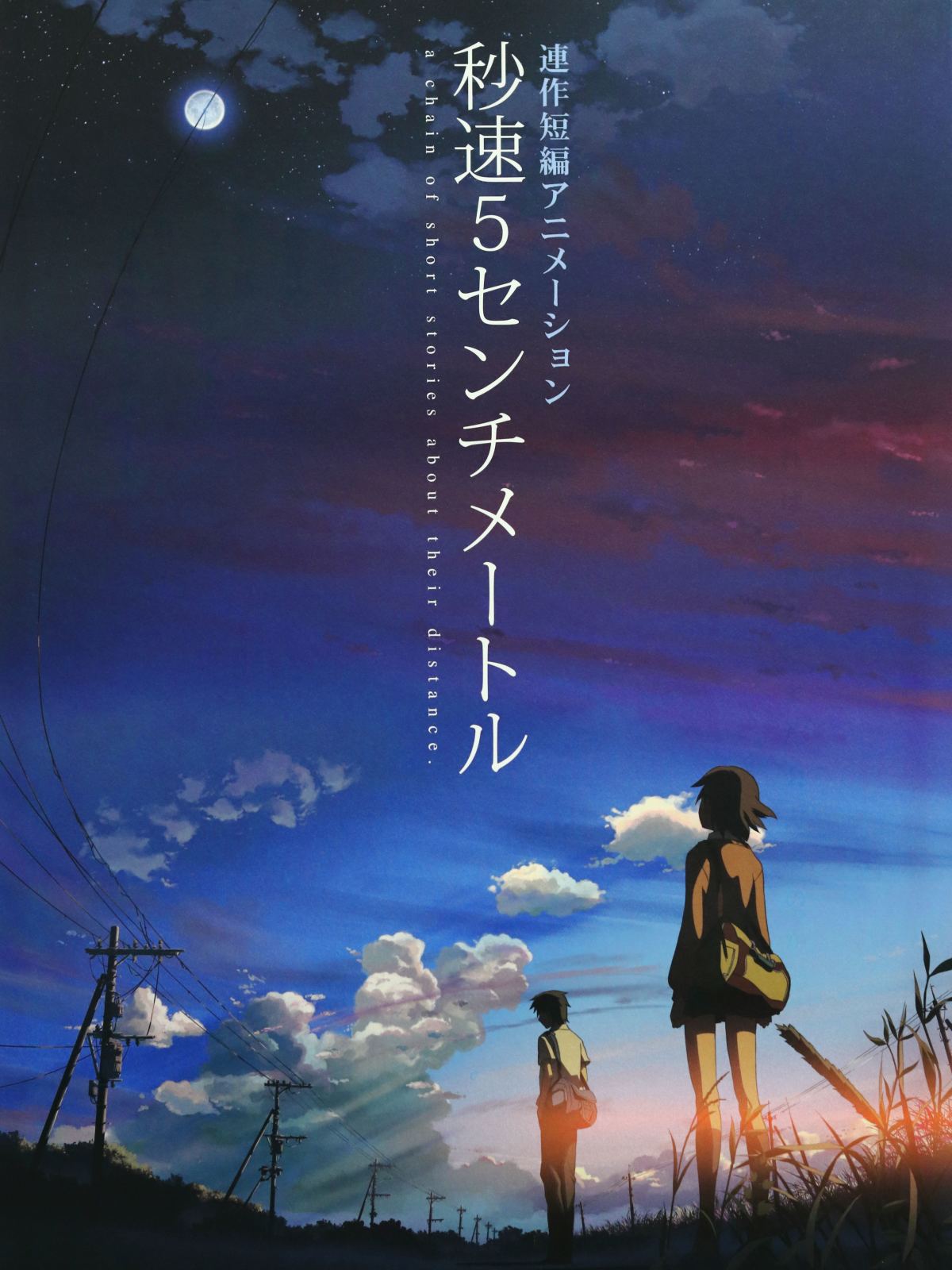
With the recent release of a live-action film, Makoto Shinkai's early masterpiece, "5 Centimeters per Second," has returned to domestic theaters for a limited two-week run nearly twenty years after its debut. Although I've long since developed an immunity to the heartache from countless mental shocks delivered by this short story collection, I took the opportunity to revisit those youthful years that can never be reclaimed. This new version includes an exclusive new director's interview, and after watching it, I don't know how many sleepless nights I'm in for.
"Cherry Blossom" (Ōkashō)
The story begins again on a downhill road lined with cherry blossoms in full bloom. Akari and Takaki, still in elementary school, chase each other down a path showered with falling petals. As the railway crossing gate slowly descends, Akari, on the other side of the tracks, says to Takaki, "I hope we can watch the cherry blossoms together again next year!" But the giant hands of fate had already pushed their future paths in different directions... Waiting is perhaps the most anxiety-inducing element. In today's technologically convenient era, it's hard to imagine that words that could be conveyed in seconds with a phone call or a text message were once so difficult to send. In the 1990s, before mobile phones were widespread, for a junior high school student in his early teens traveling alone to a distant countryside to meet someone, facing the malice of time meant he could only take off his watch and let it pass, utterly helpless. The director revealed that the background for this story came from his time working at a game company. After getting off work to meet someone, he was caught in a heavy snowstorm on his way back and was trapped on the train all night, his mind filled with anxiety about not being able to get back to work. Thinking about this ironic reversal of emotional states, one can't help but chuckle.
"Cosmonaut"
The distance between Takaki and Akari grows ever wider with time. The setting jumps from the bustling metropolis of Tokyo to a small island in the south of the country, a distance that can no longer be bridged by a train. Lonely, Takaki spends his days fiddling with his phone, typing out text messages to no one in particular, only to write and delete them over and over again. But Takaki isn't the only one with unspoken words. There's also his classmate Kanae, who has been by his side for years with an unrequited love. Troubled by her inability to confess, her constant failures while practicing surfing, and her uncertainty about her future, she finds resolution after an unexpected conversation with Takaki. Surrounded by the sky and the sea, she finally rides a wave for the first time in months and decides to confess her feelings to Takaki on this very day...
This chapter is probably the one that resonates with me the most. Although Takaki is very gentle, the two always maintain a certain distance while riding home on his scooter, unable to get any closer. It isn't until Kanae realizes that she has never been in Takaki's heart that she understands. As they watch the island's rocket launch into the sky, the point of light disappearing into the heavens seems to foreshadow Takaki's own heart, which will not remain on the island. Despite this, Kanae finds herself hopelessly falling even more in love with him. With this sweet yet bitter feeling, she silently weeps herself to sleep under the twinkling stars... It brings back memories of distant days, of my own teenage years filled with unspoken words and regrets that lasted until graduation, never to be voiced, leading to one sleepless night after another.
"5 Centimeters per Second" (Byōsoku Go Senchimētoru)
If Noboru Terao and Mikako Nagamine in Makoto Shinkai's first independent sci-fi work, "Voices of a Distant Star," were lovers separated by light-years between space and Earth, then in "5 Centimeters per Second," even on our small planet, the distance between two hearts can be just as unreachable. The novel written by the director provides more details about Takaki's university life, whereas the anime jumps to his time as a working adult, worn down by the pressures of reality, his heart no longer soft but rigid. He finally breaks, quitting his job and ending his relationship, hitting the off switch to reboot everything. One day, after finishing a freelance project at home, Takaki goes for a walk along a street blooming with cherry blossoms. He comes to a familiar railway crossing and passes by a woman. Just as Takaki turns back, a train speeds by... It is precisely because of the gut-wrenching reality of the ending of "5 Centimeters per Second" that we later received "Your Name," a film where director Makoto Shinkai preserved a trace of gentleness for his audience.
Director's Special Footage - Memories of a Certain Spring
Finally, a note on the newly included director's interview: A curly-haired Makoto Shinkai, along with several key staff members from the original production such as animator Takayo Nishimura, art director Ryoko Majima, and composer Tenmon, who wrote many of the poignant musical scores, gather at Shimokitazawa Tollywood to chat about the production. For instance, the reason for the title "5 Centimeters per Second" lies in its slightly ambiguous nature. The plot deliberately avoids over-explaining details, leaving ample empty space to give the audience more room for imagination. Furthermore, the animation was based on extensive location photography. The team ran around city train stations and wandered through the country paths of Tanegashima with point-and-shoot cameras, capturing various changes in light and shadow. Then, they all crammed into Shinkai's small home, accompanied by a cat named Sayuri (after the heroine of his second work, "The Place Promised in Our Early Days"), to complete each beautiful and moving frame. Regarding his evaluation of the work, the director admits that from today's perspective, it certainly has many flaws. But he is no longer the straight-haired Makoto Shinkai of those days; now over fifty, he couldn't replicate the same state of mind. That is perhaps a part of him that is now missing, like the faint light emitted by the firefly after it flies out of the jar in Haruki Murakami's short story "Firefly"—dazzling yet fleeting. "5 Centimeters per Second" is just that—a work like youth itself.