

OpenAI CEO Sam Altman recently drew backlash from gamers and the tech community over comments about the efficiency of personal computer memory usage, with critics accusing him of favoring AI data centers. As the controversy continued to spread, Altman took to X, formerly Twitter, to clarify that he supports people installing as much memory as they want and blasted critics for taking his original remarks out of context.

The controversy began after Altman discussed the global DRAM supply crunch during an appearance on "Cheeky Pint." From a worldwide resource-allocation standpoint, he argued that having large amounts of scarce memory sitting idle in personal computers at just 5% utilization was not an ideal use of limited resources. With supplies severely constrained, concentrating memory in cloud data centers could improve overall utilization, he said, even though many people instinctively see the issue in exactly the opposite way.
Some online interpreted the comments as a call to prioritize memory supplies for AI companies, sparking a wave of memes and criticism. Elon Musk, who has long feuded with Altman, joined the conversation by declaring that people should also have the right to own their own RAM. Altman, however, had been discussing efficiency amid tight supplies and never proposed any specific restrictions on consumers purchasing or owning RAM.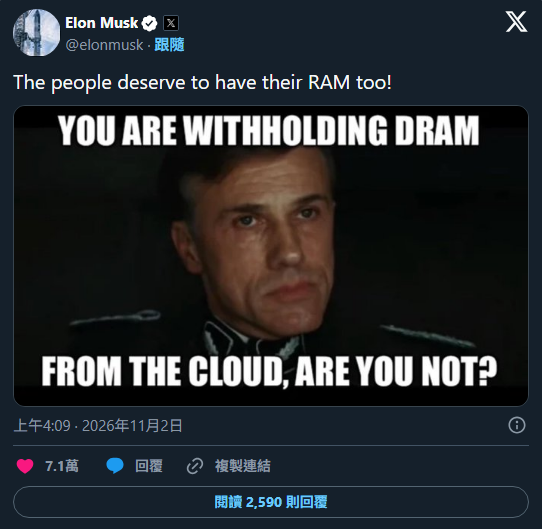
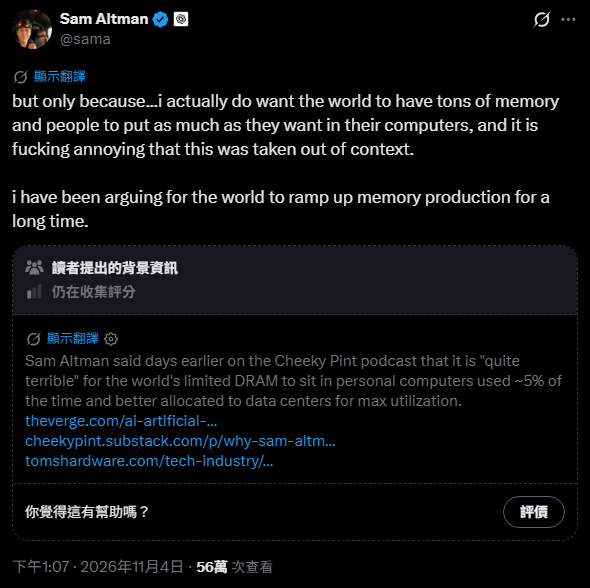
Altman later responded to users on X (formerly Twitter). At a follower's suggestion, he even briefly changed his display name to "Ram Altman":
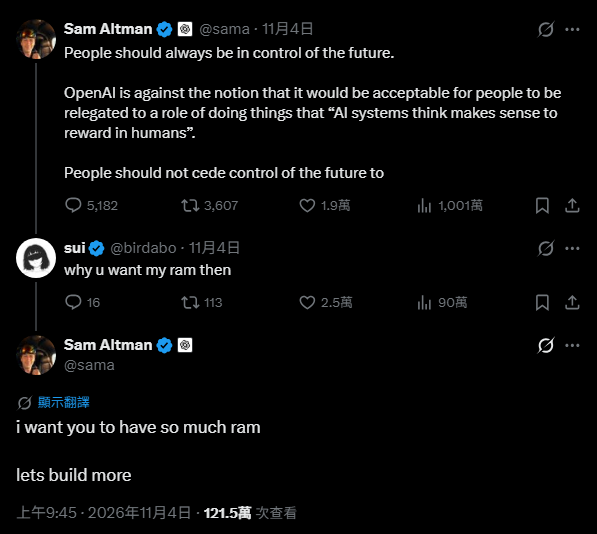
"I actually do want the world to have tons of memory and for people to put as much as they want in their computers. It is fucking annoying that this was taken out of context. I have argued for a long time that we should produce way more memory globally." In another reply, he added, "I want you to have so much RAM. Let's build more."
Beyond the memory controversy, Altman also weighed in on the direction of Artificial Intelligence during the U.S. midterm elections. On November 3, 2026, the Democratic Party defeated President Donald Trump's Republican Party and won majorities in both the House and Senate. The shift in political power also raised questions about potential changes to U.S. AI regulation.
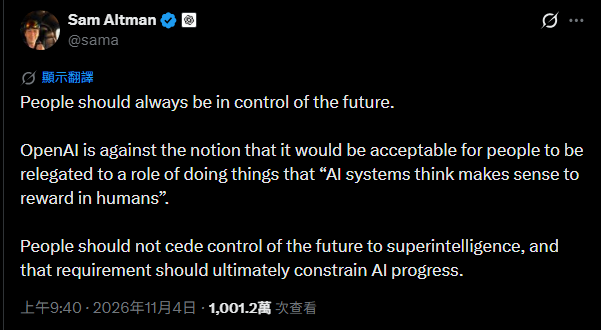
Addressing the broader issue, Altman wrote in another X post: "People should always be in control of the future. OpenAI rejects the idea that a role for people of merely doing the things that AI systems think are worthy of reward is acceptable."
"People should not cede control of the future to superintelligence, and that requirement should ultimately constrain AI progress." Altman did not explicitly link the statement to the election results.
Altman's clarification did not walk back his original argument about cloud-resource efficiency. Instead of limiting personal RAM ownership, he emphasized expanding the global supply. With AI data centers buying memory in massive quantities, consumer component supplies and prices remain under pressure, once again highlighting the competition between the AI industry and everyday buyers for limited hardware resources.