

 (Image courtesy of Lionsgate)
Over the years, Francis Lawrence has effectively become The Hunger Games franchise’s answer to David Yates: a dependable director who can keep a blockbuster series running and deliver the expected baseline. Yates directed four "Harry Potter" movies and all three "Fantastic Beasts" films, while Lawrence has now helmed five "Hunger Games" installments—and will likely return whenever author Suzanne Collins decides to write another prequel. Both filmmakers occasionally luck into a genuinely good entry, such as "The Hunger Games: Catching Fire" or the first "Fantastic Beasts and Where to Find Them," but their work is usually average at best and sometimes falls below that mark.
Within the franchise, "The Hunger Games: Sunrise on the Reaping" lands closer to the better end of the spectrum. It is neither great nor terrible. The flaws are obvious, but they never completely sink the movie. Lawrence knows this world’s tone and rhythm inside out, and he has no interest in radically reinventing the formula. His priority is staying as close to the source material as possible and making sure all the necessary pieces are in place. He also trims some of the familiar franchise rituals audiences have already seen several times, moving quickly toward the main event. There is only so much he can compress, however, and the material outside those obligatory beats still needs room to unfold. As a result, "Sunrise on the Reaping" ultimately runs for more than two and a half hours, making it the longest installment in the series to date. 
(Image courtesy of Lionsgate)
I did not particularly like "Sunrise on the Reaping"—or, more accurately, I only enjoyed the setup before the Games began. Once the story enters the arena, the prequel’s fundamental problem becomes impossible to ignore. That is not entirely the movie’s fault; the issue was already baked into the novel. Restructuring the narrative for the screen would not have been easy, either. The necessary changes would affect a substantial portion of the plot, require the filmmakers to win over the author, risk alienating readers and demand time to rebuild the story. That is a lot of hurdles to clear, and Lionsgate, clearly intent on hitting its release date, was never going to give the creative team unlimited time to rework the material.
The central idea behind "Sunrise on the Reaping" is strong. Haymitch Abernathy is repeatedly manipulated and brutalized by the Capitol, capturing the tragedy and helplessness of an ordinary person who can never defeat an enormous system. The problem is that the plot expresses this idea in painfully repetitive ways. I understand that the story needs to show how everything Haymitch lost and every blow he endured as a young man transformed him into Woody Harrelson’s jaded, half-broken version of the character. Yet each loss unfolds in almost exactly the same fashion. Again and again, a momentary lapse on Haymitch’s part gets an ally killed, leaving him to cradle the body and sob in guilt. It is like having Rue die five or six times in the same movie and forcing Katniss Everdeen to mourn her five or six times. The impact wears off quickly.  (Image courtesy of Lionsgate)
These sacrifices are meant to demonstrate the Capitol’s cruelty, but this installment pushes the idea much harder while achieving less than the previous five movies did with more selective retaliation. Those films also featured the same basic exchange—give the Capitol the finger once, and it will stab you ten times in return—but they did not keep repeating virtually identical scenarios simply to provoke outrage. When the same device is used this often, the emotional momentum stalls instead of building. The movie has nowhere more intense to go; it simply keeps draining the novelty from the same kind of shock.
The biggest attraction in "Sunrise on the Reaping" is still its star-studded cast. This is easily the franchise’s strongest ensemble to date, with every major and supporting player receiving at least one moment to shine. Even actors with minimal screen time use it efficiently, establishing their characters’ defining traits almost immediately. That was likely an important consideration for the filmmakers. With so many characters competing for attention, the movie needed sharp, confident performers who could make an instant impression. Elle Fanning, Maya Hawke, Kieran Culkin, Jesse Plemons and Joseph Zada deserve particular praise, with each finding a remarkably effective balance in their performance. 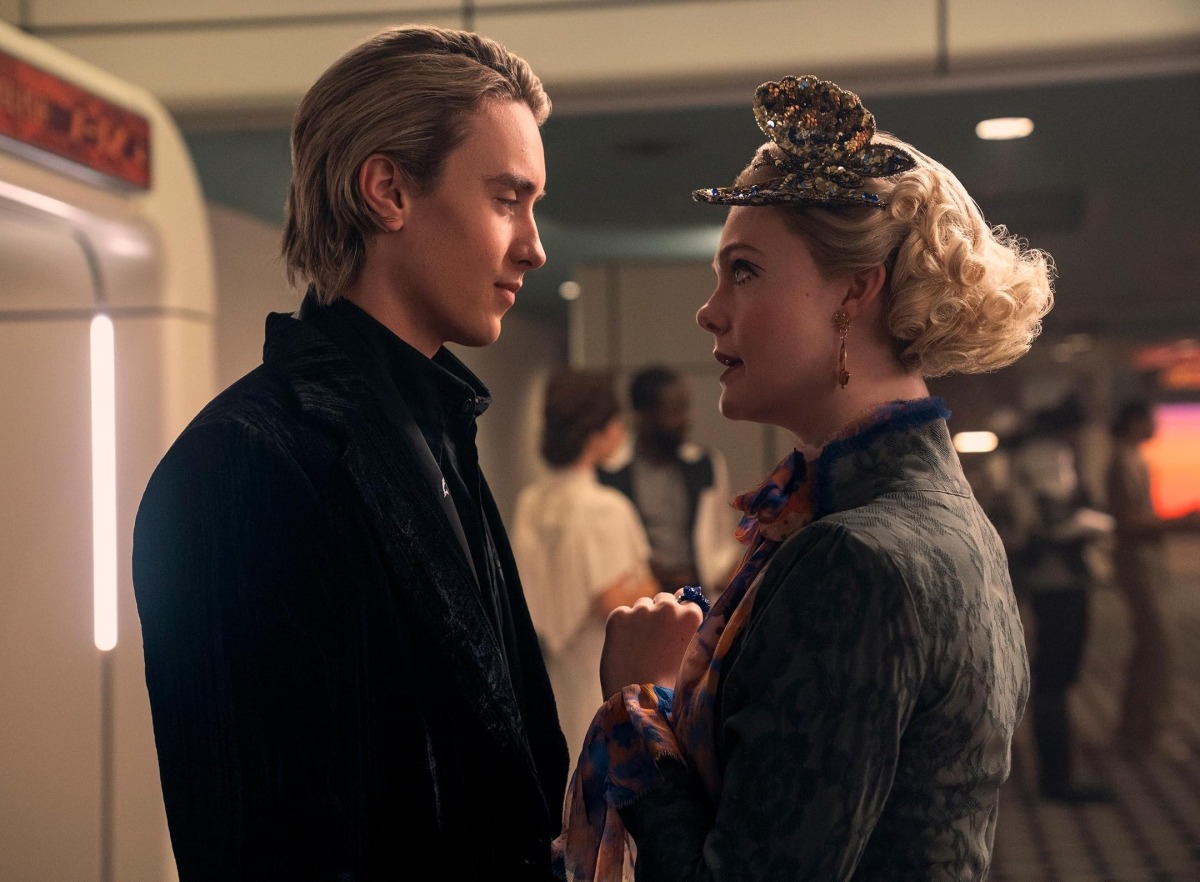 (Image courtesy of Lionsgate)
They are all playing younger versions of characters previously portrayed by veteran actors, many of whom have highly distinctive screen personas. Woody Harrelson’s middle-aged Haymitch is the clearest example: once he plays a character, his presence can easily define that role. Yet the younger cast members successfully preserve the qualities established by their predecessors while bringing fresh interpretations of their own. The casting and performances are impressively consistent across the board. Ralph Fiennes is the exception. He appears to approach the role entirely through his own interpretation, without trying to imitate or bridge the earlier portrayals. The performance remains assured; he has simply chosen a different path.
Finally, I was not particularly impressed by Lawrence’s decision to recreate the famous IMAX aspect-ratio expansion from "The Hunger Games: Catching Fire" as the characters enter the arena. That original transition worked because the frame widened in tandem with Katniss Everdeen’s rising emotions after she was forced to watch Cinna being brutally beaten while powerless to intervene. It was not merely a technical flourish; it amplified the dramatic tension. This time, there is no comparable story beat supporting the transition, so the effect carries far less impact.