
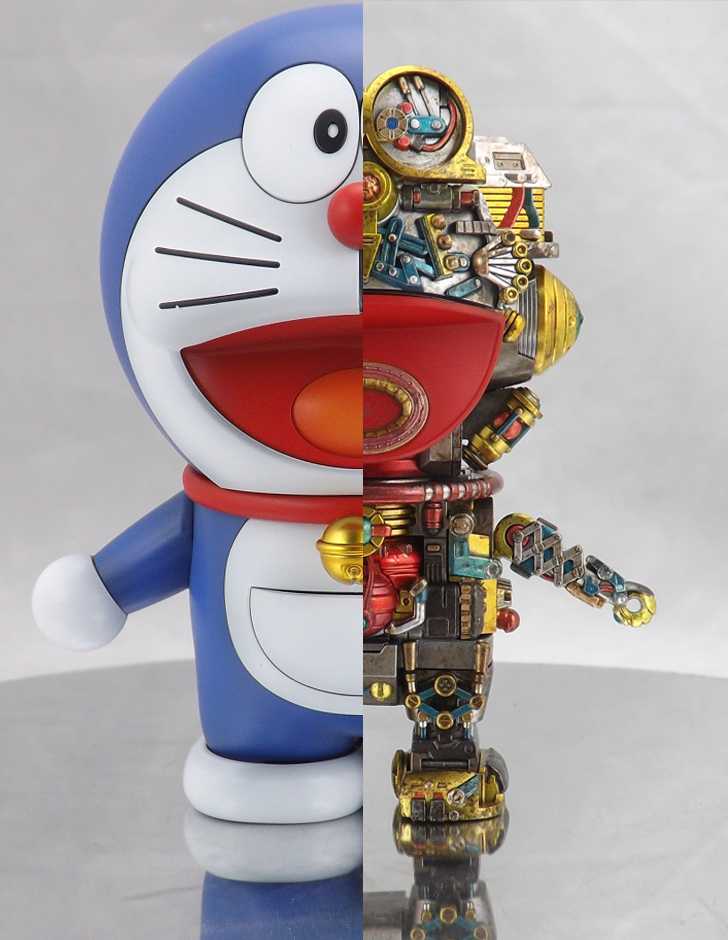
While it's a model kit, the exterior perfectly captures Doraemon's original design, even down to the subtle smile at the corners of his mouth. However, one part did receive an update: the initial release had the tongue and mouth as a single piece, but later versions separated the tongue into its own part, allowing for full color separation.


The kit also features transparent parts. While clear parts can achieve high transparency with a gloss coat after some sanding, this often results in unwanted glare. To avoid this, a meticulous sanding, polishing, and waxing method was employed. This involved progressively sanding from 400-grit all the way up to 10,000-grit, followed by coarse, fine, and ultra-fine polishing compounds. The remaining compound was then removed with a nylon stocking before a final wax, resulting in exceptional clarity without any reflective glare.


The most significant aspect of this kit is its incredibly detailed internal structure. Designed to be accessible even for children, the parts aren't overly complex. However, to elevate the internal detailing, every component was fully painted and color-separated. Before diving into the specifics, let's briefly touch upon Doraemon's original lore. Doraemon often avoids returning to the future for proper maintenance, fearing that Nobita might get into irreparable trouble during his absence. Even when he does go back, it's usually for quick, basic checks and repairs before rushing back. This lore inspired the internal structure's aesthetic: a weathered look, but without any signs of rust. The skeletal frame, in particular, was the most time-consuming, with each individual part receiving approximately 5-6 different paint colors.


For the inside of the mouth, a base coat of regular red was applied, followed by a thin spray of metallic red. A granular effect was then used to represent the tongue's texture.


The heart-like component was painted using three distinct colors to evoke the feel of a mechanical artificial heart: metallic red for the "blood vessels," rose gold for the "heart" itself, and metallic green for the "energy" core.


