


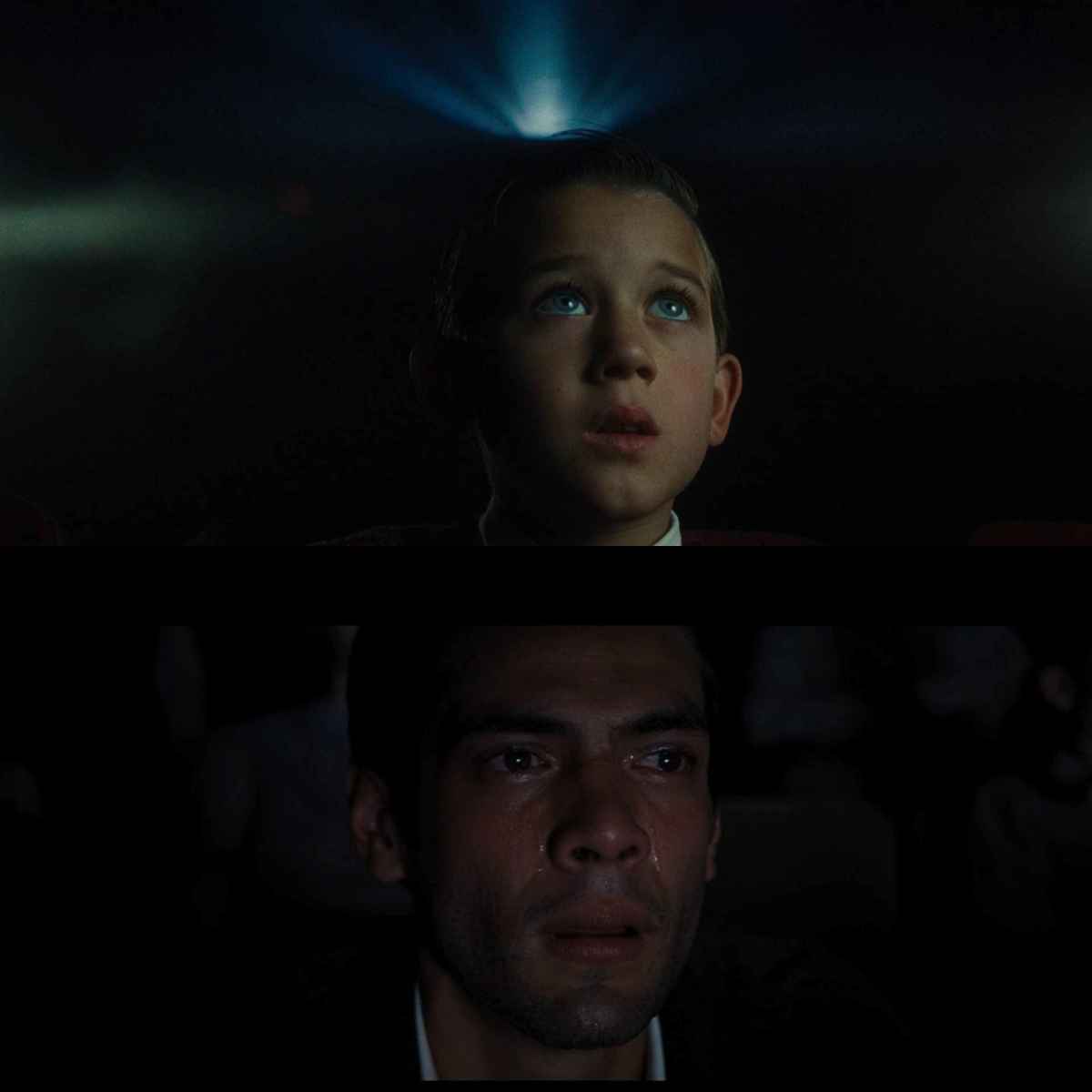
Above image is 'The Fabelmans' / Below image is 'Babylon'
In 2022, two love letters to cinema appeared: Steven Spielberg's 'The Fabelmans' and Damien Chazelle's 'Babylon'. I chose to watch 'Babylon' because Damien's previous work 'La La Land' enchanted me like a potion, making me fall in love with him as a director, and the crazy trailer for 'Babylon' heightened my attention towards it.
.
I'm not belittling Steven Spielberg; I still believe Damien is far behind him. However, in terms of promotion, 'The Fabelmans' was not as fervently marketed as 'Babylon'. It’s possible that 'The Fabelmans' is Steven's semi-autobiographical film, with plot inspirations drawn from his childhood family, fearing that his family might hate the movie and feel ashamed, and thus being reluctant for others to see it, but this is just my speculation.
.
Many people compared 'The Fabelmans' and 'Babylon' after watching them. Some felt 'The Fabelmans' was superior to 'Babylon', while others loved 'Babylon'. Some also believed that having both movies released in the same year felt a bit tedious (just like the 2023 releases of 'Barbie' and 'Poor Things'), since both are about the love for cinema and women's issues. I was certainly among those who adored 'Babylon'.
.
Today, I've rewatched Steven's 'The Fabelmans' and reassessed the relationship between these two works. I believe they cannot be compared because their love for cinema comes from different perspectives—one reflects the original intent of filmmaking, while the other mirrors the descendants who carry on that intent. They can be seen as continuous, and perfectly suited for a double feature.
.
Damien's 'Babylon' reflects the transition from silent to sound films, similar to 'Singin' in the Rain', showcasing how these actors, directors, cinematographers, and other staff who thrived during the silent era face another era's storm. Some managed to escape, some persisted through effort and wit, but others could not withstand the test of time and were eliminated. But did they truly disappear forever from the big screen?
.
The silent era may have indeed ended, but their works and spirit will continue to be shown and passed down to the next generation, even for thousands of years to come. 'Babylon' is not about the end of an era, but the beginning of a new era shaped by the old one, influencing the next generations to continue their spirit and creativity in making one film after another. The cross-century montage at the end of the film represents the imagery of passing on the torch of eras. Imagine reversing the montage, as if returning to the original intent behind creating films—those exciting singular points that can never be contained. This is also why I cried uncontrollably, 'They will never see the wonderful world they created, but we see it now.'
.
Steven Spielberg's 'The Fabelmans' tells the story through the perspective of a child named Sam, exploring his view of cinema and how it influences him (along with the crucial family factors). Sam is the aforementioned 'descendant', while the old era consists of his parents, uncle, and the films he has watched. His parents encouraged Sam's interest in filmmaking, while his uncle, who rolled in the entertainment industry, instilled the spirit and responsibility of being an artist in Sam, and cinema granted him imagination.
.
The highlight is at the end when Sam meets the director John Ford of 'Stagecoach', who tells Sam: 'What's happening above and below the horizon is what everyone wants to pay attention to; if the horizon is in the middle, then it would be a boring movie.' At the end, Steven playfully raises the camera upwards, placing the horizon at the bottom—I loved it, I loved it!!!
.
'The Fabelmans' conveys through the perspective of descendants, how fortunate it is to live in a world where cinema exists, and how exhilarating it is to create one's own film, one's own world. These descendants become the great directors we respect today, like Steven Spielberg, Martin Scorsese, Quentin Tarantino, Stanley Kubrick, Damien Chazelle, and so on.
.
So stop comparing 'Babylon' and 'The Fabelmans'; these two are practically conjoined twins. They also happen to be available on Netflix simultaneously. If the cinema cannot screen them as a double feature, then experience them at home! (Watch 'Babylon' first, then 'The Fabelmans' for better impact.)