

A true classic that's been running for 35 years, Hajime no Ippo has been a staple for many fans since childhood, with its fiery storyline still captivating audiences today.
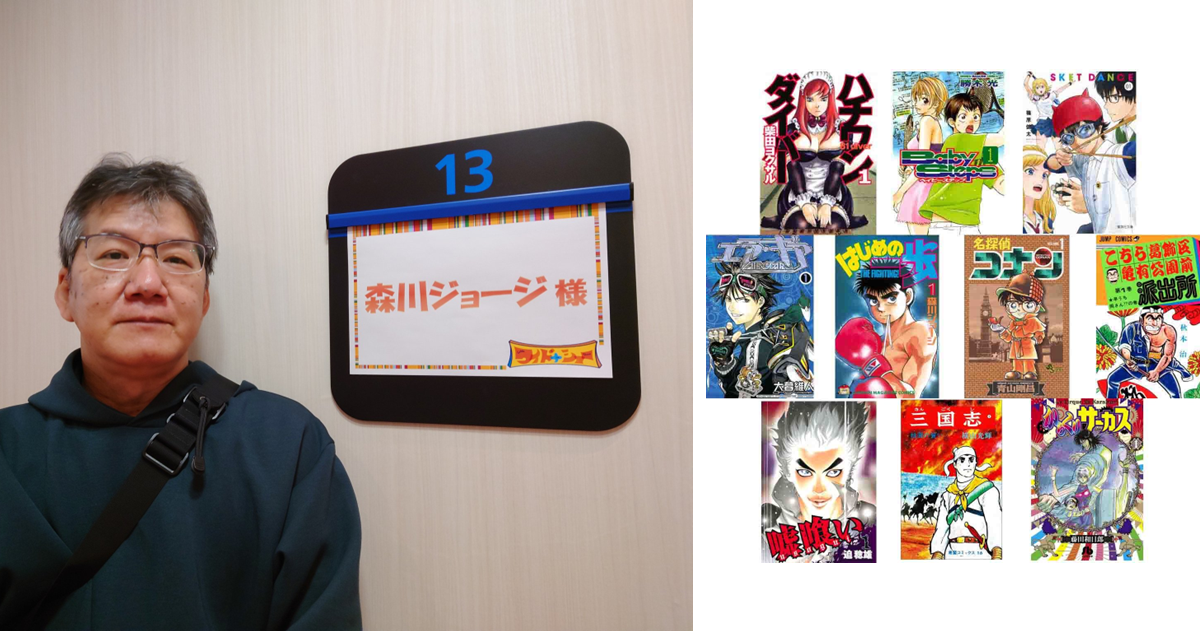
Its creator, George Morikawa, often shares glimpses of his life with fans on social media. Recently, he took to X to discuss the growing number of long-running manga series (some spanning dozens of volumes) and the past industry environment where authors were expected to "draw even if they collapsed." Drawing from his extensive experience, he offered his personal insights.
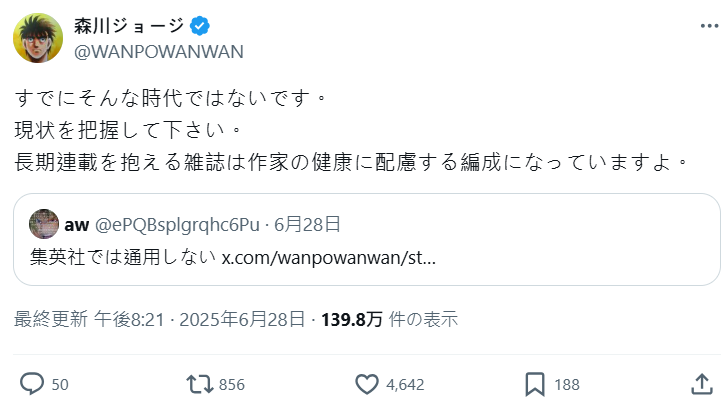
Morikawa-sensei began by addressing the "health issues of manga artists." This came after a netizen pointed out that publishers like Shueisha, known for *Weekly Shonen Jump*, were notoriously demanding, often pushing authors to continue drawing even when unwilling or facing health problems, just to keep their series going.
Morikawa-sensei remarked, "Even fast-paced, high-turnover shonen manga magazines are now seeing many long-running series. The old, twisted situation where authors were forced to 'draw even if they collapsed' has almost disappeared." He emphasized that editorial departments handling long-running series now consider creators' health when scheduling. This is why many ongoing series now grant authors time off for rest and research, a stark contrast to the past environment.
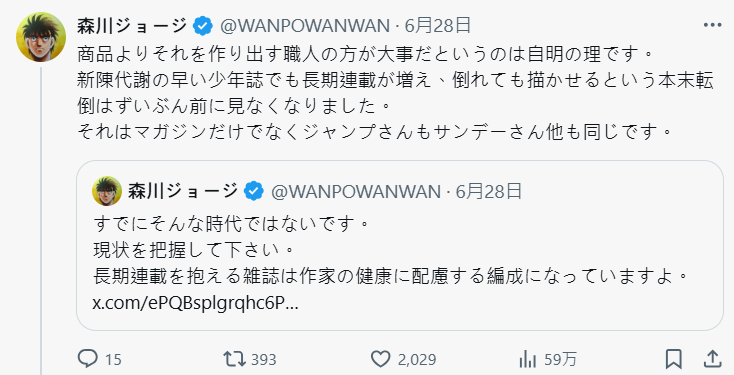
Morikawa-sensei further stated, "Everyone should know that the artisans (authors) who create these works are more important than the works themselves."
Even in the fast-paced world of shonen manga magazines, long-running series are becoming increasingly common. However, the perverse situation where "people were forced to draw even when sick" is now virtually nonexistent. And this isn't just true for *Weekly Shonen Jump*; it's the same across magazines like *Weekly Shonen Sunday* and *Weekly Shonen Magazine*.
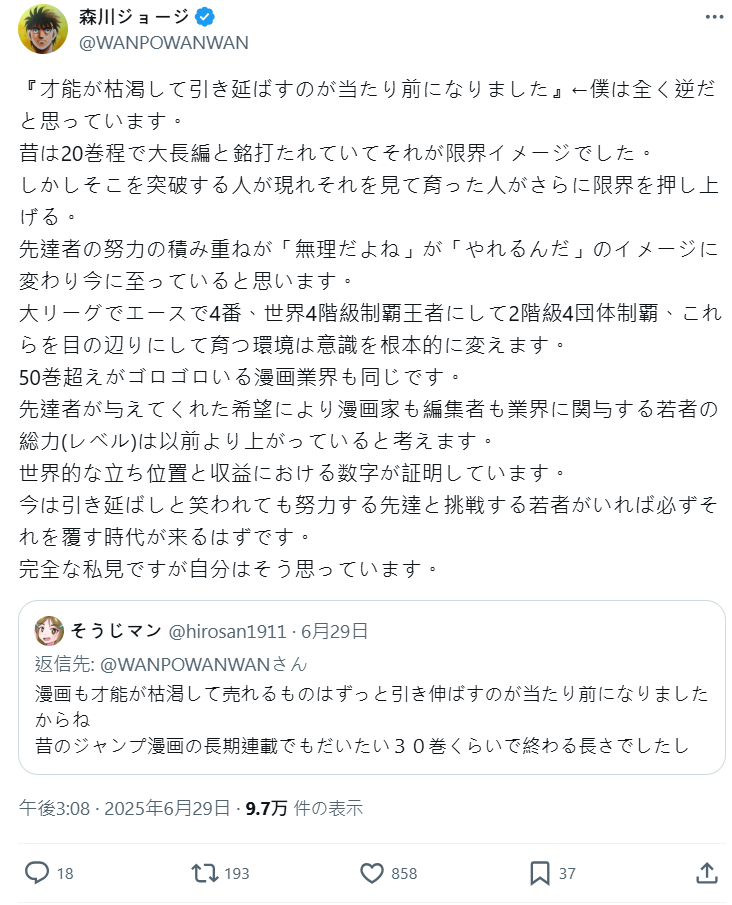
Amidst this discussion, a netizen commented, "Manga talent is also drying up now; to make money, it's become standard practice to just drag things out. Back in the day, most *Jump* series, even long ones, would wrap up around 30 volumes."
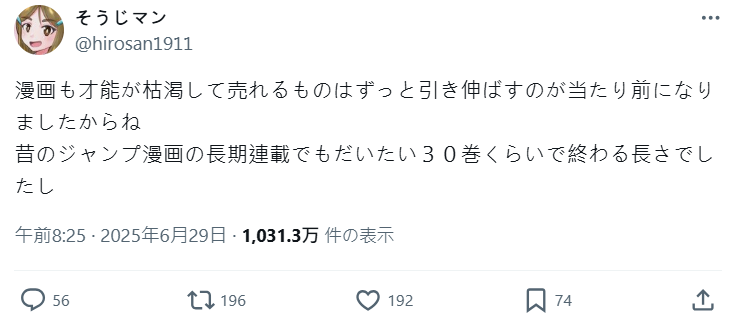
Morikawa-sensei immediately shot back, "To say 'talent is exhausted, that's why series are extended'—I completely disagree." He explained, "In the past, around 20 volumes was considered 'super long-form,' which was the perceived limit at the time. But then someone broke through that barrier, and creators who grew up in that environment pushed the limit even further. I believe it's because of the efforts of these predecessors that 'it can't be done' became 'it actually can be done,' leading us to where we are today."
He continued with examples: "Like in Major League Baseball, we now have players who can be both ace pitchers and clean-up hitters. In the world of boxing, there are champions who've conquered four weight classes, and even two who hold major titles in two weight classes... Growing up in such environments fundamentally changes people's mindsets. The manga world is no different; works exceeding 50 volumes are now incredibly common."
Morikawa-sensei believes, "Precisely because these predecessors brought hope, I'm confident that today's manga artists, editors, and even the new generation of the entire industry, are operating at a higher overall standard than before. This is evident from their global standing and actual income data."
He concluded, "Even if it's currently dismissed as 'dragging things out' or mocked for lacking ideas, as long as there are predecessors who continuously strive and new blood willing to take on challenges, I believe this perception will eventually be overturned. While this is just my personal opinion, I truly feel this way."
Indeed, Morikawa-sensei's insights, stemming from his vast experience, can certainly shift many preconceived notions about the manga industry. They also highlight that the "publishers taking advantage of authors" phenomenon of the past is largely gone.
Many contemporary works conclude very decisively, suggesting there's no longer pressure to endlessly extend a series. Recent examples like *Demon Slayer: Kimetsu no Yaiba*, *Jujutsu Kaisen*, *My Hero Academia*, and *My Dress-Up Darling* all feel like authors' self-initiated conclusions rather than stories dragged out past their prime. This progress in the industry environment likely allows authors to dedicate themselves more fully to their creative work.