

The first-ever animated feature film for Chiikawa, titled Chiikawa the Movie: The Secret of Mermaid Island, hit the big screen on July 24, 2026, to massive box office success. Nearly a month into its theatrical run, the film is already on the verge of crossing the monumental 10-billion-yen milestone.
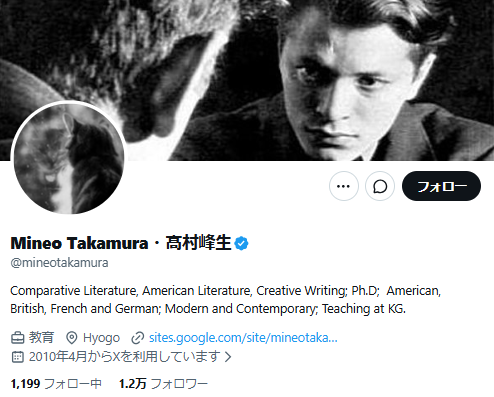
Amid the film's soaring popularity, Mineo Takamura, a university professor specializing in contemporary British and American literature and an avid film enthusiast, shared his experience on X (formerly Twitter) after going into the theater with zero prior knowledge of the Chiikawa universe. His subsequent review, packed with insightful literary, philosophical, and sociological perspectives, quickly went viral across Japanese social media.

Professor Takamura explained that prior to watching, his only knowledge was a vague rumor that "the ending is supposedly pretty scary"—he had never even seen an episode of the anime. He jokingly described the experience as a kind of "human experiment" to see what conclusions an avid film-watching professor would draw when diving into Chiikawa completely blind.
His immediate reaction after the credits rolled was simple and direct: "This movie is really fascinating."
A Masterclass in "Subtraction": Why a Non-Verbal Protagonist Carries So Much Weight
The first aspect that caught Professor Takamura's attention was how thoroughly Chiikawa employs the art of "subtraction" in its storytelling. What left the deepest impression was that the titular protagonist, Chiikawa, barely speaks at all. While long-time fans may take this for granted, from the fresh perspective of a first-time viewer, this silence carries immense expressive power.
He even drew a contrast with Demon Slayer: Kimetsu no Yaiba, noting that the two works occupy polar opposite ends of narrative delivery. While Demon Slayer's protagonist constantly articulates his inner thoughts and struggles through internal monologues, Chiikawa hardly utters a single coherent line. From a literary standpoint, Takamura noted, it is precisely this "silent protagonist" that offers far more intriguing depth to unpack.
He added humorously that if Hachiware didn't speak either, the entire film would have turned into an overwhelmingly avant-garde piece. However, because Hachiware speaks normally, the narrative retains the accessible rhythm and charm expected of mainstream entertainment.

"He Doesn't Speak, Yet the Audience Understands Everything"
Professor Takamura further observed that Chiikawa's rare vocalizations catch the audience off guard, but even more fascinating is how Chiikawa seamlessly communicates one-on-one with characters like Shimajiro. This led him to observe that the story establishes a layer of interpersonal communication among characters that operates independently of how the audience decodes words, prompting reflection on how these characters truly understand one another.
Netizens echoed this sentiment, highlighting how intriguing it is that Chiikawa holds genuine dialogues with verbal characters like Hachiware despite not speaking complete sentences. As many remarked, "We don't know the exact words he's saying, yet we instinctively understand what he means." Fans praised this subtle balance as a testament to creator Nagano's brilliant storytelling craft.

The "Weed Pulling Certification" Baffles First-Time Viewers
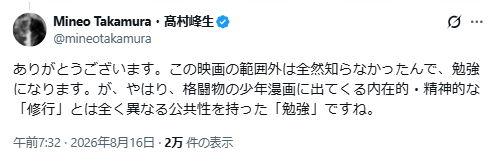
Another element that puzzled Professor Takamura was the concept of the "Weed Pulling Certification" (Kusamushiri Kentei). He described the exam taken by the protagonists as a curious institution where it is "hard to tell whether it reflects high ambition or a total lack thereof," pointing out that it operates very differently from the typical "training and spiritual growth" arcs found in standard shonen manga.
Fans of the original work quickly stepped in to provide lore context. They explained that in the world of Chiikawa, weeding is not just routine garden maintenance, but an institutionalized form of labor. Holding a higher grade of Weed Pulling Certification yields higher wages and unlocks access to broader working zones, functioning much like academic degrees or professional licensing in the real world.
Moreover, certain hazardous plants can contaminate an entire region if not promptly eradicated, meaning characters approach weeding with genuine dedication and professional seriousness.
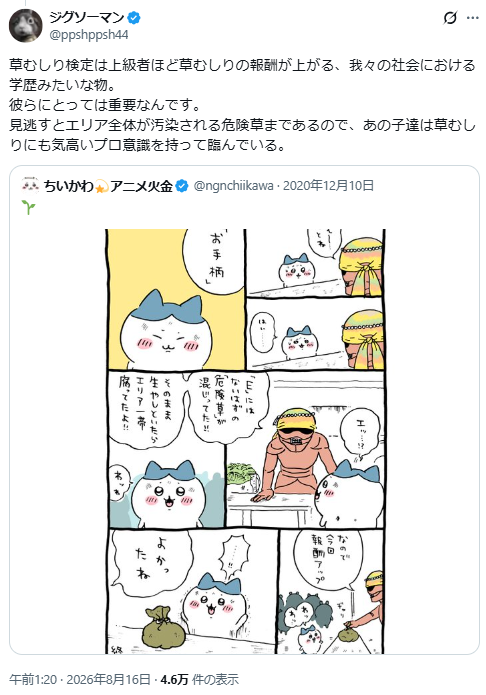
Upon reading these fan explanations, Professor Takamura acknowledged that such background lore was entirely new territory to him. However, it reinforced his observation that the concept of "learning" in Chiikawa diverges fundamentally from the inward, individualistic discipline of battle manga training arcs—it is an act of learning tied directly to social systems and civic engagement.
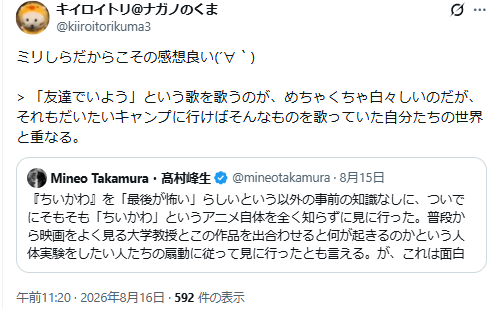
He also highlighted the use of the classic Japanese folk song "Kyō no Hi wa Sayōnara" (Farewell for Today) as an insert track, describing the scene's execution as deliberately "overt and theatrical." Yet, paradoxically, it evoked a vivid touch of reality: "It feels just like being at a school camp where everyone sings an awkward, slightly cheesy song that somehow feels completely natural in the moment." To him, this juxtaposition forged a striking emotional bridge to real-life experience.
Knowledgeable fans chimed in, noting that for those familiar with the manga's lore, the song takes on a vastly different and far darker emotional resonance, underscored by the tragic narrative underpinning the story arc.
"A Terrifying Climax"? The Professor's Take: "Less Brutal Than Expected"
Addressing the widely circulated rumor that the film features a "terrifying ending," Professor Takamura offered his own perspective. He noted that while he had anticipated how things might resolve as the credits rolled, the film was ultimately not as brutally bleak as he had braced for. He had even braced for a resolution of "utter, unbearable existential isolation" or some dark twist involving "batteries," but the story refrained from going to such extreme despair.
Consequently, Takamura concluded that he saw no reason why the film would be unsuitable for children.
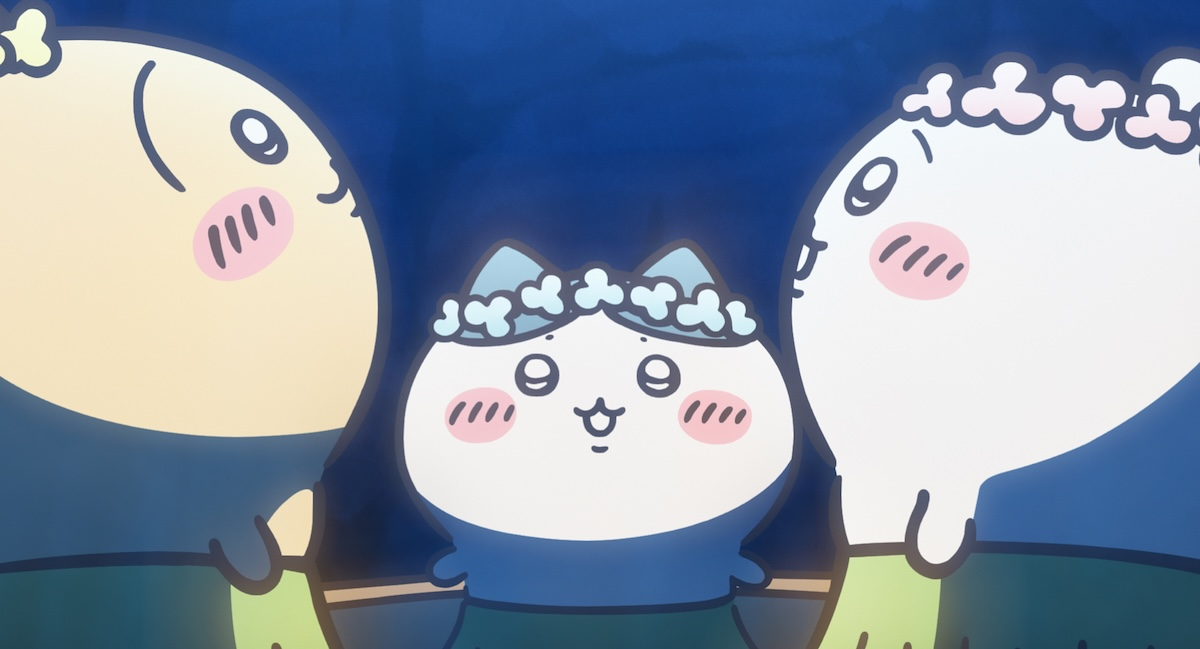
Philosophical Analysis: "Immortality Is a Prison; Only Mortal Life Is Truly Alive"
Professor Takamura even analyzed the narrative through a philosophical lens, remarking that the story brought to mind philosopher Martin Hägglund's discourse on mortality: namely, that "immortality is a prison, and only mortal, finite life constitutes true living."
However, he emphasized that Chiikawa is not a puzzle meant to be cleanly "solved." Instead, he believes the work deliberately preserves an open, ambiguous space without over-explaining every detail—which is precisely what makes it so captivating.
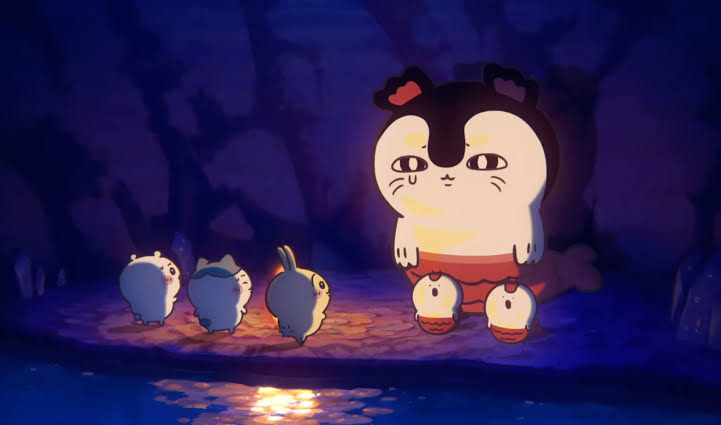
Professor Takamura also observed that the islanders are depicted as pitch-black, largely indistinguishable figures forming a collective "mass", which invites intriguing interpretations through a postcolonial lens. Yet, against this eerie backdrop, having the characters sing about being "friends forever" struck him as delightfully surreal, prompting an amused chuckle in the cinema.
He further noted that the character "Siren" naturally evokes the mythical Greek sea creature whose enchanting song lured sailors to their doom. Since the Homeric epic era, the "seductions" of femininity, the other, and foreign tongues have frequently been framed as destabilizing forces to a community. However, he also pointed out an interesting distinction: in Homer's epics, the Sirens themselves did not sacrifice their own lives.
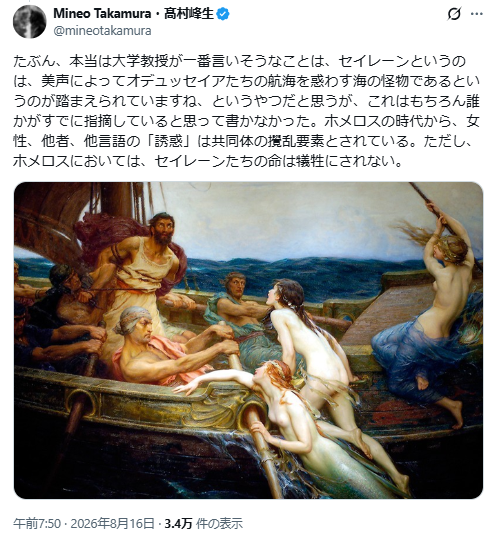
Professor Takamura's review thread resonated widely across X, drawing widespread acclaim from readers who praised his commentary as "remarkably articulate" and "refreshingly accessible." Many lauded it as a "perfectly balanced review of Chiikawa that neither over-hypes nor dismisses the work, struck with just the right emotional temperature."
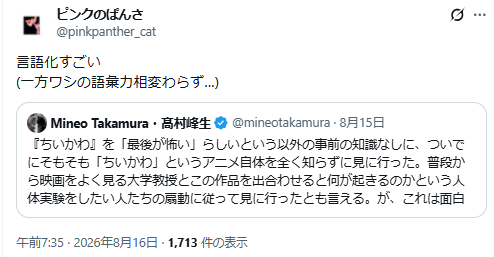
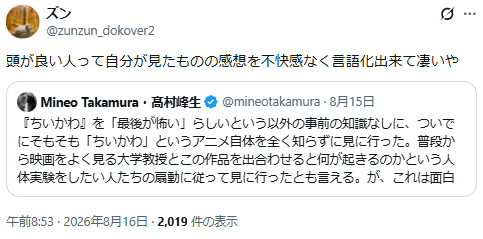
Other netizens commented that watching someone completely new to the franchise unpack the film through themes of "subtraction," "interpersonal communication," "public learning," and "finite mortality" offered a refreshing way to appreciate Chiikawa. One user humorously quipped, "If Hachiware didn't speak either, having two non-verbal characters carry a 99-minute film would have tested the audience's auditory limits!"
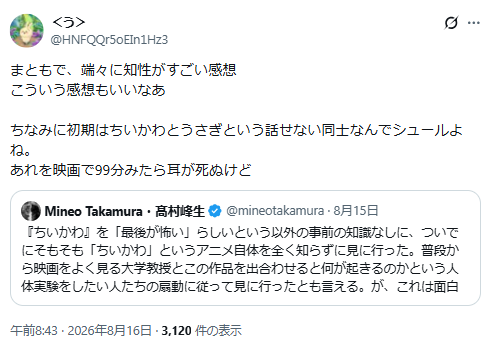
For longtime fans of Chiikawa, many elements—such as the Weed Pulling Certification, the idiosyncratic communication between characters, and the dark undertones of specific songs—have long been accepted as second nature. Yet when viewed through the uninitiated eyes of a first-time spectator, these familiar tropes become fascinating subjects for critical contemplation.
From "Why does the protagonist barely speak?" to "Why does a weed-pulling certification exist?," elements taken for granted by the fandom transformed into compelling intellectual inquiries for a newcomer. Chiikawa proves to be far more than just a haven of easter eggs for existing fans—it stands as a rich, layered narrative capable of inviting entirely new, profound interpretations from anyone who approaches it through their own lived experience and intellectual perspective.