

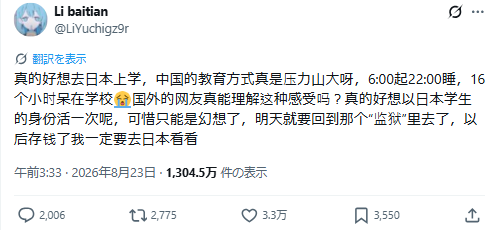
A Chinese social media user recently posted on X, "I really want to go to school in Japan!" lamenting the intense academic pressure faced by students in China.
The post unexpectedly kicked off a massive discussion among Japanese and Chinese netizens, who began comparing everything from daily school hours to culture festivals, sports festivals, clubs, romance, and part-time jobs. They even debated whether the cooking and swimming classes often seen in Japanese anime actually exist, sparking a wide-ranging cultural exchange about the differences in their high school experiences.
The conversation started with the Chinese user, who described their daily routine as "waking up at 6 AM and going to sleep at 10 PM," spending a grueling 16 hours a day at school, which they couldn't help but describe as a "prison." They clarified that they didn't believe Japanese school life was easy, but rather envied that Japanese students seemed to have more time to pursue their own interests.
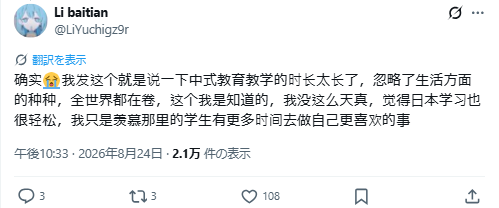
The user acknowledged that "the whole world is competitive" and that whenever they complain about the excessive length of Chinese schooling, they feel envious of Japanese students having more time for their passions. They stressed that they weren't naive enough to think Japanese education is pressure-free, but simply wished they could experience life as a Japanese student just once.
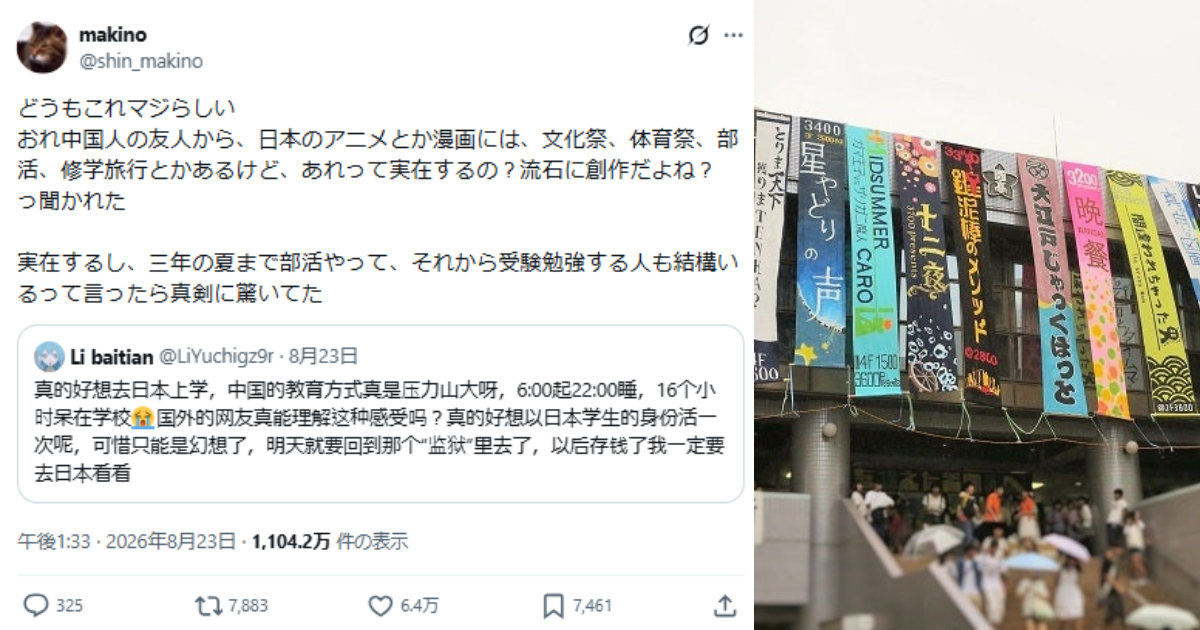
In the discussion thread, a Japanese user shared that a Chinese friend had once earnestly asked them, "Anime and manga are full of culture festivals, sports festivals, club activities, and school trips. Are those real? Or are they just made up for stories?" To this, the user replied, "They're real."
They even added that many Japanese students participate in club activities right up until the summer of their third and final year of high school before starting to prepare for university entrance exams. This revelation left their Chinese friend completely stunned.
Another Chinese user followed up, asking if the kind of high school life depicted in anime was accessible even to students from average or less affluent families.
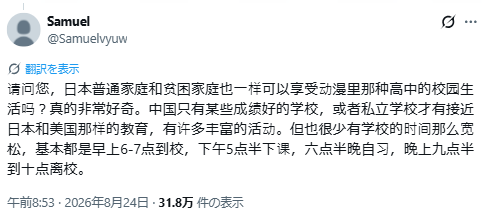
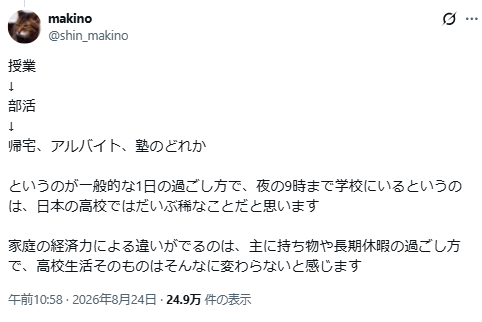
The Japanese user explained that a typical day for a Japanese high schooler looks something like this:
Classes → Club Activities → Go home, work a part-time job, or go to cram school
They noted that staying at school until 9 PM is not common in Japanese high schools. As for differences caused by family finances, they believed it mainly affects the kinds of personal items students own and how they spend long holidays; the core high school experience, however, doesn't change much.
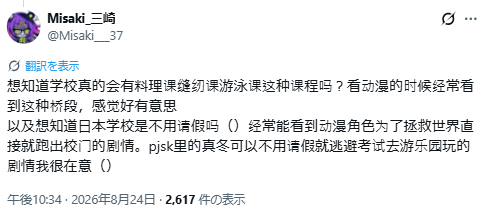
The school classes frequently shown in Japanese anime also became a point of fascination for Chinese users. One asked if Japanese schools really hold classes for cooking, sewing, and swimming, as these scenes always look fun in anime. They even joked about how anime characters often skip class to run out of school and save the world.
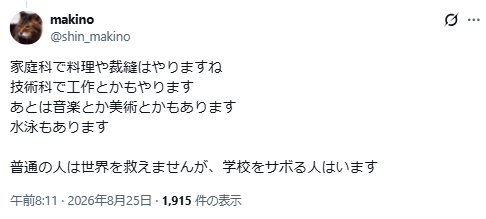
The Japanese user confirmed that home economics (katei-ka) does indeed teach cooking and sewing, while technical arts classes involve various hands-on projects. In addition, music, art, and swimming are also part of the curriculum. As for the plot point of students ditching class to "save the world," they laughed and said, "Normal people can't save the world, but yeah, people definitely skip class."
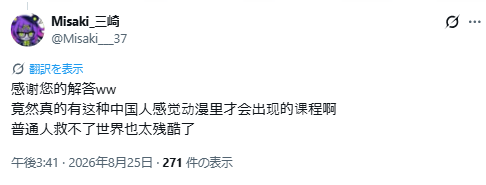
This answer made Chinese users laugh, realizing that the classes they thought "only existed in anime" were actually real.
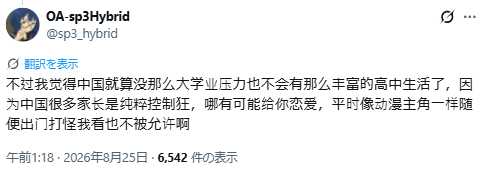
The discussion also turned to the degree of student freedom. A Chinese user commented that even if Chinese students had less academic pressure, they likely wouldn't have the rich high school life seen in anime because many parents are extremely strict, restricting things like dating or going out freely after school.
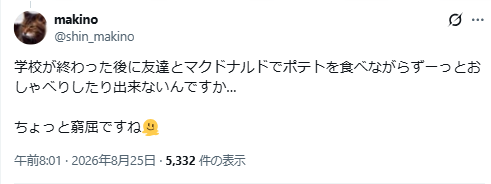
A Japanese user responded with a question of their own: "You mean you can't go to McDonald's with friends after school and just hang out and chat...?" adding, "That sounds a bit too restrictive."
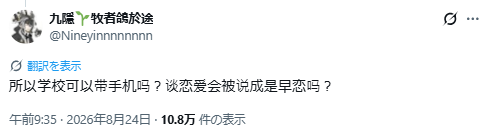
Furthermore, someone asked if Japanese high schoolers could bring their phones to school and whether dating was considered "puppy love" and frowned upon.
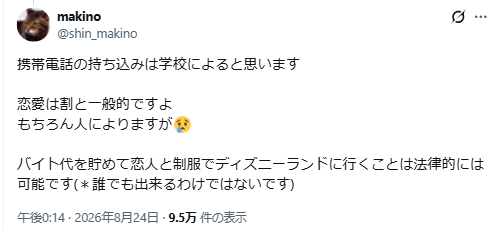
The Japanese user explained that phone policies vary by school, but dating among high schoolers is quite common. As for going to Tokyo Disneyland on a date with your significant other while wearing school uniforms, there are no legal issues with that at all.
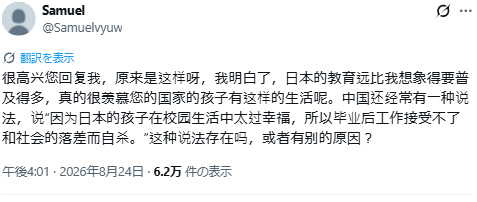
Finally, the topic shifted to whether Japanese students are truly happier than their Chinese counterparts. A Chinese user brought up a common belief in China that Japanese kids are too happy during their school years and, upon entering the workforce, can't handle the gap between school and society, sometimes even leading them to take their own lives.
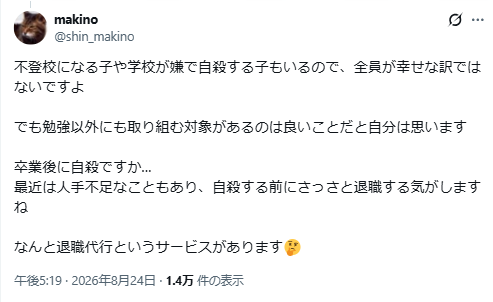
In response, the Japanese user clarified that of course not every student in Japan is happy. "There are kids who refuse to go to school, and some who take their own lives because they hate it." However, they believe a positive aspect of Japanese education is that students have many other things to invest their time in besides just studying, such as clubs, hobbies, and various school events.
Regarding the transition to the workforce, they joked that with Japan's current labor shortage, it's probably better to just quit a bad job rather than toughing it out. They even mentioned the existence of "taishoku daiko," professional services that help employees quit their jobs.
What began as a single Chinese user's lament—"I really want to go to school in Japan"—unexpectedly blossomed into a large-scale discussion and cultural exchange about high school life between Japanese and Chinese netizens.
From daily school hours and academic pressure to culture festivals, sports fests, clubs, school trips, dating, part-time jobs, and even cooking, sewing, and swimming classes, many Chinese users discovered that school scenarios they once thought were pure anime fiction are, in part, a real aspect of daily life for Japanese students. On the other hand, the discussion gave Japanese users insight into the immense pressure and long hours Chinese students face, highlighting a stark contrast with their own high school experiences.
However, the exchange also revealed a common ground: regardless of the country, students everywhere face pressures related to academics, future prospects, and social relationships. The different educational systems and social environments simply shape these challenges into vastly different forms of school life.