

Manga artist is a notoriously tough profession. If you've seen an anime like Draw This, Then Die!, which began airing in July, you'll know that the work is far from easy. Many who chase the dream with lifelong dedication can end up crushed by the pressure, a reality that's especially true for artists working on serialized titles.
However, a Japanese manga artist recently set the creative community abuzz on X after sharing his unique workflow. He revealed that he averages just two to three hours per page and completes around 30 pages a month—all while holding down a full-time job as a serialized manga artist. The revelation drew a wave of discussion among illustrators and creators, with many netizens calling it "unbelievable" and "totally monster-level."

The artist, Yora Nangi, just turned 45 and decided about two years ago to seriously pursue his goal of "becoming a commercial manga artist." After experiences creating doujinshi and entering manga newcomer awards, he landed a project with a publisher. This year, he officially broke into the commercial manga world as the illustrator for the manga adaptation of the light novel A Salaryman's Restaurant in Another World.

Nangi explained that he is both a full-time office worker and a serialized manga artist. For him, the key isn't finding more time but rather figuring out how to reduce the time needed to draw. He noted that his current speed is about "an average of 2–3 hours per page." Moreover, he uses any spare five-minute gap during the day to draw, even if it's just a single character. This method allows him to maintain a monthly output of about 30 pages, even with occasional weekend activities.
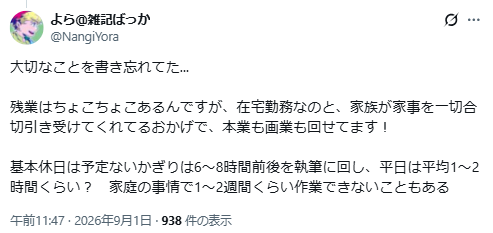
Regarding his schedule, he elaborated that while he sometimes works overtime, he currently works from home, and his family handles all the household chores, which enables him to juggle his day job and manga creation. On weekdays, he dedicates about 1–2 hours to drawing; on weekends with no other plans, he typically puts in 6–8 hours.
However, he also admitted that family matters can sometimes prevent him from working for a week or two, so his creative schedule isn't always consistent.
As for how he compresses the work for a single page into just 2–3 hours, he said his method is quite simple: just draw, and keep drawing, to make his hand movements faster during actual production. He recommends "Gesture Drawing" as a practice method. By repeatedly sketching human poses and movements, he improves his grasp of character structure and dynamics, which in turn shortens the time needed for the final artwork.
He also mentioned that he has always worked alone, from his doujinshi days to his current serialization, without any assistants.
After his post gained traction, it was met with a flood of astonishment. One person commented, "Holding a full-time job while doing a serialization is just insane!" Another bluntly stated, "That's beyond monster-level... what kind of elite is this guy...?" Someone else joked, "I can't even just draw, let alone hold a full-time job. This is a whole other dimension."
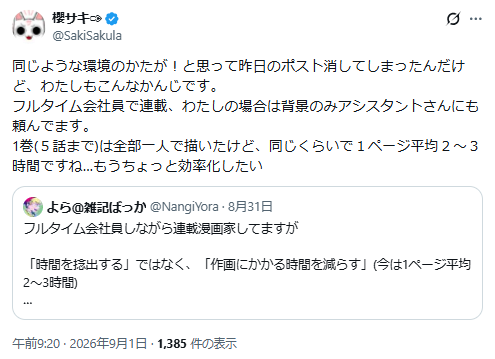
The share resonated with many manga artists and illustrators. One creator, who is also a full-time employee with a serialized manga, said their situation is quite similar, averaging 2–3 hours per page, though they have an assistant for backgrounds.
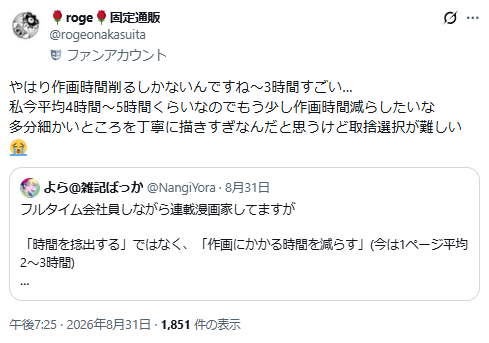
Another artist mentioned they currently take about 4–5 hours per page and were envious of the "2–3 hours per page" speed, hoping to improve their own efficiency.
Many netizens believe that the artist's style itself seems optimized for speed, noting that the ability to shorten drawing time while maintaining quality is a highly practical skill.
This highlights the importance of knowing "what's worth spending time on and what should be simplified" in manga creation. Some also argued that for creators juggling a day job, establishing a sustainable workflow is more important than striving for perfection on every single page.
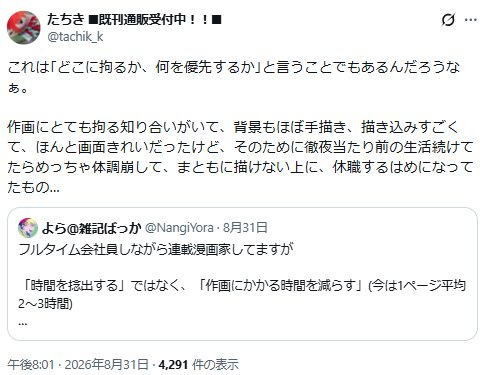
Of course, this also shows that while many people in Japan may be doing manga work on the side, taking on a serialized project—even just as the illustrator—while holding down a full-time job is something not everyone can achieve.