

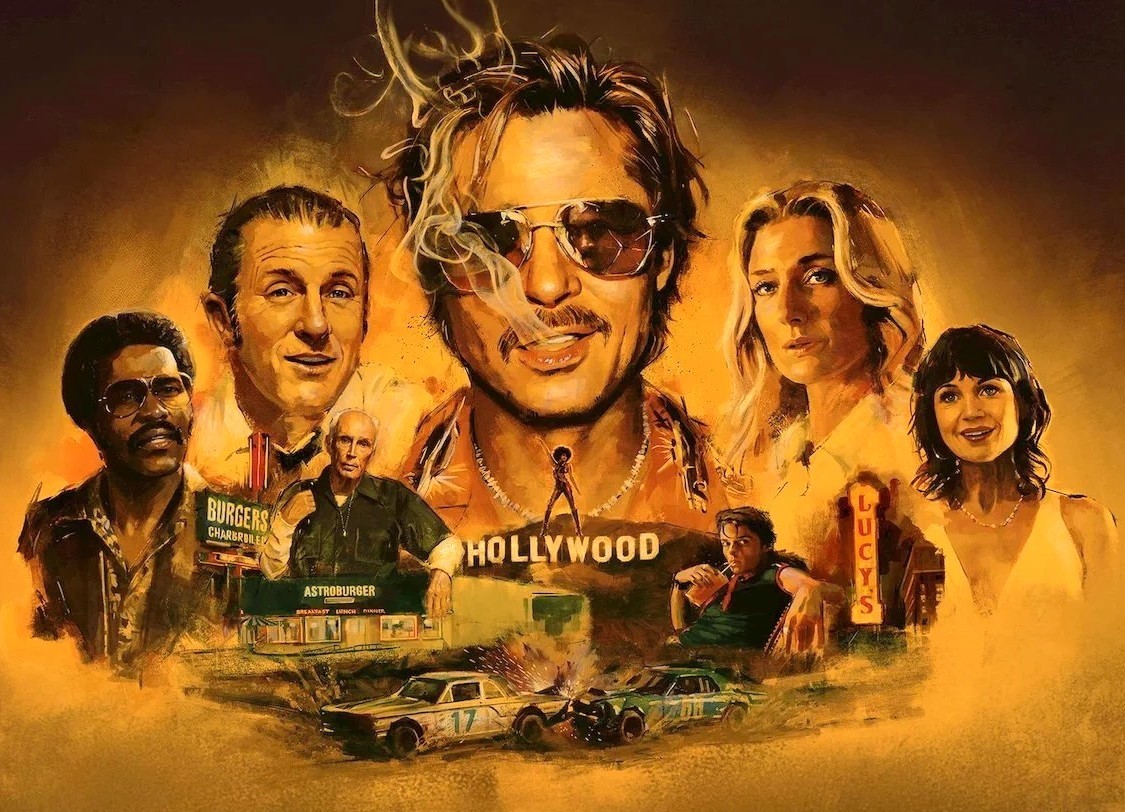
Quentin Tarantino has handed his scripts to other directors before. Oliver Stone made "Natural Born Killers," Tony Scott took on "True Romance," and Robert Rodriguez directed "From Dusk Till Dawn." But those collaborations all came during Tarantino's rise in the 1990s. Ever since, he has kept his screenplays for himself. "The Further Mis-Adventures of Cliff Booth" finally breaks that streak, though Tarantino would never entrust his work to just anyone. Every filmmaker who has directed one of his scripts has had a distinctive voice and a formidable reputation. This time, he chose David Fincher.
.
Technically, Brad Pitt — a friend of both filmmakers and the movie's star — was the one who suggested the pairing and brought them together. Tarantino already admired Fincher, so he happily agreed. His willingness to give up the director's chair came down to his long-standing insistence that he will direct only 10 movies in his lifetime. With just one slot supposedly remaining, he also felt that adding "The Further Mis-Adventures of Cliff Booth" to his résumé would not push him far enough outside his comfort zone. Even after surrendering the project, Tarantino remained deeply involved in production. He visited the set almost daily, helped revise the screenplay and even contributed voice-over narration. Despite the change behind the camera, the film loses very little of its unmistakably Tarantino flavor.
.
Setting aside Tarantino's decision to split "Kill Bill" into two volumes during postproduction, "The Further Mis-Adventures of Cliff Booth" is the only sequel he has ever made. He did not return to the material for an easy payday or because a studio pressured him. He simply believed Cliff Booth had more stories worth telling — stories radically different from "Once Upon a Time... in Hollywood." The first movie explored a changing era and the ways people resist, then eventually adapt to, that transformation. Rick Dalton stood at the center of that theme. But Rick and Cliff have since gone their separate ways, leaving Cliff to carry a very different kind of movie on his own.
.
"The Further Mis-Adventures of Cliff Booth" plays more like pure entertainment. There is no grand message or deep vein of nostalgia driving the story; it continues simply because it is fun. Of course, every era defines entertainment differently. Today's audiences associate the term with Marvel superheroes, Jedi and John Wick mowing down enemies. This film instead finds its thrills in watching a detective-like protagonist tumble through a string of scenarios that feel ripped from hard-boiled crime fiction. In some respects, its tone is closer to Tarantino's most overlooked film, "Jackie Brown." For a more mainstream comparison, imagine a looser, more laid-back version of "Reacher," with Cliff taking on shades of a character like Jack Reacher.
.
These hard-boiled elements have gradually been filed away in the public imagination as the territory of prestige dramas, art-house films or niche cinema — or, less charitably, slow and boring movies. Yet throughout the 1950s, '60s and '70s, a film like "The Further Mis-Adventures of Cliff Booth" would have been the equivalent of a Marvel movie: a commercial crowd-pleaser aligned with mainstream tastes. Viewers who cannot connect with that concept, or simply have no interest in this style of filmmaking, may find the experience painfully dull. Those who understand and enjoy it, however, are in for a tremendously entertaining ride. It feels like flipping through a cheap pulp-fiction anthology packed with simple, punchy thrills.
.
Still, "The Further Mis-Adventures of Cliff Booth" is not completely removed from "Once Upon a Time... in Hollywood." Both are fundamentally hangout movies, built around loose narratives and the pleasure of simply spending time in their characters' everyday worlds. Like its predecessor, the sequel devotes long stretches to minor social encounters, searching the radio for the right song, transitional driving sequences and the ritual of sitting down to watch television. It also parodies — and occasionally lifts directly from — older movies and TV shows to flesh out its characters' careers. This time, the main reference point is the Blaxploitation franchise "Shaft," with "Shaft" star Samuel L. Jackson making a cameo in one of the movie's films-within-the-film. Naturally, no Tarantino project would be complete without its required pop-culture analysis sessions, as characters deliver extended monologues filled with the filmmaker's sharp personal takes on music, movies and television.
.
This time, however, those discussions feel richer and more distinctive than they did in "Once Upon a Time... in Hollywood." Tarantino digs deeper into his observations about actors' habits and the everyday working environment of the entertainment industry at the time. I strongly suspect that pieces of "The Movie Critic," the project he planned and ultimately abandoned, quietly found their way into "The Further Mis-Adventures of Cliff Booth." Elizabeth Debicki's talent agent is a former film critic, and Tarantino gives that part of her life a surprisingly detailed backstory. During one dinner scene, she delivers a cutting overview of the age-old question of whether movies are fundamentally art or entertainment.
.
Tarantino previously said that "The Movie Critic" would have centered on a man known for writing vicious reviews in a porn magazine. Debicki's character may be a woman, but her criticism is similarly caustic, and her work once appeared in a publication that few people took seriously. I am also convinced that the opinions Debicki expresses in the film reflect Tarantino's own views rather than ideas he invented solely for the character. Her character, Karen Crosby, argues that movies are entertainment, not art. She does not even consider "The Godfather" an art film, viewing it instead as an unusually polished commercial movie with some artistic qualities. Tarantino has made similar arguments in interviews, often carefully separating pure entertainment from art, regardless of how revered a classic may become. He even uses movie to describe straightforward entertainment and film for more artistically minded work.
.
"The Further Mis-Adventures of Cliff Booth" can easily be described as a cinematic stew, with Tarantino tossing everything he loves into the same pot. The trick is that he knows exactly how to season it. What looks like a random assortment still comes out irresistibly flavorful, making every bite satisfying. Fincher's primary contribution is streamlining the narrative and sharpening its visual presentation. His editing is flashier and faster than Tarantino's, but that energy also helps compress the material at the right moments. Their lighting preferences are noticeably different as well: Tarantino favors brighter imagery, while Fincher gravitates toward darker, moodier frames. In this case, that gloom better serves the story.
.
Pitt, unsurprisingly, remains as effortlessly handsome as ever. Cliff's negotiating skills and seductive banter rely heavily on the actor's charisma. The role only works with Pitt — or, at minimum, someone operating at his level of movie-star magnetism. For me, however, Elizabeth Debicki and Scott Caan deliver the more surprising performances. Debicki is especially strong in her flirtatious scenes with Pitt, generating electric chemistry while calibrating every shift in tone. She reveals flashes of Karen's sweetness and bashfulness without undermining the character's cool, reserved demeanor. Tarantino also deserves credit for proving that he can write a genuinely polished romantic comedy — perhaps someone has found him a new lane. The flirtation he creates for these two is wonderfully entertaining, with dialogue that states their sexual preferences openly yet feels far more romantic than vulgar.
.
Caan's casting, meanwhile, reveals the fascination with character actors that Fincher and Tarantino share. Both filmmakers have occasionally ignored box-office calculations to cast performers whose fame has faded, or who never became major stars, in leading and prominent supporting roles. Caan is exactly that kind of choice. He has earned a degree of recognition on television, primarily through police procedurals such as "Hawaii Five-0," but never gained a firm foothold as a movie star. His range and screen persona fit the film's TV action hero perfectly. Casting a modern television action star as one from an earlier era carries an appealing meta quality, and Tarantino pulled a similar trick in the first movie by having contemporary TV Western icon Timothy Olyphant play a TV Western icon from the 1960s.
.
The larger point is that Tarantino has a gift for drawing rarely seen depths from character actors, and he does it again here. Caan's charisma and the subtlety of his performance make this an undeniable career highlight. In many ways, that is what this series has always been about. Across two movies, Tarantino has celebrated the greatness and radiance of character actors. In his eyes, being confined to a particular lane is not necessarily a limitation. Mastering one specialty and taking it as far as possible is equally worthy of applause — and of a place in the pantheon where movie lovers can worship it.