

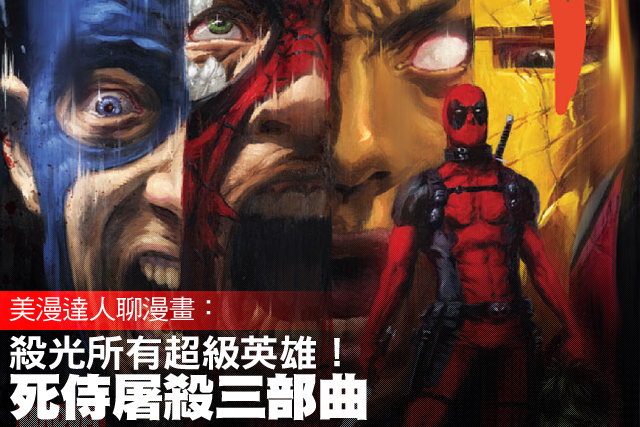
The story we're introducing today is MARVEL's famous mad hero "Deadpool"'s "Deadpool Killogy." Although Deadpools are aware that they and their worlds are fictional, the Earth-12101 Deadpool developed a desire to free characters from being manipulated by their creators by killing them. For instance, he first eliminated other superheroes and supervillains in his own world, then proceeded to various parallel universes to kill other versions of Marvel characters. When he realized this wasn't enough, he went on to kill characters from literary works that influenced the birth of superheroes. Finally, he concluded that since only "Deadpool" knows everything is fictional, to erase the root cause, he must kill all Deadpools across all worlds. 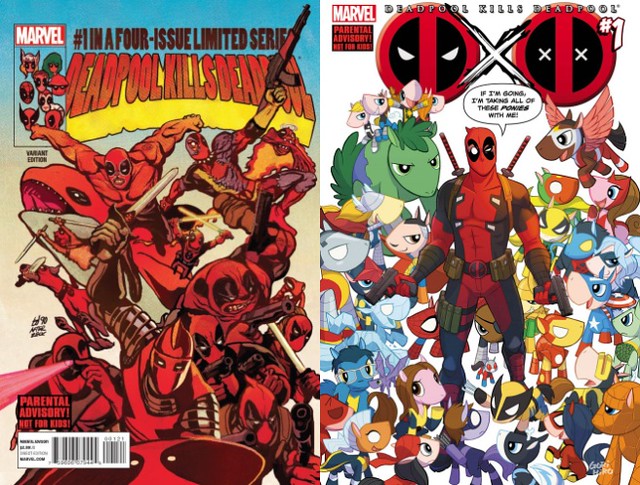
This development thus spawned a trilogy of stories, all penned by writer Cullen Bunn, which is why some refer to it as the Cullen Bunn Trilogy, or the Deadpool Killogy. This series has masterfully explored Deadpool's madness and unique meta-narrative in recent years, especially the third installment, which involves Deadpools from all worlds. It features not only the mainstream universe's Deadpool but also all parallel universe versions of Deadpool that have ever appeared in comics, and even introduces some original Deadpools, such as the Galactus-themed Deadpool.
Furthermore, it's important to note that abilities are never the sole determinant of victory or defeat; they merely serve as parameters within the battle process. For example, take the Hulk: in terms of strength, he might be incredibly powerful, perhaps even the strongest, but that doesn't mean other heroes can't outsmart him with equipment, right? Abilities merely express a character's traits, not their absolute combat power. If you claim "the writer is the strongest" because you believe writers can disregard power levels, it implies you think abilities are everything, while simultaneously overlooking the story's core theme and believing character traits should only be distinguished by combat power, rather than their spirit or how they utilize their abilities.
It's like in real life: no matter how well you plan everything, unexpected problems or rapid destruction can always arise. Even those born with a silver spoon will encounter obstacles. People who believe that ability is everything are essentially subscribing to the fantasy of a perfect, flawless life. It's not that such fantasies are inherently bad, but Westerners tend to be more realistic, so naturally, there aren't many storylines where abilities dictate everything. 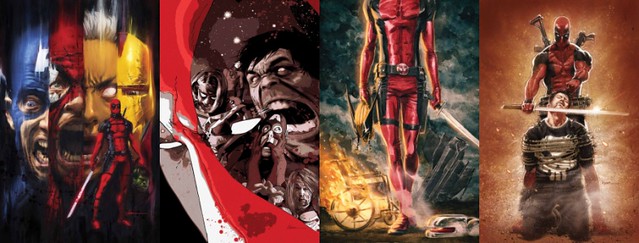
The first part of the story is called Deadpool Kills Marvel Universe. The X-Men brought Deadpool to a mental asylum for supervillains. However, the director of this hospital intended to brainwash Deadpool, only to reveal his plan to control all supervillains to form an army. This resulted in the deletion of Deadpool's two internal monologues, which could be said to represent his good nature (?!), replaced by a third, more malicious one. *The speech bubbles for the first two monologues were yellow; this third one is red. 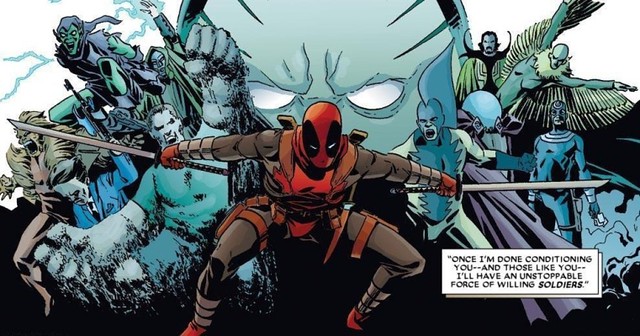
Deadpool retaliated, only to discover that the director was merely a robot. Its head opened to reveal a tiny figure, Psycho-Man (a character from the Microverse, and a major villain in early Marvel comics featuring the American version of Micronauts). Deadpool pulled him out, smashed him to death like a bug, and then set fire to and blew up the asylum, killing all the villains imprisoned within. 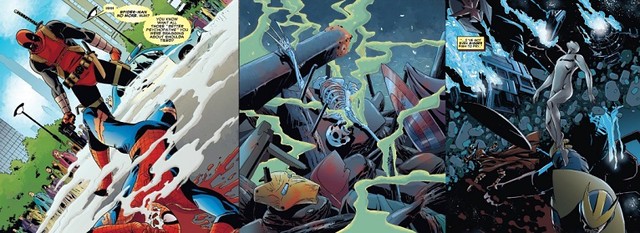
Subsequently, using his knowledge of breaking the fourth wall, he began to slaughter all superheroes and supervillains, starting with the Fantastic Four, then the Avengers, followed by the X-Men. Finally, he used the Puppet Master to control the remaining villains and heroes, forcing them to kill each other or commit suicide. 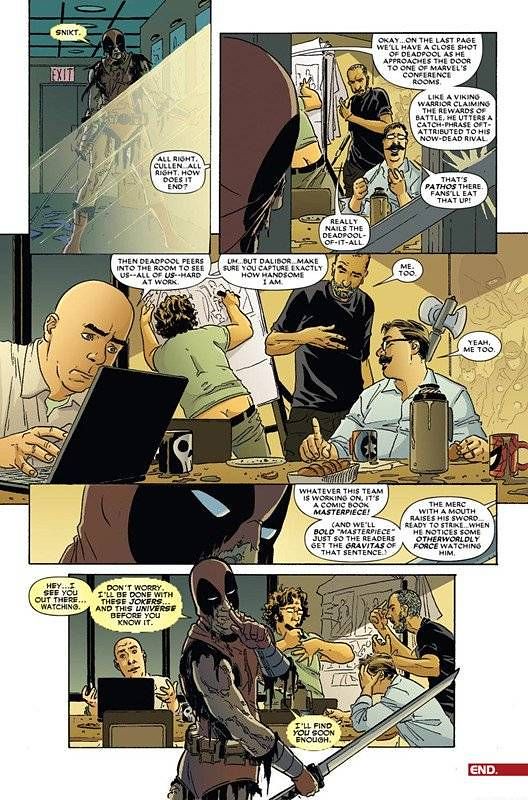
Meanwhile, the families, lovers, and friends of some heroes hired Deadpool's archenemy and best friend (?!), Taskmaster, to kill Deadpool. But of course, Deadpool easily killed his opponent and revealed the true purpose of the entire massacre: Deadpool believed they were living in a fictional world, and all manipulation of their destinies was orchestrated by those beyond the fourth wall. Therefore, he felt he had to kill them to escape their pathetic manipulated fates. Finally, Deadpool traveled to a real world, similar to that of readers, intending to kill the production team that created the Killogy, and concluded by speaking directly to the readers. 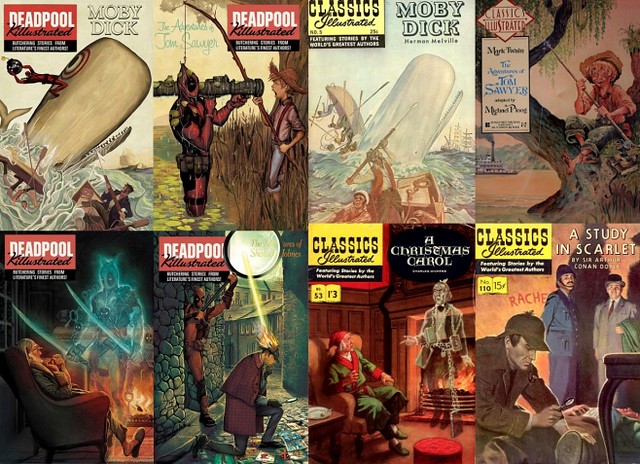
The second part is called Deadpool: Killustrated. At the beginning of the story, Deadpool kills all fictional people and things, including ordinary passersby, because they too are creations of authors and might be implicated. He also traveled to many worlds, killing different versions of heroes and villains. (This image is a comparison of the comic cover and the original artwork, showing where the homages lie.) 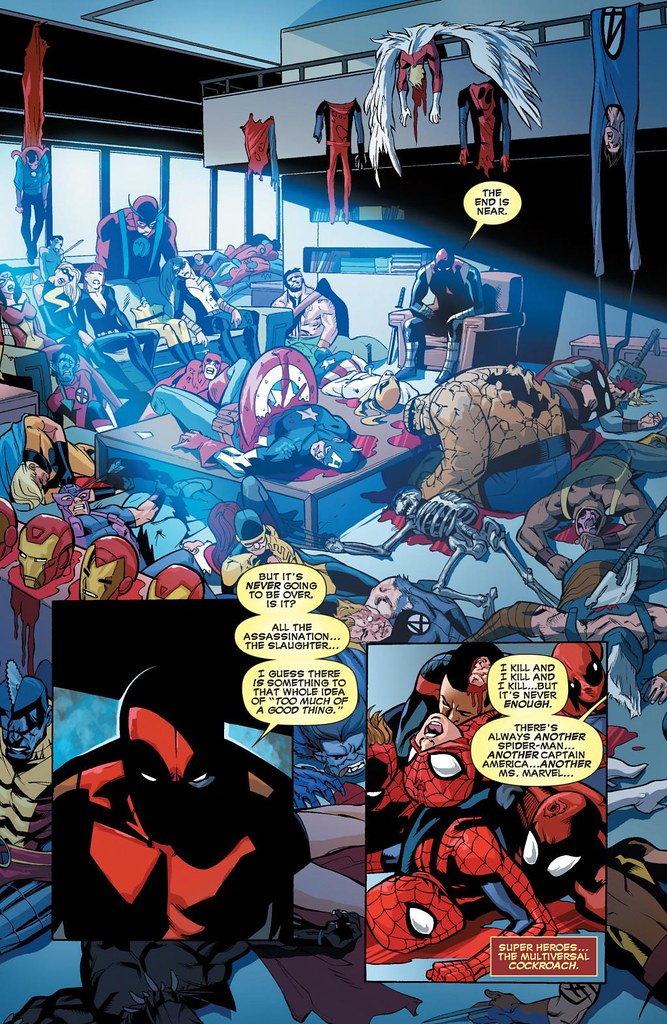
But Deadpool grew weary, for no matter how many he killed, there were countless versions of Spider-Man, Hulk, Captain America, and others active in different worlds. So, he conceived of addressing the root cause: the source of inspiration for superhero creation, which is the world where classic literary works reside. 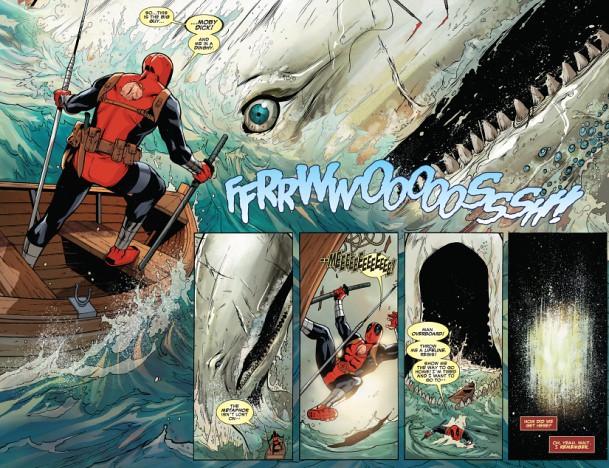
Deadpool spared the lives of several evil geniuses, allowing them to develop a time-traveling machine based on the theory that everything in the world is a fictional creation. However, as soon as Deadpool traveled through time, he unleashed the machine to kill those genius villains. He then proceeded to the shared world where many literary classics reside, beginning to murder the main characters from stories like Moby Dick, Tom Sawyer, Don Quixote, Sleepy Hollow, Twenty Thousand Leagues Under the Seas, and more. 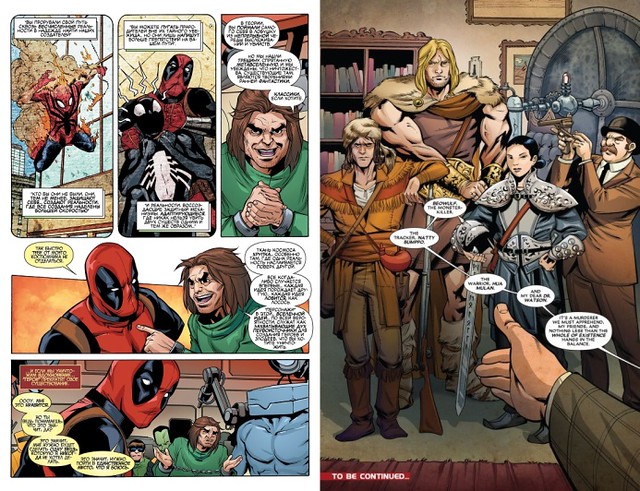
However, Sherlock Holmes received a machine sent by the evil geniuses and learned that Deadpool's massacre would cause the universe to unravel. He then assembled a five-person team consisting of Mulan, Nefertiti Bambi, Beowulf, and Watson, and began tracking Deadpool to stop him, but they always found themselves one step behind.
*Note: This literary world is a shared universe for all classic literary stories, where all characters live within the same worldview but in different eras. It's not one literary work per world. Holmes also used a teleporter to travel to different eras and locations within his own world to track Deadpool.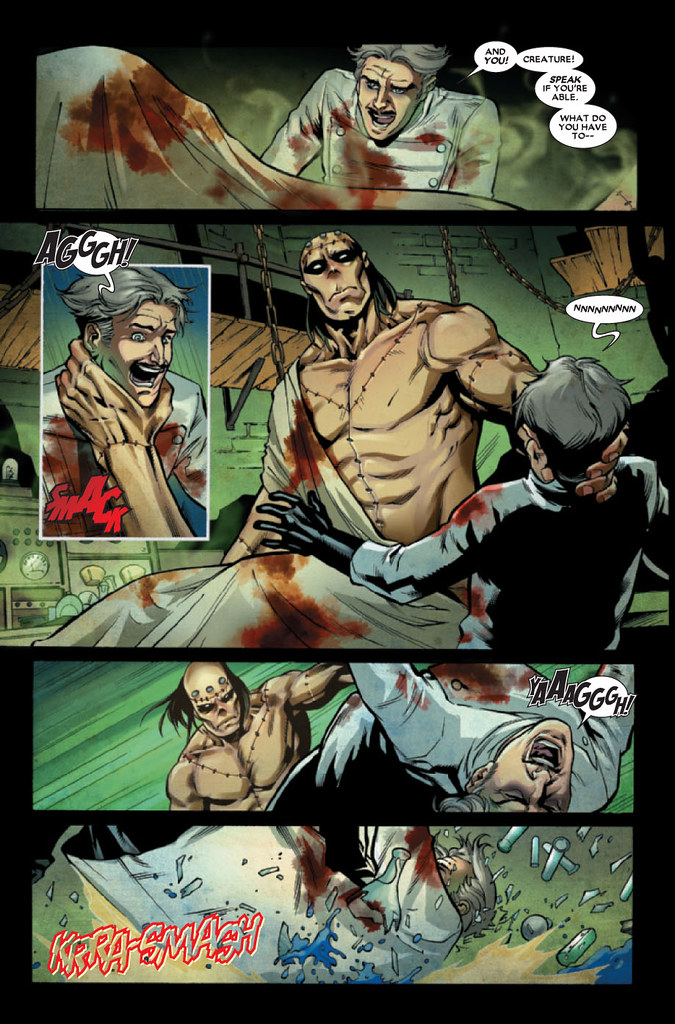
To gain allies, Deadpool went to Frankenstein, placing a portion of his brain into the monster's corpse. The moment Dr. Frankenstein resurrected the monster, Franken-Deadpool was born, thus giving him a companion for his massacre. However, after Deadpool killed the Three Musketeers and D'Artagnan, Holmes's team also killed Franken-Deadpool, and Mulan, with the sacrifice of her comrades, severed Deadpool's hand that held the teleporter. 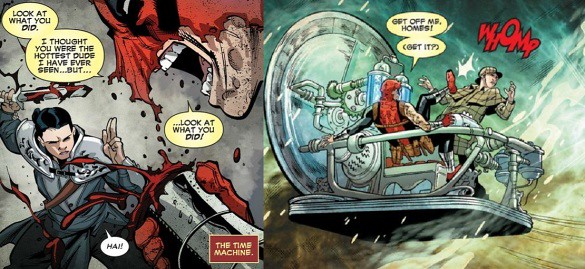
Consequently, Deadpool stole the time machine that Holmes had arrived in (the one from H.G. Wells' novel), and Holmes, at the last possible moment, also jumped aboard, leading to a fight between the two.
During the struggle, Deadpool shouted that by killing these literary characters, he was also freeing them, and that Marvel would certainly not miss the opportunity to publish a comic with this plot. However, Holmes ultimately gained the upper hand, throwing Deadpool out of the machine, leaving him to drift in the time vortex. Holmes then diligently recited the experiences and settings of the murdered literary characters to prevent their existence from being erased by oblivion.
*Note: The interesting aspect of this story is that when Deadpool kills these literary characters, what he sees in his eyes projects as corresponding Marvel characters, making it clear to readers which literary characters inspired creators to create classic comic characters.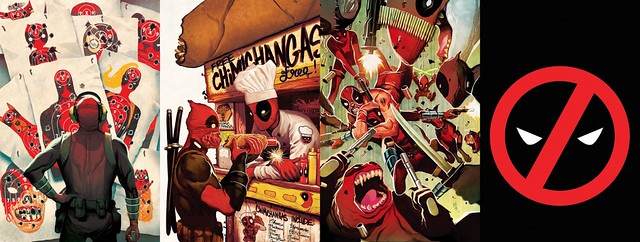
The third part is called Deadpool Kills Deadpool. After drifting in the time vortex for several years, Deadpool reached a conclusion: since Deadpool is the only one who knows he is a fictional character, he should be eliminated. So, he killed Major Deadpool of Earth-6466, who had arrived in the time vortex, and stole his vehicle to return and resume his massacre plan. 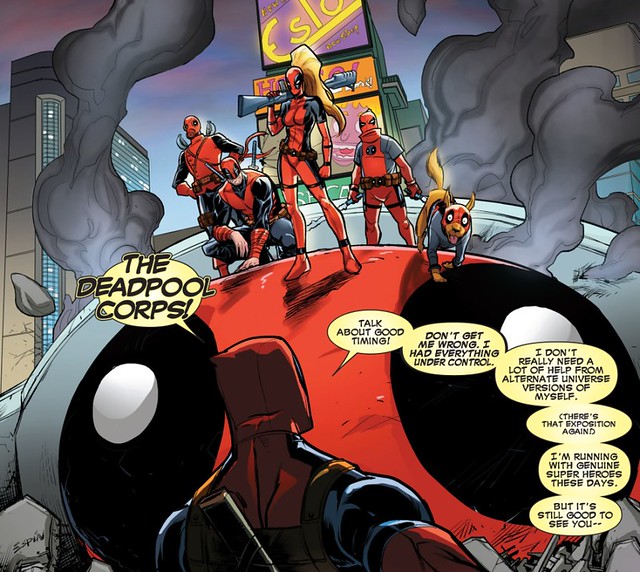
He gathered several Deadpools who were evil in their parallel worlds, forming the Evil Deadpool Corps, and began slaughtering the "good" Deadpools. The Good Deadpool Corps, in turn, sought out the mainstream Earth-616 Deadpool to help resolve this crisis, but the mainstream Deadpool was still slowly coming to terms with the situation.
*Note: To avoid confusion with the mainstream Deadpool, the Deadpool who is the protagonist of the Deadpool Killogy will henceforth be referred to as Dreadpool, while the mainstream Earth-616 Deadpool will simply be called Deadpool.
Dreadpool recalled killing other Marvel characters in the first part and murdering many protagonists of literary classics in the second part, which further solidified his belief that his existence as Deadpool must be destroyed. Thus, he sourced weapons specifically designed to eliminate Deadpools from various parallel universes, such as anti-healing factor laser guns, nanoviruses targeting Deadpools, and specialized enhanced sulfuric acid capable of melting even bones. 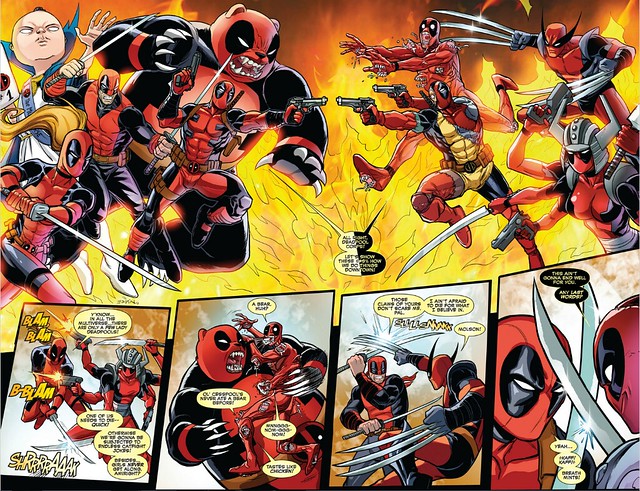
However, with the sacrifices of the Good Deadpool Corps and a Watcher who was a Deadpool fan, they continuously broke through numerous obstacles. Deadpool also confronted an evil Deadpool who was essentially his counterpart (for a detailed introduction to Evil Deadpool: http://on.fb.me/1Iv96tv), finally reaching Dreadpool's base. 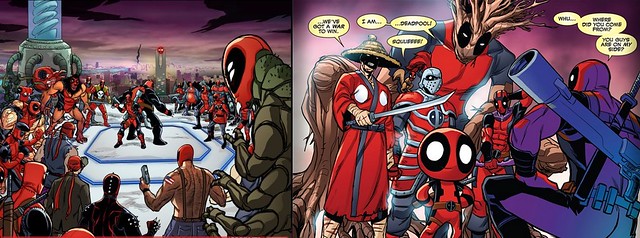
There, he