

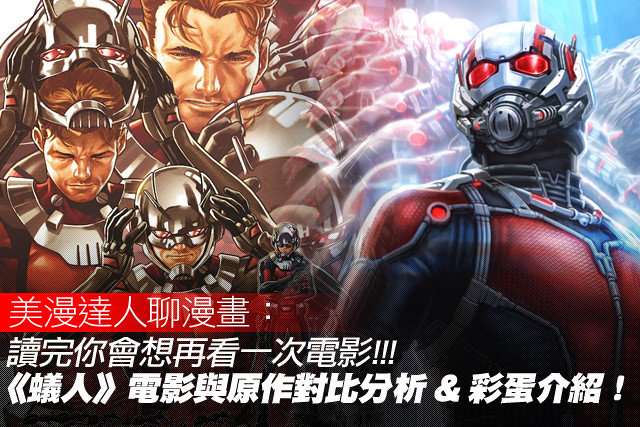
The Ant-Man film is the twelfth installment in the Marvel Cinematic Universe and the final film of MARVEL's Phase Two. Of course, this article isn't a review, as I'm not a film critic. So, as per usual, it's a comparative analysis of the original work and the film adaptation, along with an introduction to the film's Easter eggs!~
Differences Between the Film and Original Versions of the First Ant-Man:
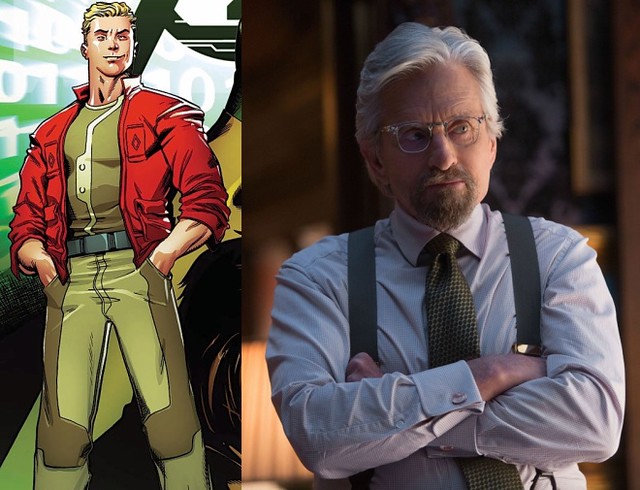
The similarities between the two versions are that both discovered Pym Particles, both hold the hero title of Ant-Man, and their abilities are the same. However, the film version's active era was changed to the Cold War (although Ant-Man's earliest comics were also released in the 60s, so technically it's the same era, but in terms of world-building, it's not the same period). He was also one of the individuals who worked alongside Agent Carter and Tony's father, Howard Stark, during the early days of S.H.I.E.L.D., serving as both a scientist and a combatant.
I believe the reason for this change is that, due to the extensive serialization and lower publication costs of mainstream comics, films creating a shared universe must be linked by many common elements. Unlike comics, which can develop characters separately before bringing them together. Furthermore, the Ant-Man film project was repeatedly delayed, and it also had to consider the development of S.H.I.E.L.D., in addition to the film's protagonist becoming the second Ant-Man.
Therefore, although the first Ant-Man remains a predecessor like in the comics, to focus on the second Ant-Man and for the reasons I mentioned above, he became a guiding elder. His age was thus set higher than that of the Avengers members, and he was also established as an early S.H.I.E.L.D. agent. Based on this age inference, he naturally became a warrior active during the Cold War.
Moreover, overt warfare was not possible during the Cold War, making espionage the primary focus. A person who can shrink to be invisible to the naked eye, use ants for infiltration and reconnaissance, and maintain their strength while miniaturized is perfectly suited for the conditions of espionage warfare. Therefore, I personally find this adaptation, which aligns with the film's world-building, acceptable and commendable.
For an introduction to the mainstream version of the first Ant-Man, please see this article: http://www.fhm.com.tw/inner.php?i=36409
Differences Between the Film and Original Versions of the Second Ant-Man:
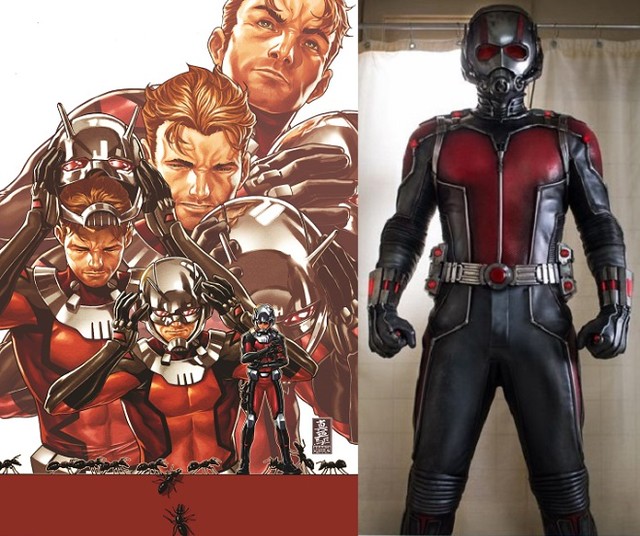
Basically, there aren't many differences between the two versions; both have been to prison, are electronics experts, and single fathers. However, the film version incorporates some of the third Ant-Man's personality, who wants to do good but occasionally gets discouraged and gives up halfway. Why this change? I think since Hank is already set as an elder, the younger Scott needs some guidance.
Characters who need guidance often lack life goals, which is another reason I believe choosing the second Ant-Man, a character who has served time, as the protagonist was correct. Because after being released from prison, one needs to rebuild their life in society and find new life goals. This also deepens Scott's core motivation and emotion of striving to become a hero for his daughter. Furthermore, the team of thieves who cooperate with the second Ant-Man are original to the film and do not appear in the comics.
For an introduction to the mainstream version of the second Ant-Man, please see this article: http://www.toy-people.com/?p=27815
Differences Between the Film and Original Versions of the Wasp:
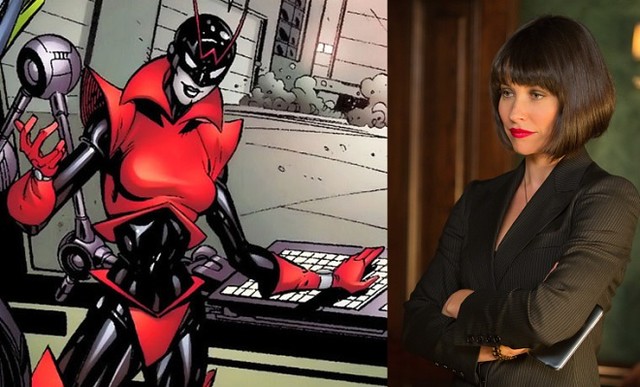
The film's Wasp is not based on the mainstream universe, but rather on MC2, a world where Spider-Man's daughter, Spider-Girl, is the protagonist, and heroic legacies are inherited by descendants or apprentices. In this world, Hank's daughter is a member of the next generation of Avengers. Why adopt the daughter setting? Firstly, Hank is set as an elder here, so having a daughter fits his age perfectly and also corresponds to the father-daughter relationship of the second Ant-Man.
Secondly, Ant-Man must have Wasp as a partner; it's a classic pairing. But with Hank being so old, it's unlikely his wife, who would be around the same age, would partner with the second Ant-Man, who could be her son. Therefore, the MC2 universe's setting of having a daughter was adopted. In the original comics, Hank and Scott are peers, so in the MC2 universe, both Hank's daughter and Scott's daughter are members of the new generation of Avengers. We could jokingly say that this romance in the film is like a father-daughter relationship, LOL. 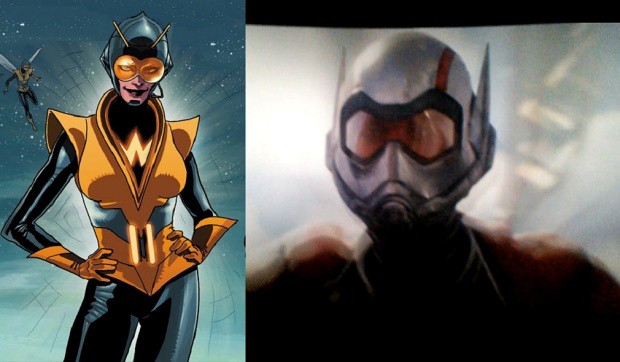
As for the film universe's first Wasp, Janet, who is the mainstream comic version of Wasp, I believe making her temporarily disappear (since the story doesn't explicitly kill her off) was the correct choice. Because if she appeared now, it wouldn't be able to convey Hank's guilt and the conflict and reconciliation with his daughter. Thus, she can only appear in flashback scenes. However, it also allows for the arrangement that just as Ant-Man's legacy is passed from Hank to Scott, Wasp's legacy can be passed from Janet to Hope, meaning both heroic partners have successors.
Differences Between the Film and Original Versions of Yellowjacket:
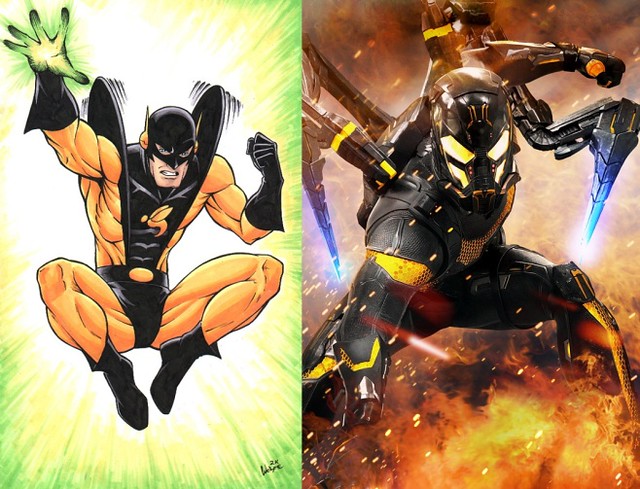
The adaptation of this character is probably my favorite in the entire film. Firstly, in the original comics, Yellowjacket was a negative personality created by Hank through Pym Particles, thus representing Hank's arrogant and evil nature.
*Ultron reflects Hank's fears.
Therefore, the film changed him to Darren Cross, who also becomes evil through Pym Particles. Especially when Hank tells Darren, 'It's like looking at too much of myself,' I thought it was absolutely brilliant. This change clearly shows an understanding of the original work, reflecting how Hank in the comics often reflected on his personality when he first became Yellowjacket and his domestic abuse towards his ex-wife. 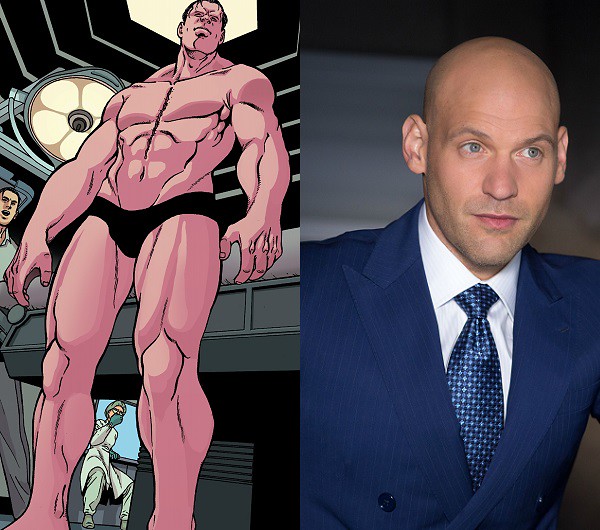
So why use the character Darren Cross? It's simple: please refer to the introduction to the second Ant-Man. Darren was Scott's first villain after becoming Ant-Man, and since the film is Scott's origin story, it's natural for this character to become the villain. This adaptation is truly well-researched, so now everyone can understand why it's my favorite.
*When the original article about the second Ant-Man was written, Darren had not yet been resurrected in the mainstream universe. He was only resurrected recently to coincide with the film's popularity.
Therefore, I once said on my fan page that true comic fans can definitely feel that many adaptations are made by people who truly understand comics. Only fake comic fans will complain about a film just because it's different, trying to show off that they've read the original and are therefore superior. Of course, the early Batman 4 was an adaptation that didn't understand the original and deserved criticism. So I often say that an adaptation depends on whether it captures the spirit of the original, not just whether the