


In the mainstream Marvel Comics universe, several fictional Registration Acts related to superpowers have appeared, such as the early Mutant Registration Act (MRA) targeting mutants, and the current Superhuman Registration Act (SRA or SHRA).
Of course, besides Marvel Comics, other superhero world-building works often feature such acts, with some even introducing similar concepts earlier. Typically, these acts are discussed as legislative actions by governments to legally compel superhumans to register. Therefore, most related works and story arcs primarily explore whether superhumans or so-called heroes should be regulated.
The provisions of these acts were rarely detailed before the Superhuman Registration Act appeared during the Civil War event. It was generally understood that when registering with the government, the government would have many procedures to evaluate the registrant's habits and superpowers, and further require registrants to comply with government-established standards. Afterwards, suitable jobs utilizing their superpowers would be arranged for the registrants as appropriate.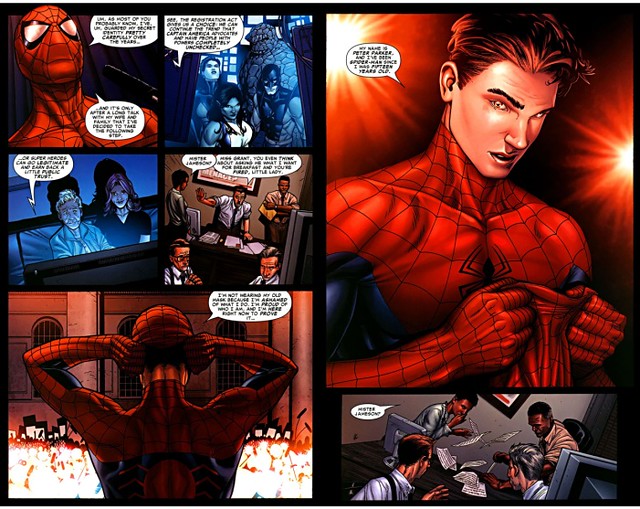
The Superhuman Registration Act that emerged after Civil War only required registrants to disclose their secret identities to the government (Spider-Man publicly revealed his identity at a press conference to help Iron Man promote the correctness and necessity of the registration act, not because the act required public disclosure). Furthermore, before obtaining legal authorization to combat supervillains, registrants had to undergo a certain level of training and testing (because the New Warriors, whose unplanned attack on supervillains led to the Civil War, caused the tragedy of over six hundred deaths).
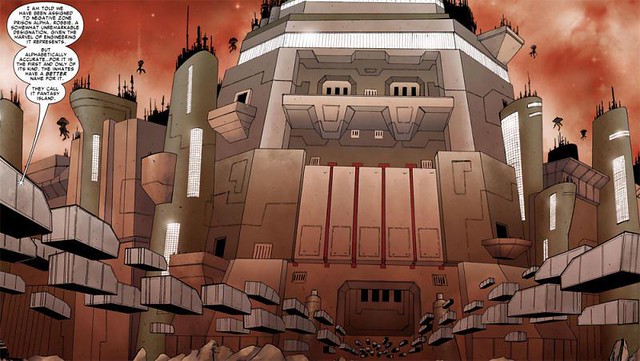
As for the job opportunities arranged by the government, they were not mandatory to accept. Also, in Spider-Man's own series during the Civil War storyline, it was mentioned that Iron Man took him to visit a prison built in a pocket dimension, where unregistered superhumans were incarcerated. Iron Man claimed these individuals had no civil rights. Furthermore, S.H.I.E.L.D. at this time strongly supported the government's decision and assisted in the forced arrest of anti-registration factions. Below are the registration acts and their evolution mentioned in the mainstream Marvel Comics universe.
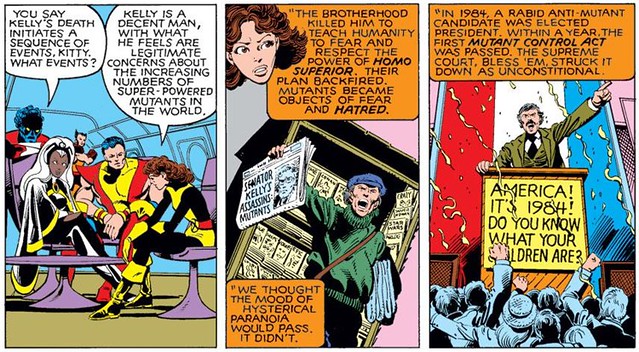
Mutant Control Act – This was the first act mentioned, appearing in the X-Men storyline "Days of Future Past." However, this was an act that appeared in a possible future timeline. The story describes Kitty Pryde, Shadowcat, traveling to a dystopian future where mutant-hunting Sentinels control the United States, and mutants are confined in concentration camps.
With the help of future Wolverine, Kitty was given hope to return to her original timeline, attempting to prevent her reality from evolving into such a dark future. However, even though the Supreme Court in the present era found this act unconstitutional, the Sentinels, citing the severe threat posed by mutants, attempted to replace the government and form a regime that persecuted mutants, which would later escalate indefinitely to include all superhumans, and even all of humanity.
Ultimately, the X-Men successfully prevented a key event that would have led to the dark future Kitty witnessed: the assassination plot against anti-mutant Senator Robert Kelly, making it seem as though this act would not come to fruition...
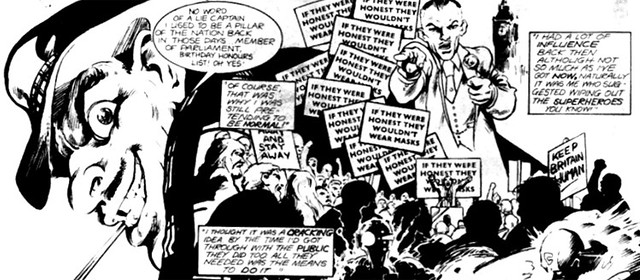
British Super Hero Legislation – In the storyline "Jaspers' Warp," the mutant madman Jim Jaspers used his abilities to alter reality, making himself the Prime Minister of the United Kingdom and forming a fascist regime. He utilized S.T.R.I.K.E.'s armed forces to search for and detain all superhumans within the UK. Ultimately, Captain Britain confronted him, overthrowing both the mutant Prime Minister and his regime, and consequently suspending this legislation.
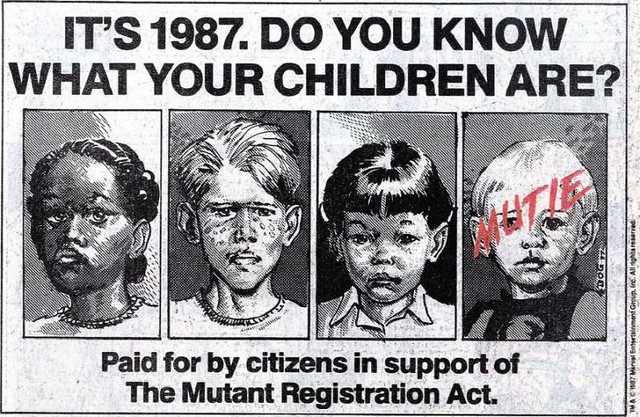
Mutant Registration Act – Although Senator Kelly was saved from assassination by the X-Men, who are themselves mutants, the plot to kill him was also orchestrated by mutants. Therefore, Kelly's view that mutants needed strict management remained unchanged. This time, he modified the Mutant Control Act to avoid constitutional conflicts (the emergence of this legislation was also one of the important reasons why Cyclops and Jean Grey decided to form the X-Factor team), thus creating the Mutant Registration Act.
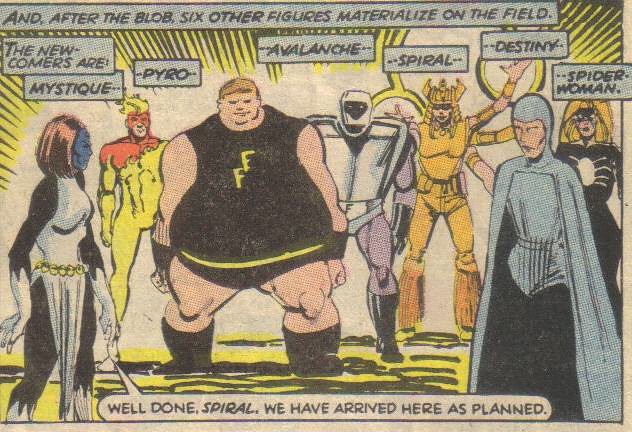
After the act was introduced, government agent Valerie Cooper collaborated with the mutant terrorist Mystique and other evil mutants under her command to form Freedom Force, the only government-sanctioned mutant hero team, to forcibly arrest unregistered mutants.
They even deployed two government-sanctioned superheroes – Captain America (at the time, John Walker had replaced him, as the government wanted a hero who would blindly obey them; this individual is now the famous U.S. Agent, who, like Captain America, no longer blindly follows the government) and Battlestar (who had temporarily taken on the mantle of Captain America's sidekick, Bucky) – to join the arrest teams.
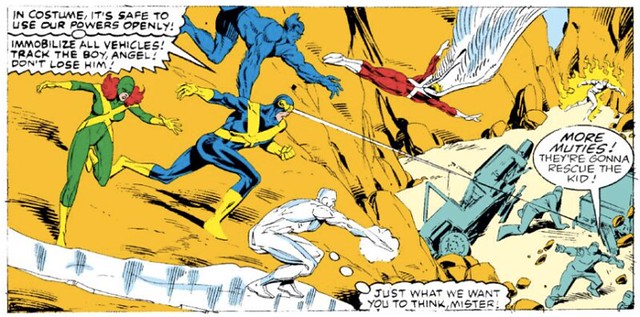
During the peak of this act, the X-Men and their affiliated teams continuously publicly opposed it, but the government showed no signs of backing down. However, as the X-Men and other mutants consistently demonstrated goodwill to the public, and with the assistance of other heroes, the MRA was eventually terminated. Nevertheless, under the current Superhuman Registration Act, the X-Men and mutants do not need to apply for related registration procedures, as they are already considered registered. This implies that even though the MRA was terminated, its effects are still legally protected.
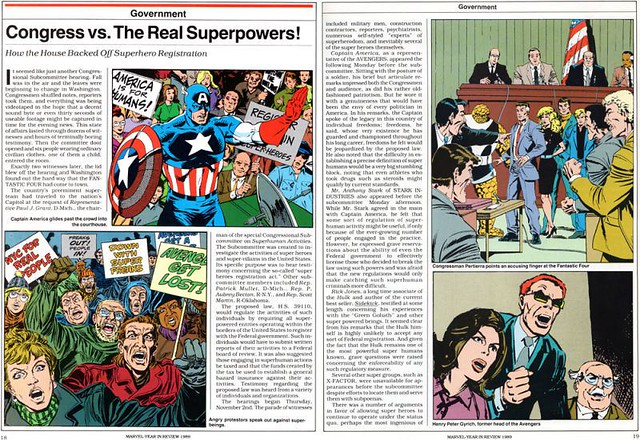
Super-human Registration Act – During the "Acts of Vengeance" event, the Fantastic Four went to Congress to investigate the committee's Super-human Registration Act. Mr. Fantastic argued in Congress that this act was unnecessary because most superhumans who became superheroes had proven themselves over many years, earning significant public trust. He stated that such government action would only inhibit these heroes' ability to protect the world.
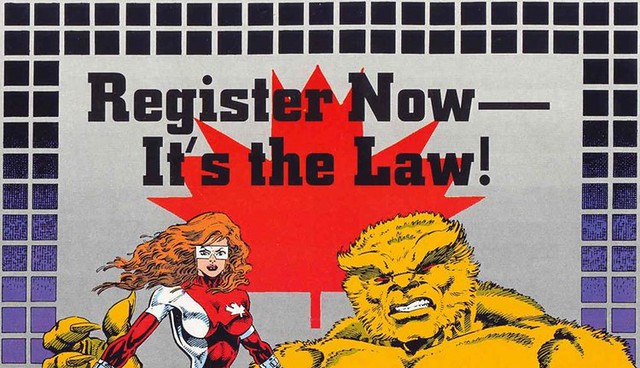
Canadian Super-powers Registration Act – This act was promoted by Canadian government minister Robert Hagon and was also part of the supervillain Master's intricate plan. The provisions stipulated that all superhumans in Canada must become government agents, recruited by Department H, the government department that handles superhuman-related issues. Selected superhumans would become members of superhero teams in the Flight program, such as Alpha Flight.
This act was not explicitly terminated or transformed into another form of legislation like the American Mutant Registration Act. Furthermore, in many comic series, when characters mentioned Canadian superhuman laws, there were conflicting accounts. However, considering that after the U.S. implemented the Superhuman Registration Act, some individuals who did not wish to register fled to Canada, stating that Canada had no such registration act, it is evident that Canada's related registration act had long been repealed.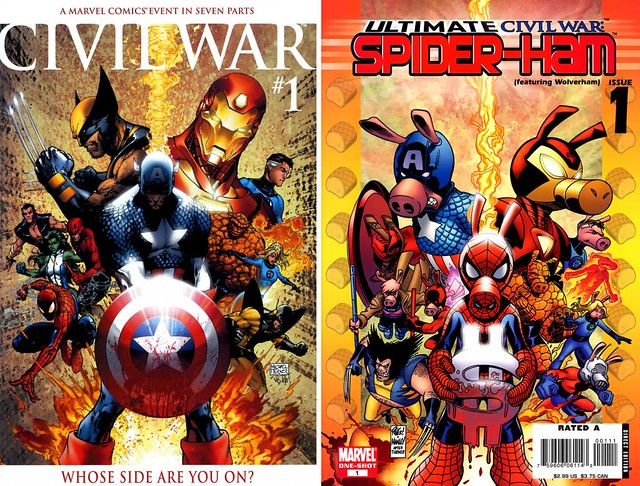
Superhuman Registration Act – Following the major events of "House of M" and the subsequent discussions in "Decimation M," the U.S. government once again discussed a superhuman registration act. Tony and Peter, acting as a embedded reporter, also rushed to the White House to participate in the relevant discussions.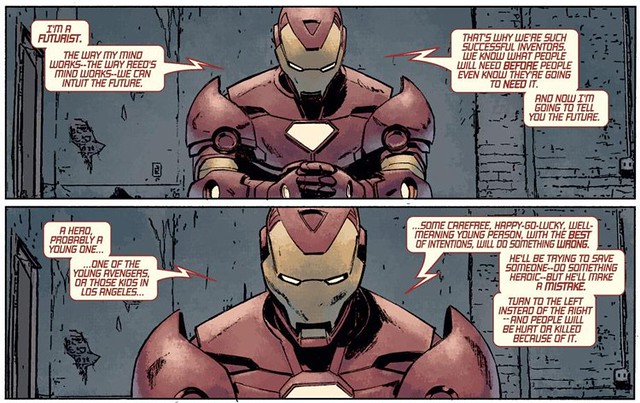
Upon learning the government's stance, Iron Man subsequently participated in a meeting of the Illuminati (a group composed of Professor X, Black Bolt, Iron Man, Doctor Strange, Mr. Fantastic, and Namor, with each member being an expert in one field within the Marvel universe, formed to prevent major crises).
Iron Man predicted that superhero groups like the Young Avengers, being too young, would one day impulsively misuse their powerful abilities, leading to the loss of hundreds of lives. This would then be used by the government as a justification to propose a new act even stricter than the Superhuman Registration Act, possibly even using force to compel registration. Therefore, if it happened, he urged everyone to be mentally prepared and not resort to violence, lest the government use it as an excuse to expand its powers indefinitely.
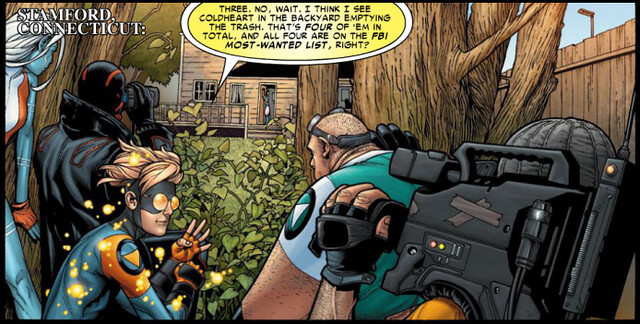
However, Iron Man's prophecy soon came true. A group of young heroes called the New Warriors, while collaborating with a TV station for a live broadcast of combating supervillains, likely sought too much attention and overlooked the opponent's powerful abilities, resulting in hundreds of deaths, including elementary school students.
This led to the act being supported by the public's indignant sentiment. With the assistance of Iron Man, Mr. Fantastic, and S.H.I.E.L.D., 6 U.S.C.S. 558, the Superhuman Registration Act (SHRA), was quickly formed. Furthermore, various federal criminal statutes, such as Chapter 40, Section 120, New York Penal Law Section 120, and California Penal Code Section 245, were also amended to avoid constitutional conflicts and began to be implemented.
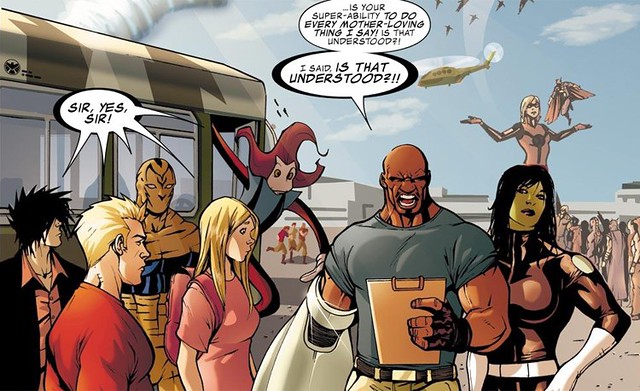
This event led to a Civil War between heroes, with the anti-registration faction led by Captain America and the registration faction led by Iron Man. Ultimately, Iron Man emerged victorious and established and implemented the subsequent Fifty State Initiative, providing a military training center for aspiring superheroes and ensuring each U.S. state had a team of registered superheroes for protection.
However, after the Secret Invasion event, Norman Osborn, formerly the Green Goblin, became the supreme commander of all superhuman-related agencies. Theoretically, Norman could access all registered superhuman data, so he intended to investigate the identity of his arch-nemesis, Spider-Man. Unbeknownst to him, Tony had anticipated this and had pre-programmed a virus to destroy all the database content. The Superhuman Registration Act was only canceled by the President after the Siege event.
*Although Spider-Man publicly revealed his identity at a press conference during Civil War, this also led to Kingpin hiring an assassin to target Aunt May. To save his aunt, Peter sacrificed his marriage to Mary Jane, making a deal with the demon Mephisto to regain his secret identity and save Aunt May. Therefore, only by accessing the data Spider-Man left during registration could his true identity be known. Next, we will introduce registration acts from Marvel's alternate universes and other publishers' works.
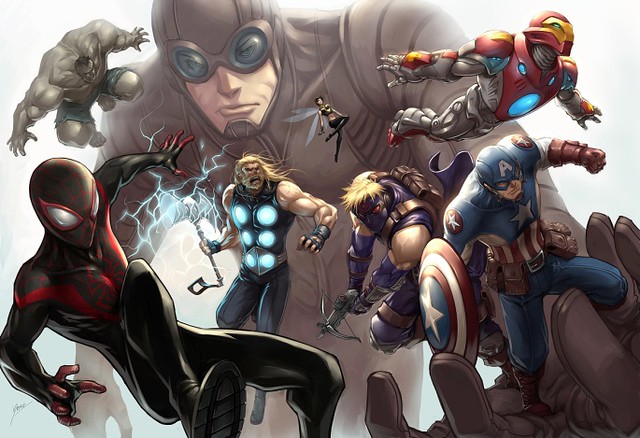
Marvel Ultimate Universe – Although no registration acts exist in this universe, several related anti-superhuman abuse laws have been enacted. For example, prohibiting arbitrary genetic modification of humans and banning nations from employing superhumans for nuclear weapons experiments. The latter even established related international treaties to prevent the indiscriminate proliferation of deadly weapons and the disruption of international military balance.
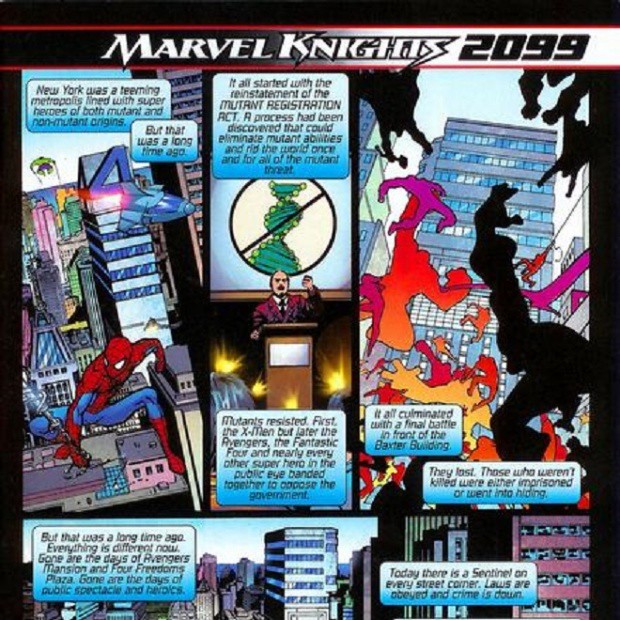
Marvel Knights: 2099 Universe – In this timeline, the Mutant Registration Act was re-implemented. Although it did not target all superhumans, due to emotional ties and human rights concerns, the conflict escalated from a war between mutants and the government to a war between superhumans and the government. Ultimately, the government won, the registration act was successfully implemented, and all superheroes went underground.
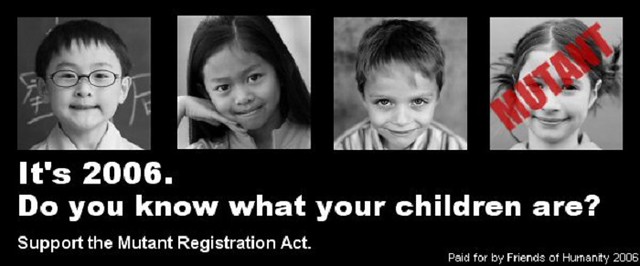
X-Men Film Universe – In this timeline, the Mutant Registration Act was spearheaded and proposed by Senator Kelly. The act's provisions allowed the government to count the mutant population, ascertain their abilities, and track them. However, Magneto subsequently kidnapped Senator Kelly, and Mystique, impersonating the senator, canceled the act, after which Senator Kelly died. Shortly thereafter, William Stryker brainwashed Nightcrawler to stage a fake assassination attempt on the President, creating an opportunity to reactivate the Mutant Registration Act. But after the X-Men dealt with Stryker's conspiracy, Professor X persuaded the President, and the act was canceled again.
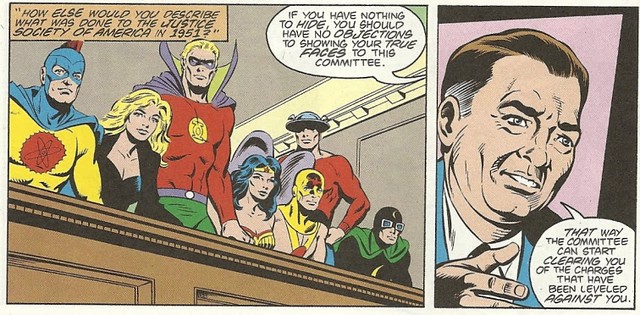
DC's Main Superhero Universe – In 1951, due to McCarthyism, the Justice Society of America (JSA) chose to disband rather than publicly reveal their secret identities under the orders of the American Committee. This act referenced the Keene Act from the Watchmen story, stating that unless you registered with the government and revealed your identity, fighting crime privately would be considered illegal.
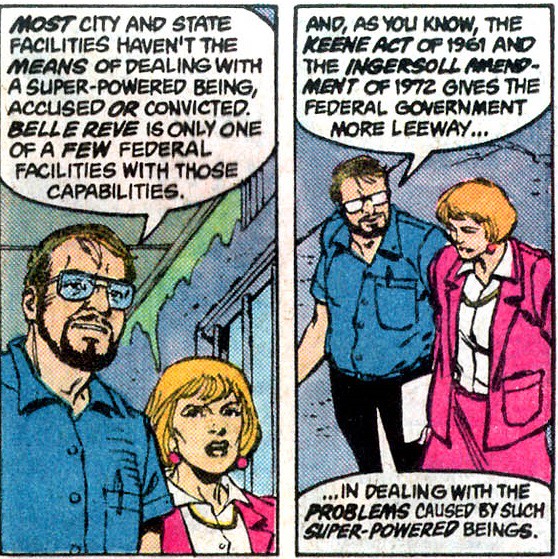
Later, in the modern era, the government formed the Suicide Squad, a black ops team composed of supervillains, to handle unsavory tasks. The government cited the Keene Act (named after the Watchmen act of the same name), a related act established in 1961, to execute its procedures. It stated that superhuman criminals could have more legal leeway than ordinary criminals~
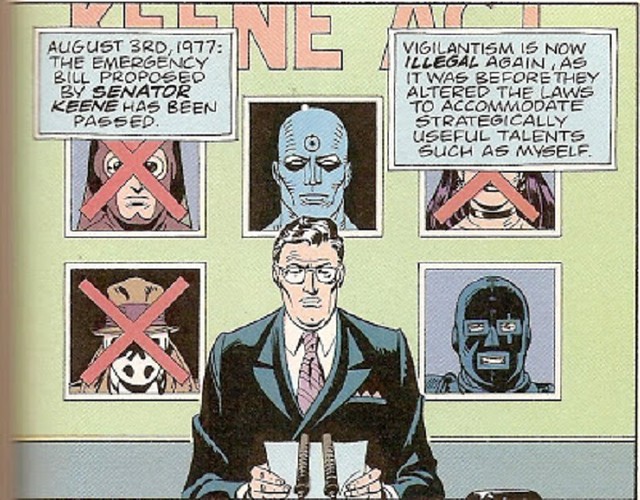
Watchmen Universe – Due to the active crime-fighting of masked heroes, a strike and riot by New York police and their families occurred in 1977. The government then introduced the Keene Act, prohibiting unregistered masked heroes from continuing to fight crime privately, otherwise they would be arrested. This led many superheroes in the Watchmen universe to retire, with only the registered Comedian and Doctor Manhattan, and the defiant Rorschach, continuing their crime-fighting activities.
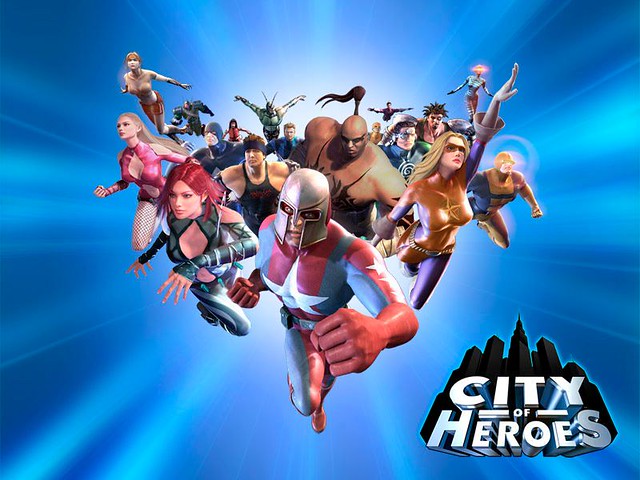
City of Heroes Universe – After World War II, the U.S. government, fearing Soviet dominance in the superhuman field, enacted the Might for Right Act. It stated that if you were an American citizen with superpowers, supernatural magic, high technology, or were a vigilante, you were considered a valuable national resource of the U.S. government and could be conscripted as a super-soldier or agent without special notification.
Of course, this infringed upon civil rights, and after multiple objections, the Supreme Court overturned this act. In the modern era, the new act is the Citizen Crime Fighting Act, which grants registrants police privileges and does not necessarily require them to work for the government, though the government still has the right to track any superhuman. In a parallel universe of the City of Heroes, a superhuman registration act similar to Marvel's is adopted, where every superhuman is employed by the government's Powers Division.
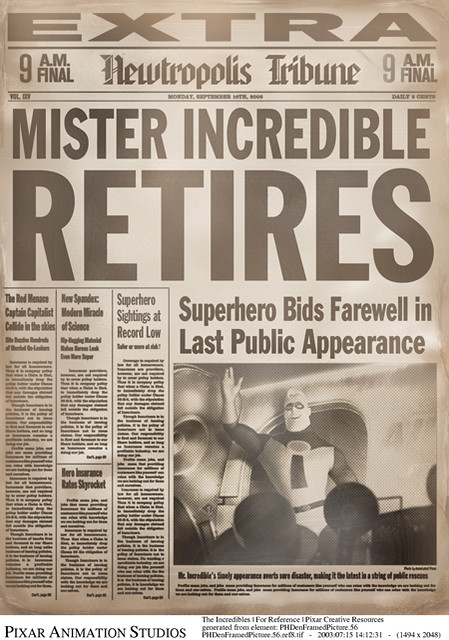
The Incredibles Universe – Superheroes had to register with the National Supers Agency (a parody of the real-world National Security Agency, both abbreviated as NSA) to have the legal right to fight criminals. However, due to an increasing number of citizens being injured or suffering financial losses during superheroes' crime-fighting, especially influenced by the Sansweet v. Incredible case (a legal case where a citizen sued Mr. Incredible), most heroes were forced to retire.
The government then established the Superhero Relocation Program, granting amnesty for all heroes' legal liabilities, and like a witness protection program, creating new identities for heroes and providing them with ordinary jobs, allowing them to live like normal people. However, at the end of the film, it is implied that this program has been canceled.
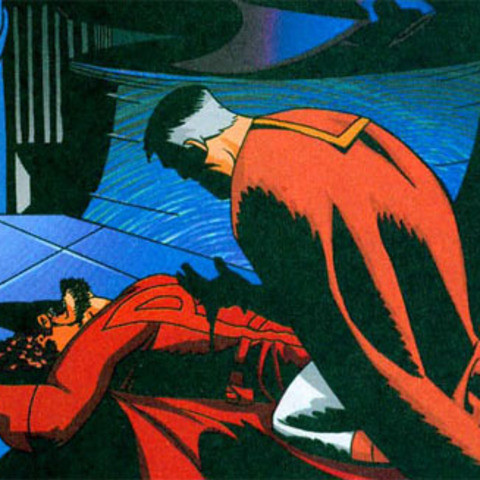
Powers Universe – In this police-centric world where superhumans are the focus, there was once the world's greatest hero, named Super Shock. But he betrayed everyone's trust, traveling the world and causing many massacres. This led the U.S. to force all superhumans into retirement, replacing them with SWAT teams composed of ordinary people to combat supervillains. However, as the story progressed, some superheroes began to re-emerge, naturally leading to more social and political problems.
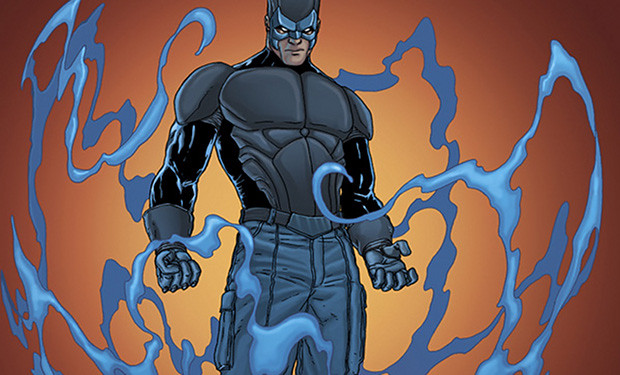
Absolution Universe – In this story, superhumans serving as police is a common phenomenon, used to handle cases involving superhumans, or politically and socially sensitive matters.
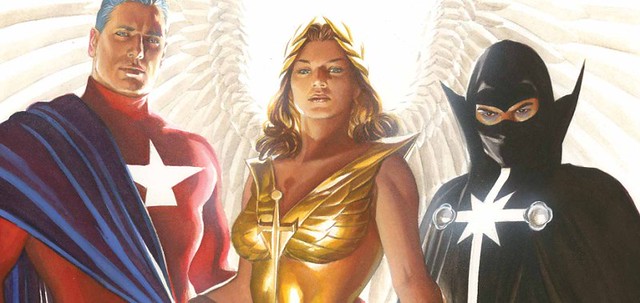
Astro City Universe – Due to a superhuman serial killer rampant in the city, Astro City's mayor attempted to initiate a superhuman registration effort. However, the greatest female hero in history, Winged Victory, bluntly stated she did not want to register, and many heroes followed suit in opposition. Later, the mayor was discovered to be an alien who had been preparing for a large-scale invasion for years. The superhumans of Astro City then collaborated to stop the invasion, and naturally, the registration act was canceled and never mentioned again.