

Bandai's recent reveal of the METAL BUILD God Gundam & God Gundam Ni set has sparked some serious debate. The new "God Gundam Ni," which hails from the 30th-anniversary side-story novel, caught many fans off guard with its heavy Chinese martial arts aesthetic and arsenal of weapons—a direction that didn't quite line up with everyone's expectations ( as we covered previously ).
But now, the man himself is setting the record straight. On March 31, Bandai's official "Tamashii Web" site published an interview with Yasuhiro Imagawa, the original director of Mobile Fighter G Gundam, who also supervised the new METAL BUILD figure. He dished on the design process and shared some wild stories from the anime's production days.
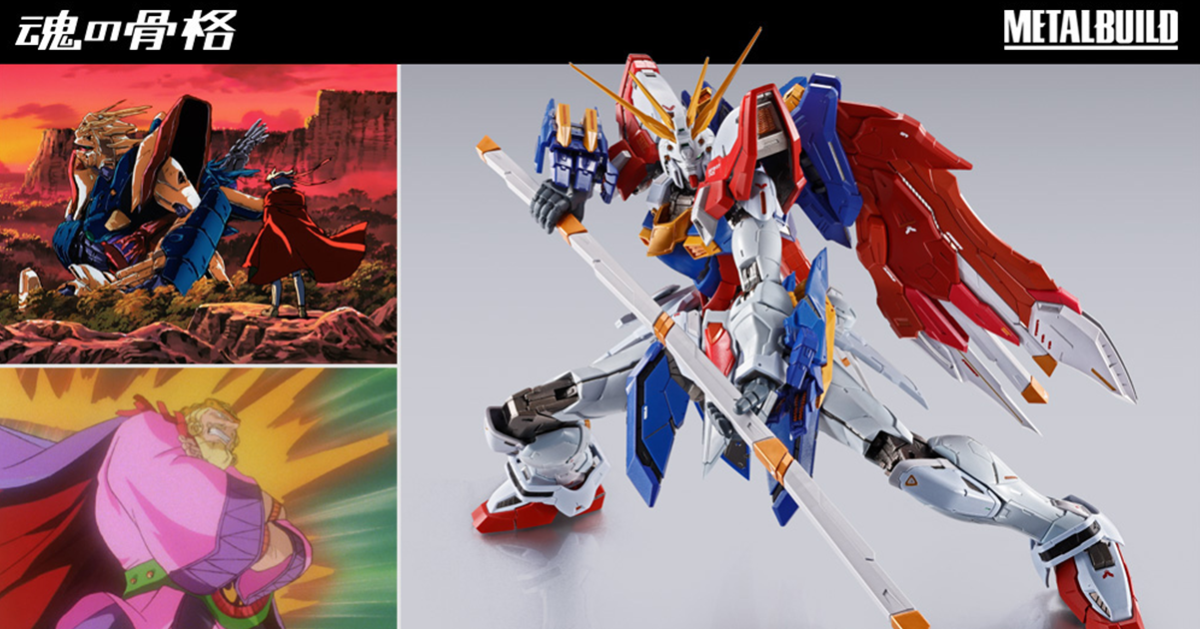
Here are some highlights from the interview:
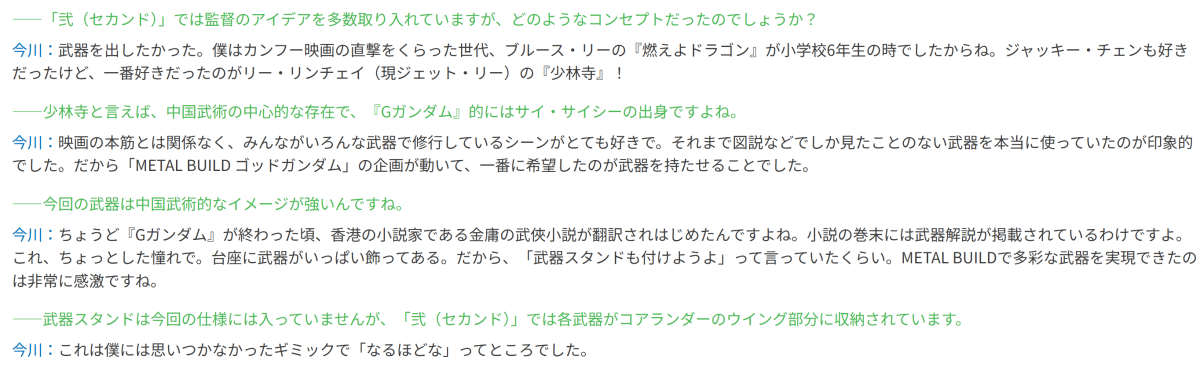
Q: The "God Gundam Ni" version incorporates a lot of your ideas. What was the core concept behind its design?
Imagawa: I wanted to give it more weapons! I'm from the generation that grew up on kung fu movies. I was in sixth grade when I saw Bruce Lee's Enter the Dragon, and it blew my mind. I like Jackie Chan too, but my all-time favorite is Jet Li's Shaolin Temple!
Q: Shaolin Temple is a cornerstone of Chinese martial arts cinema. In G Gundam, that would correspond to Sai Saici's background, right?
Imagawa: What I actually loved most about that movie were the scenes where everyone was training with different weapons. Just seeing all these weapons I'd only ever read about in books actually being used was incredible! So, when the METAL BUILD God Gundam project kicked off, my very first thought was, "It absolutely needed more weapons!"
Q: The weapon designs definitely have a strong Chinese martial arts vibe.
Imagawa: It just so happened that shortly after G Gundam finished airing, wuxia novels by Hong Kong author Jin Yong started being translated and published in Japan. The books even had appendices explaining all the different weapons, which I found totally fascinating! I was so into it that I even suggested, "How about we add a weapon rack?" I'm thrilled that the METAL BUILD was able to incorporate so many different weapons. I also never imagined that all of God Gundam Ni's weapons could be stored in the wings of the Core Lander. When I saw that design, I couldn't help but shout, "Whoa, I didn't even think of that!"
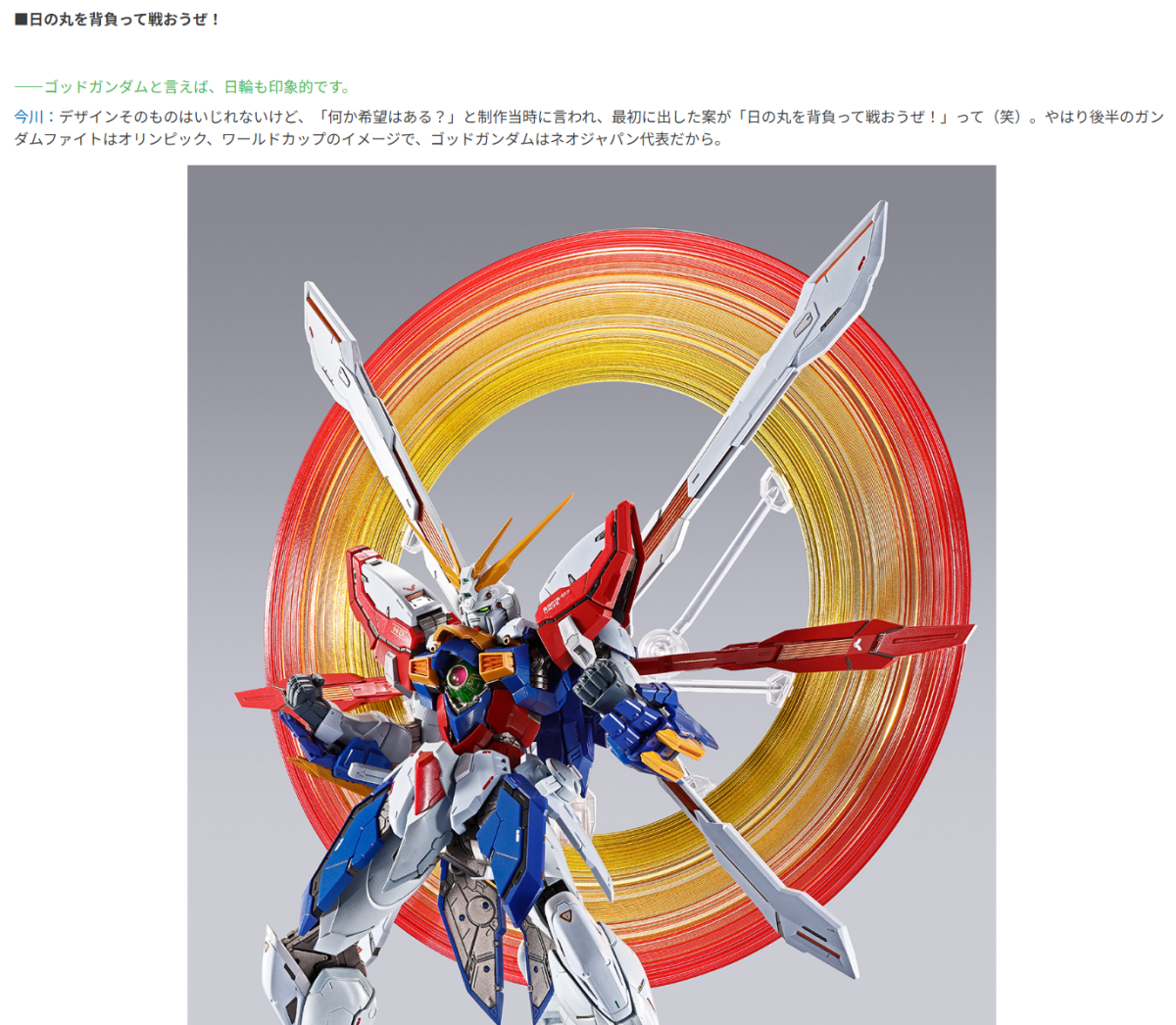
Q: Speaking of the God Gundam, you can't ignore its iconic "Nichirin" (sunburst) design.
Imagawa: At the time, we couldn't just change the mobile suit designs on a whim. But when the production team asked if I had any requests, I immediately said, "Let it fight with the Rising Sun on its back!" (laughs). After all, the second half of the Gundam Fight tournament was basically the Olympics or the World Cup, and the God Gundam was representing Neo Japan!
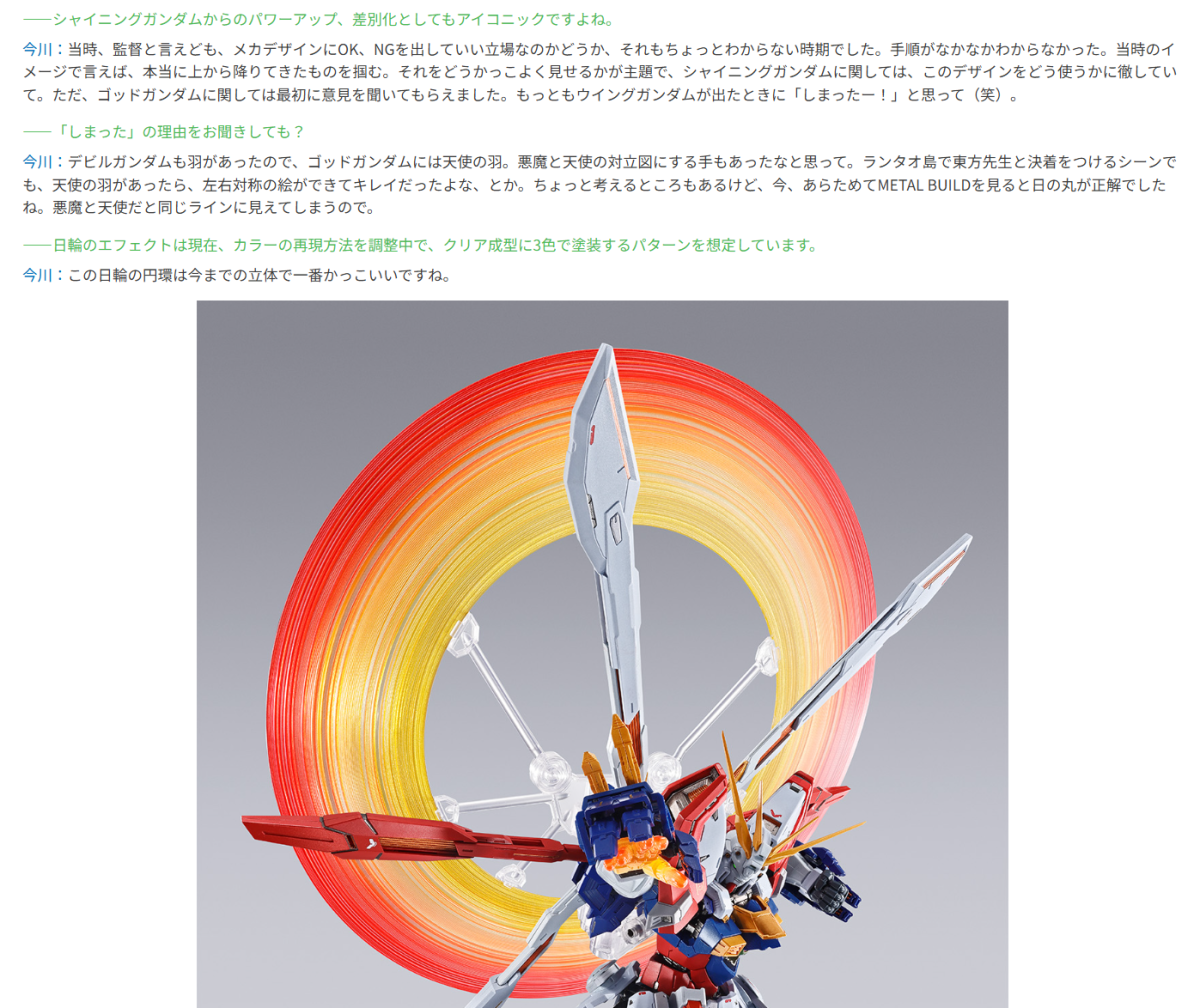
Q: That really set it apart from the Shining Gundam and became a signature part of its design.
Imagawa: Back then, I wasn't sure if it was my place as a director to comment on the mechanical designs, since I was new to the process. But I was really touched when the team actively asked for my input on the God Gundam. However, when Wing Gundam from Mobile Suit Gundam Wing showed up, my first thought was, "Oh crap!"
Q: Why was that?
Imagawa: Because the Devil Gundam has wings, and if the God Gundam had angelic wings, it would have created a perfect "Devil vs. Angel" contrast. But I didn't think of it at the time. Looking back at the METAL BUILD version now, I think the "Nichirin" was the right call! If it had angel wings, the two suits might have looked a bit too similar visually.
"What Part of This Is Gundam?!" — The Struggles and Breakthroughs of the Past
Q: How did you feel when you first took on G Gundam?
Imagawa: For me, it was pure agony. I was genuinely worried I'd get stabbed by Gundam fans back then (laughs). I'm not trying to knock "robot pro-wrestling," but the Universal Century Gundam series were created specifically to move *away* from that style. And here I was, being asked to take the "Gundam" name and drag it right back into the wrestling ring. Honestly, I was terrified. The person who resisted the concept the most was me. I kept screaming internally, "What part of this is Gundam?!" It took a very long time for me to come to terms with it.
Q: But in the end, it not only won over existing Gundam fans but also captured the hearts of kids. It became a trailblazer for non-UC series and is incredibly popular!
Imagawa: Yeah, I was surprised that kids were actually watching. The turning point for me was probably the Pharaoh Gundam in episode 10, "Terrifying! The Phantom Fighter Appears." That episode was designed completely for kids. And then, once Master Asia showed up, the whole thing just exploded (laughs).
Q: Master Asia's debut in the Shinjuku arc was a major turning point for the series, wasn't it?
Imagawa: In the beginning, everyone kept telling us, "This show has no villain," which was a huge problem. It's hard to create conflict if the protagonist's power doesn't have a clear "opposite" to push against. Another major headache early on was the Shuffle Alliance's four Gundams—the Gundam Maxter, Dragon Gundam, Gundam Rose, and Bolt Gundam. According to the Gundam Fight rules, you win by destroying the head. But these suits were also supposed to sell toys! How could we let their heads get smashed? For a model kit, the "face is the soul"!
Looking back now, there were probably other ways to handle it, but at the time, we were just rushing to get it done. That's why episodes 2 through 5, which introduce those four Gundams, feel a bit overly formal (laughs).
Q: Could you talk about the anime's opening theme sequence?
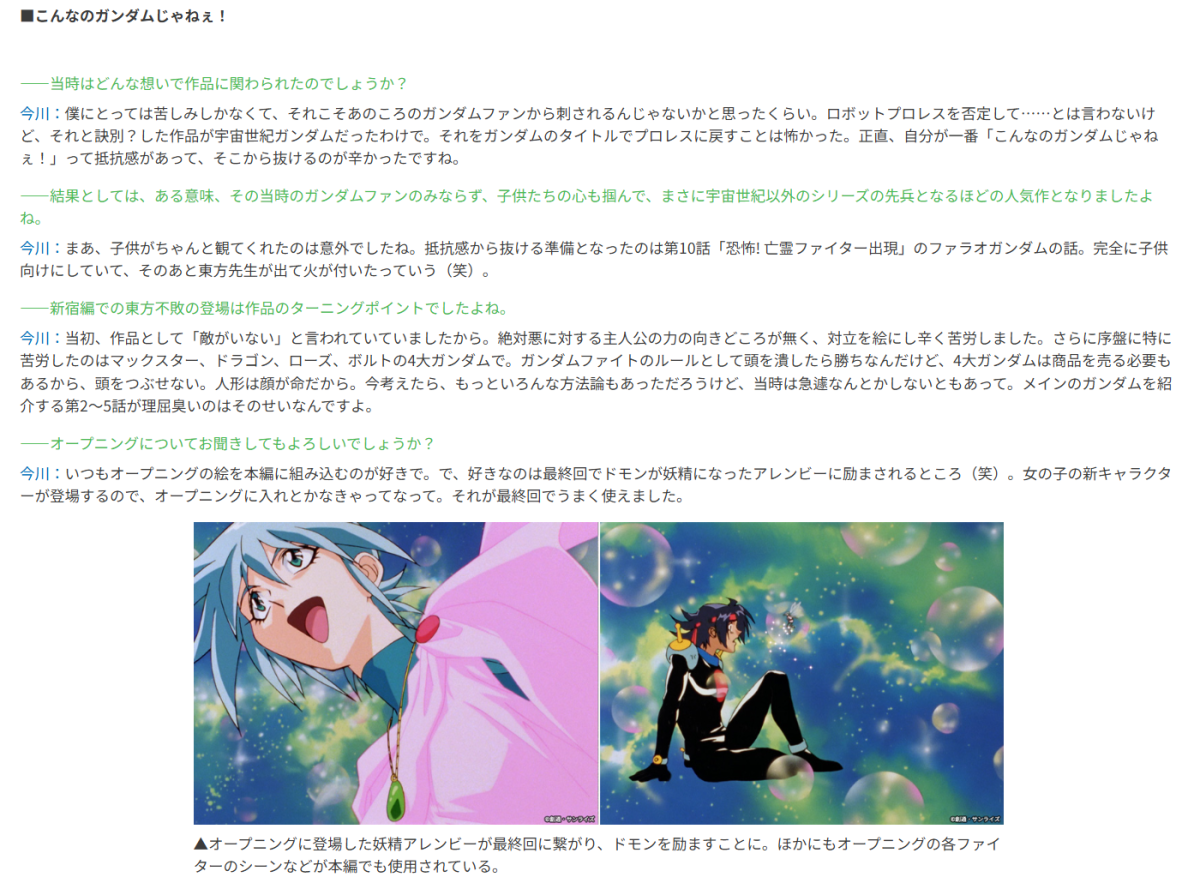
Imagawa: I've always loved incorporating scenes from the opening animation into the actual episodes. My favorite example is in the final episode, where Allenby appears as a "fairy" to encourage Domon (laughs). Since we had a new female character, I knew we had to put her in the opening, and it just so happened to pay off perfectly in the finale. I was pretty happy about that.
So there you have it. With the explanation coming straight from the original director of both the anime and the novel, there's no more mystery behind the Chinese martial arts theme or the abundance of weapons. It's all just what Director Imagawa loves. XD
For the full interview, check out the complete article on Tamashii Web to get even more insights from Director Imagawa.
via: 魂WEB