

The Japanese government announced its Autumn 2025 Honours list today, November 3rd, and two absolute legends of their respective fields are among the recipients.
Manga master Go Nagai, the creative force behind classics like Devilman, Cutie Honey, and Mazinger Z, and Yuji Horii, the celebrated game creator and father of the Dragon Quest series, have both been awarded the Order of the Rising Sun, Gold Rays with Rosette. The prestigious award recognizes their decades of contributions to Japan's manga and gaming culture, and both creators took to social media to share their thoughts.

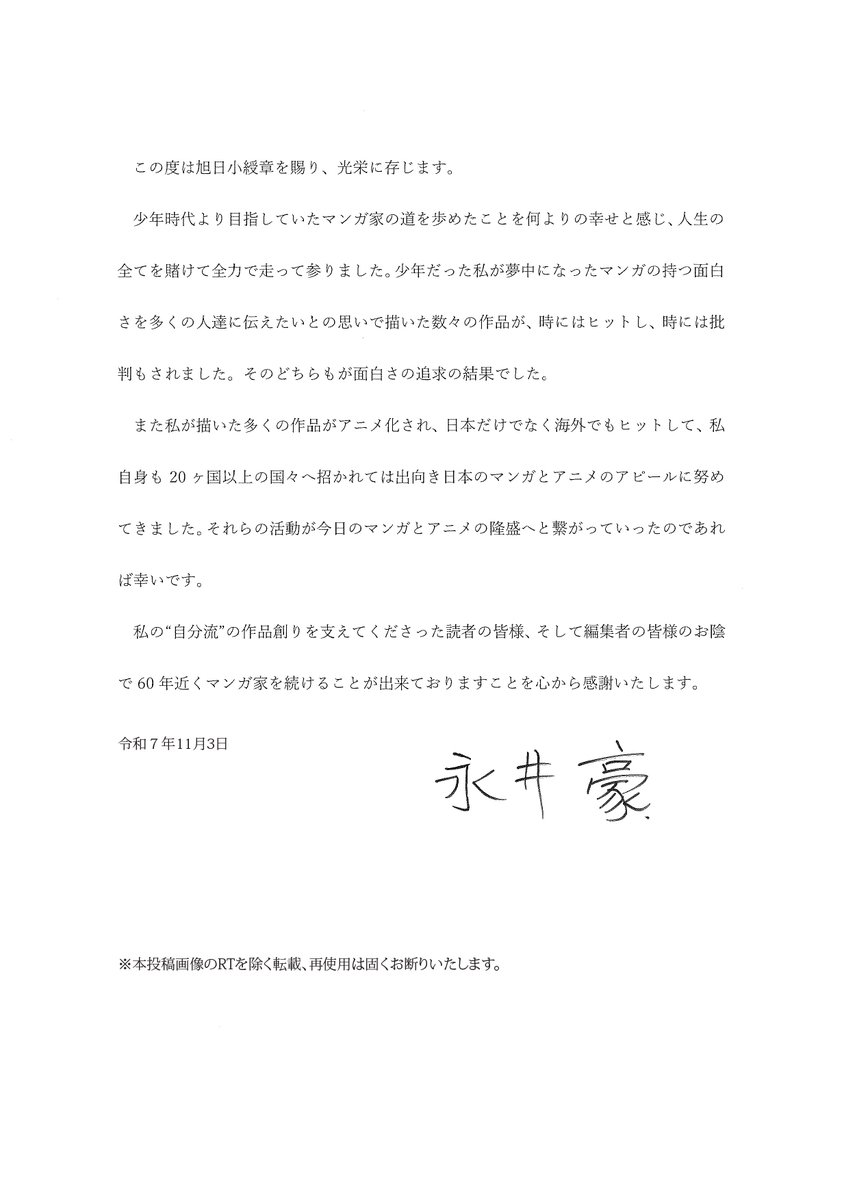
Go Nagai, 80, has spent over half a century unleashing his boundless creativity across various manga genres, from comedy to action. "Being able to walk the path of a manga artist, my childhood dream, has been the greatest happiness of my life," he said. "To the readers who have supported my 'personal style' of creation all this time, I thank you from the bottom of my heart."
Born in Wajima City, Ishikawa Prefecture, Nagai began his career as an assistant to Shotaro Ishinomori before making his official debut in 1967. He went on to produce a string of hit series. Devilman explored the tragedy of a hero transformed into a demon, while Harenchi Gakuen (Shameless School) stirred controversy with its bold humor and sexual innuendos. "I've always hoped to share the joy of manga with as many people as possible," Nagai reflected. "Along the way, some of my works became huge hits, while others faced criticism—but both were the result of my pursuit of what I found 'interesting.'"
Many of his works, including Mazinger Z, were adapted into anime, building a massive global fanbase. Nagai has personally visited over 20 countries, actively promoting Japanese manga and anime culture. "If these efforts contributed even a little to the prosperity of manga and anime today, I would be truly delighted," he said with a smile.
Yuji Horii, 71, is a pivotal figure who changed the course of Japanese gaming history. His creation, the Dragon Quest series, ignited the RPG boom in Japan and spread its influence worldwide. On receiving the award, he humbly stated, "I feel truly unworthy of such an honor. This is all thanks to the team I've worked with and the players who have always supported us. I hope this award can also serve as an encouragement to the next generation."
After graduating, Horii worked as a writer for a shonen magazine before a prize-winning entry in a game competition, which he programmed on a self-built computer, launched his career in the gaming industry. The first Dragon Quest was released in 1986, but it was 1988's Dragon Quest III that became a full-blown social phenomenon, with massive queues forming on its release day—a benchmark in gaming history.
Horii also offered some characteristically warm advice for aspiring creators: "Life is like a game. When you face a tough challenge, just think of it as a level—telling yourself 'I'm going to clear this stage' will help you move forward." As for his own future? He laughed, "I have no plans to retire yet. I'm still thinking about 'what I want to be when I grow up.'" His spirit of adventure remains as strong as ever.


In a fascinating reveal on X, Yuji Horii shared a personal story connecting him to Nagai. Over fifty years ago, during the summer vacation of his senior year in high school, he dreamed of becoming a manga artist. With a half-finished manuscript in hand, he gathered his courage and went to visit Go Nagai, hoping to be taken on as an assistant. Despite calling from a payphone at Otsuka Station and showing up completely unannounced, "Master Nagai was incredibly kind and met with me anyway." Although he didn't end up becoming his assistant, Nagai still gave him an autograph.
"Now, to receive this award at the same time as Master Nagai... I'm overcome with emotion. This is just incredible."

As two of Japan's national treasures in the worlds of manga and gaming, it's no surprise to see them receive this official recognition for their "conspicuous merits of public service to the nation."