

Who's taking out the trash? Who's buying the drinks? Or maybe it's just some ridiculous, spur-of-the-moment bet among friends. When all else fails, it often boils down to a simple "Let's play rock-paper-scissors!" Most of us treat it as a game of pure luck, but what if there's a hidden psychological pattern at play?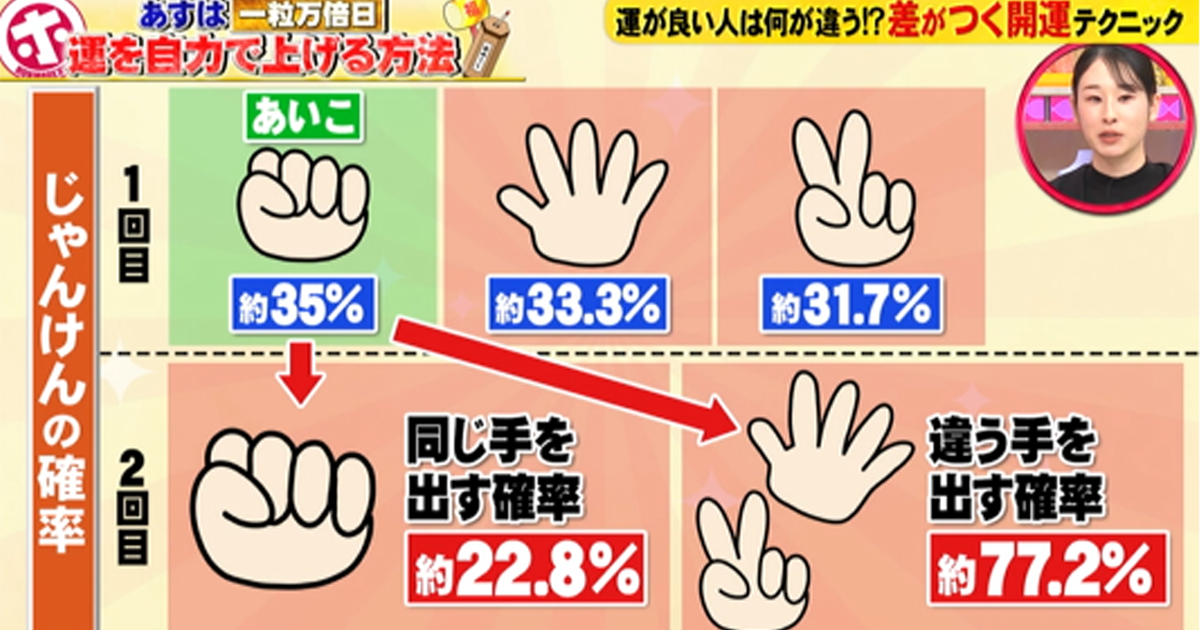 A Japanese variety show recently unveiled a "luck-boosting" tip that unexpectedly turned into a hot topic: a rock-paper-scissors strategy. Netizens on Japanese X (formerly Twitter) shared clips from the show, highlighting a specific move: if the first round ends in a tie, the trick is to play the hand that *would have lost* to the tied hand in the next round. This, apparently, significantly reduces your chances of losing.
According to the show's statistics, rock is the most common opener in the first round at approximately 35%, followed by paper at 33.3%, and scissors at 31.7%. If the first round is a tie, the probability of players repeating the same hand in the second round drops to a mere 22.8%. Conversely, the likelihood of them switching to a different hand is a whopping 77.2%. By assuming your opponent is likely to change their hand, you can deduce a more advantageous choice.
For instance, if both players throw rock in the first round, your opponent is more likely to switch to paper or scissors in the second. Since the chance of them sticking with rock is low, if you throw scissors, you'll either win or tie again. This isn't a guaranteed win, but it leverages the human tendency to "want to change it up" after a tie, transforming the outcome from pure luck into a game of probability.
This mind-bending strategy got Japanese netizens buzzing. Some exclaimed, "This might be the biggest discovery of the century!" while others mused, "If both players adopt the same strategy, it'll just be a stalemate."


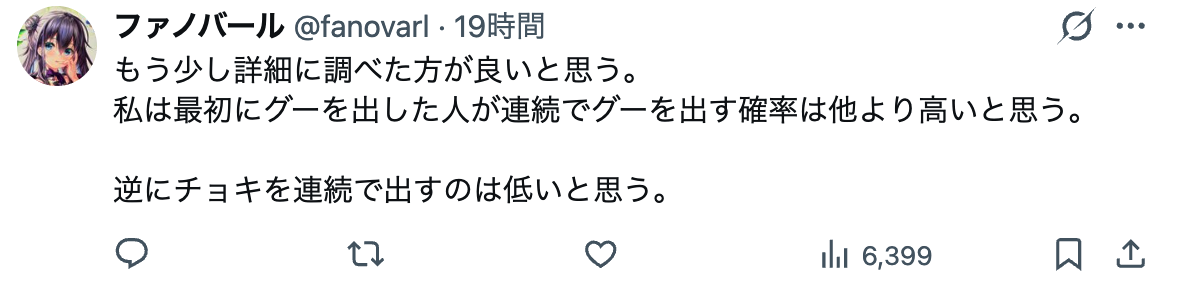
However, not everyone was convinced. Some netizens offered different perspectives: "I think people who start with rock are more likely to stick with rock than in other scenarios. Conversely, I think the chance of playing scissors twice in a row is lower." Another confessed, "After a tie, I'm too lazy to change, so I often just throw rock again after rock! I do that all the time!"

But let's be real, when it comes to this game of probability, it still boils down to who has the quicker intuition and reaction time. When both players start overthinking—"Will they switch?" "Do they know I know they'll switch?"—a simple three-second decision suddenly transforms into a high-stakes mental chess match! Ugh.