

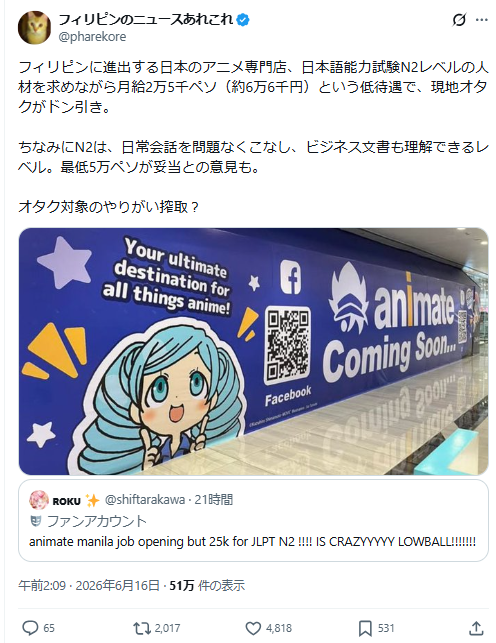
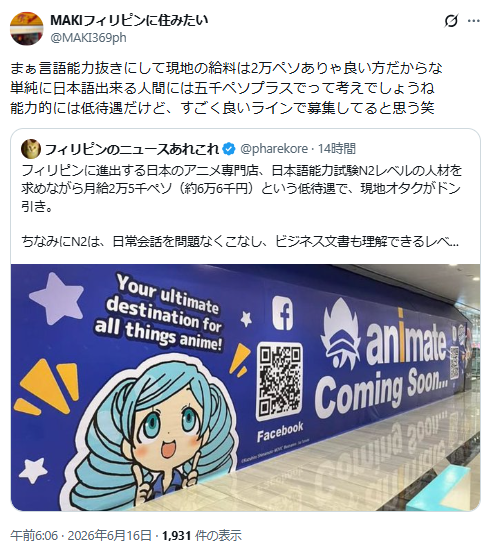
Japanese anime merchandise giant Animate is expanding its overseas presence in Southeast Asia, with a new branch set to open in Manila, Philippines, aiming to capture the local anime fanbase. However, a recent job posting has stirred controversy among Filipino anime enthusiasts and even Japanese netizens, who are now debating the compensation practices of Japanese companies abroad. The issue stems from a significant mismatch between the salary offered and the job requirements.

The position advertised is for a store-based Product Buyer. The job description demands not only a strong passion for Japanese pop culture, including anime and manga, but also Japanese Language Proficiency Test (JLPT) N2 certification. Yet, it's the proposed salary that has ignited the most heated debate.
According to the recruitment details, the monthly salary offered is approximately 25,000 Philippine Pesos (PHP), which is roughly equivalent to NT$13,000 or JPY 66,000.

However, Japanese netizens familiar with the Philippine job market quickly pointed out that individuals with JLPT N2 certification are typically highly competitive candidates. N2 proficiency generally signifies the ability to engage in daily conversations, read business documents, and communicate effectively in Japanese in a professional setting. Critics argue that a fair salary for such qualifications should be "at least 50,000 PHP," accusing Animate of "exploiting otaku passion to drive down wages."
(It's worth noting that this perspective reflects the opinion of a specific netizen, and whether N2 proficiency is truly sufficient for the role can vary by individual.)
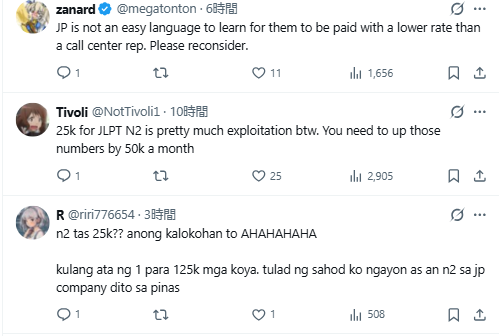
Many online commenters echoed this sentiment, stating that it's not uncommon for N2-qualified professionals in the Philippines to command monthly salaries ranging from 50,000 to 100,000 PHP, suggesting Animate's offer warrants reconsideration.
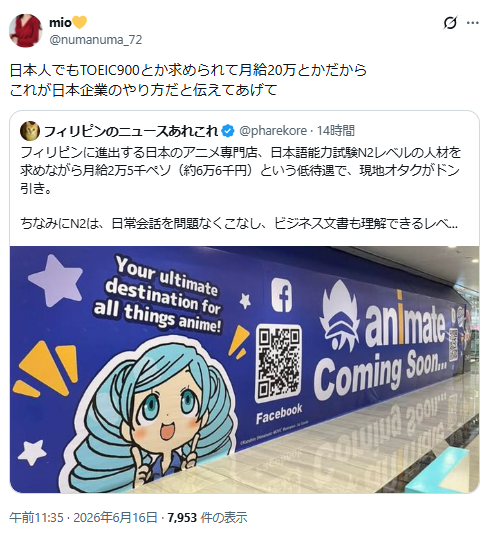
As the discussion spread to Japanese social media, some Japanese netizens highlighted a perceived pattern among Japanese companies: demanding high qualifications, such as a TOEIC score of 900+, yet offering monthly salaries as low as JPY 200,000. This practice, they noted, appears to have been extended to the Philippines.
Other commenters pointed out that even foreign workers in Japanese convenience stores are often required to have N2-level Japanese proficiency (roughly equivalent to Eiken Grade 2 in English proficiency), yet they receive low wages despite demanding requirements. This, they argued, contributes to the declining popularity of Japanese companies. 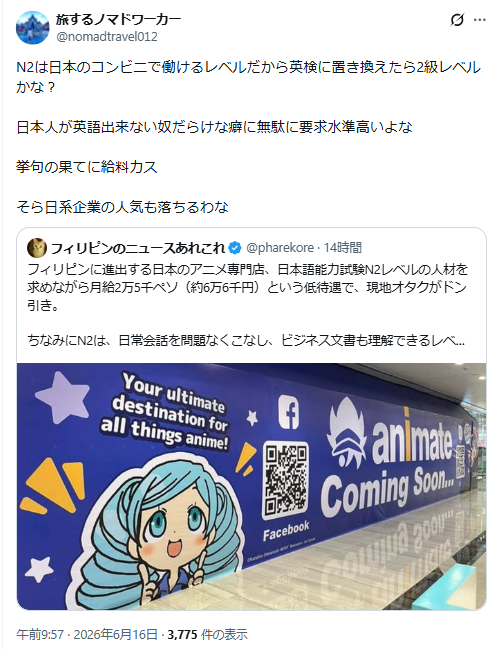
Conversely, some Japanese netizens argued that true business communication typically requires JLPT N1, and N2 might not be sufficient for the role. They speculated that the N2 requirement might be a tactic to justify a lower salary.

However, a segment of online users believes the criticism is overly harsh. Supporters highlighted that the offered salary still exceeds the Philippine statutory minimum wage, and the company provides benefits such as insurance and paid leave. Furthermore, some argued that "if it's an entry-level position, it shouldn't be directly compared to the salary standards for highly proficient Japanese speakers." Consequently, opinions remain divided on whether the compensation is genuinely too low.
Notably, Animate's job posting did not explicitly emphasize salary competitiveness, instead focusing on job responsibilities and employee benefits. This controversy has prompted a broader discussion: are Japanese companies expanding overseas still applying domestic Japanese salary and employment mindsets to local markets, leading to a significant perception gap?
Particularly in Southeast Asia, demand for Japanese-speaking talent has steadily increased in recent years, driving up salary expectations. When companies demand high language proficiency and specialized knowledge but fail to offer commensurate compensation, it naturally sparks contention.