

If you've ever gone treasure hunting for Japanese goods online, you're probably familiar with the secondhand marketplace Mercari.
But recently, Japanese users stumbled upon something truly bizarre: a slew of everyday items—including manga, magazines, old books, and even Wi-Fi routers—listed for a staggering 1.05 million yen, all marked as "SOLD." Since these items were clearly not worth anywhere near ¥1.05 million, screenshots of the listings quickly went viral on X, sparking a heated debate. While many immediately jumped to "money laundering," others suggested the issue might be a simple quirk in the platform's inventory system.
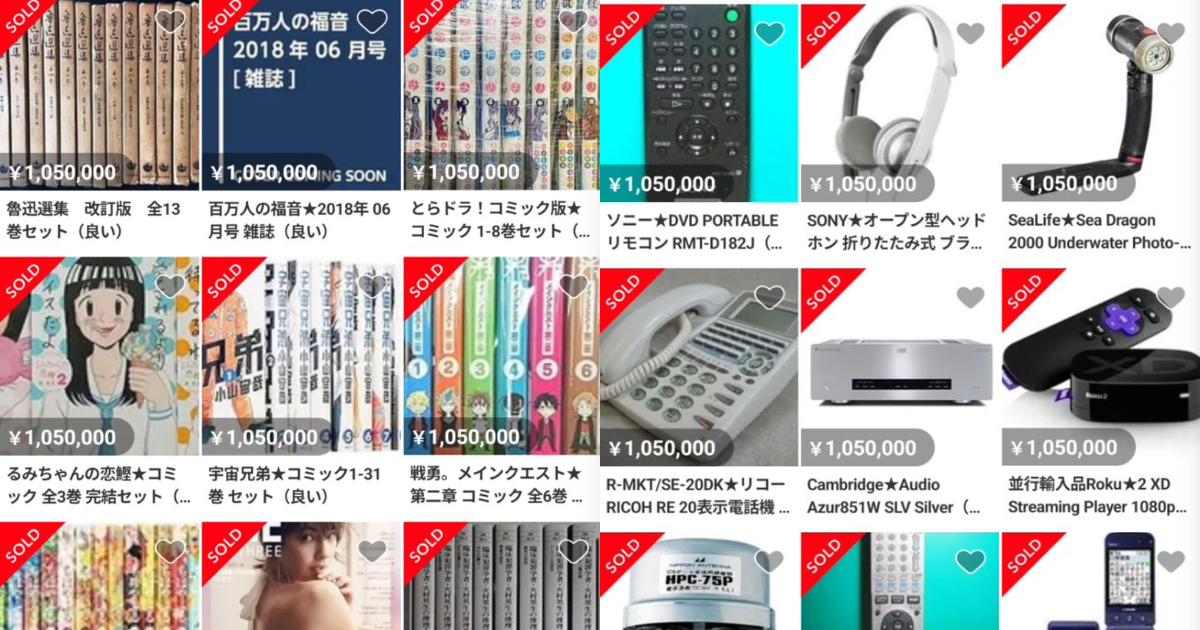
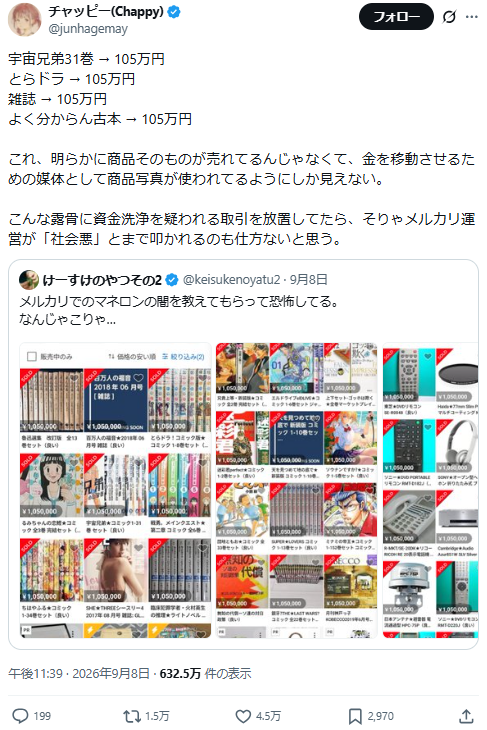
The whole thing kicked off when a user on X posted screenshots, expressing fear after hearing about potential money laundering schemes on Mercari and asking, "What on earth is this?"
The items in question included single volumes like Space Brothers Vol. 31, Toradora!, a magazine, and an assortment of old books—all with a price tag of 1.05 million yen and a "SOLD" banner. This immediately set off alarm bells for countless netizens.
Many felt that no one would genuinely pay 1.05 million yen for these products, speculating that "the product photos are just being used as a vehicle to move money."
The theories started flying, with users drawing parallels to credit card cash-out schemes and money laundering operations seen on tipping platforms. Some even pointed out that the 1.05 million yen figure is suspiciously close to Japan's 1.1 million yen gift tax exemption threshold.
However, it's important to note that these are all just user-generated theories, with no concrete evidence to prove any money laundering activity.
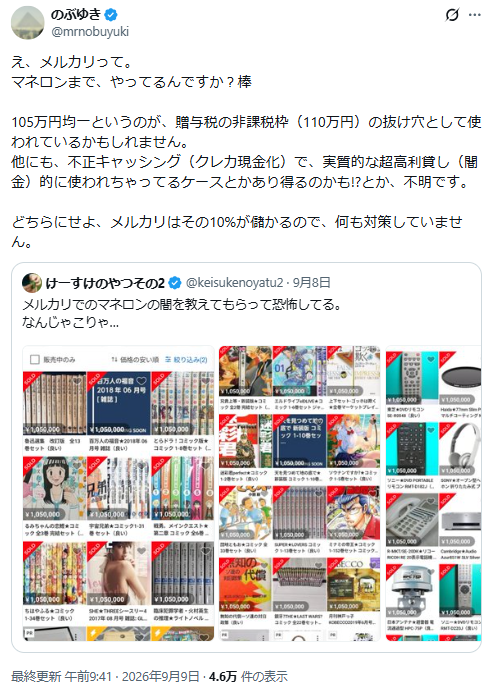
As the discussion raged on, users familiar with Mercari's system stepped in to offer a less sinister explanation, suggesting it could all be a major misunderstanding. According to them, on Mercari, if a seller sets an item's stock quantity to 0, the listing page may automatically display "SOLD." In other words, seeing "SOLD" doesn't necessarily mean the item actually sold at the listed price.
For example, a used bookstore might list the same book on Mercari and sell it in their physical store. To prevent it from being sold twice, the seller would set the Mercari stock to 0. The problem is, if the seller first inflates the price to 1.05 million yen and *then* sets the stock to 0, the listing will appear as "1.05 million yen, SOLD." To an outsider, it looks exactly like an incredibly high-priced sale just went through.
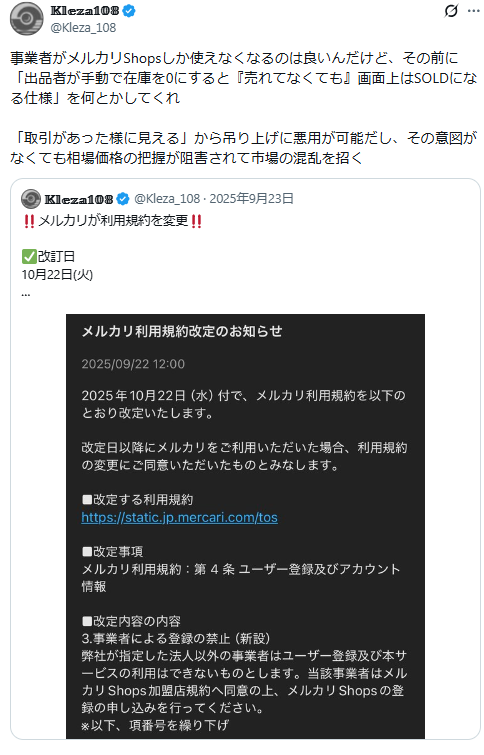
"It doesn't mean it actually sold for 1.05 million yen," one user clarified. Others suggested this was simply the messy result of sellers cross-listing products on multiple platforms.
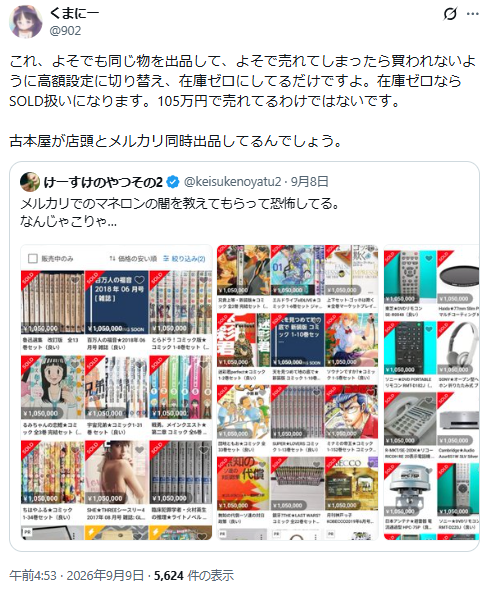
But the mystery wasn't over yet. Some users dug deeper and found a troubling pattern: different shops appeared to be using the exact same product photos for their 1.05 million yen listings.
This revived the darker theories. "Since different shops are using the same images to 'sell' items, it's highly likely to be a sham transaction for money laundering," one user concluded. However, there is still no definitive proof of fake trades, and the "SOLD" display itself is now being criticized as inherently misleading.

Experienced Mercari users argue that the platform's own display logic might be the real problem. Since sellers can manually trigger a "SOLD" status by setting stock to zero—even when no transaction has occurred—it's incredibly easy for onlookers to be misled.
Beyond just causing confusion, this mechanism could be exploited to manipulate market prices. For example, a seller could take an item that typically sells for a few thousand or tens of thousands of yen, create a fake high-priced listing, mark it as "SOLD," and trick people into believing the item's market value has skyrocketed. Over time, this could seriously distort consumers' perception of what an item is actually worth.
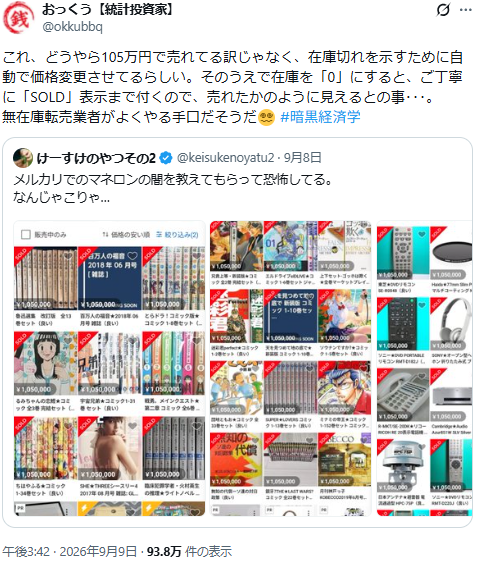
For now, the "1.05 million yen SOLD" phenomenon remains a hot topic on X. The bizarre combination immediately led many to suspect money laundering or fake trades. At the same time, Mercari veterans insist that the platform's own "zero-stock-equals-SOLD" feature is a more likely cause for the confusion.
This whole saga has served as a crucial reminder: when an e-commerce platform's "SOLD" tag doesn't necessarily mean an item was sold at that price, consumers need to be more critical and aware of the real story behind online transaction data.