

An X user in Japan who runs a steakhouse and collects Pokémon cards said that he had repeatedly offered large numbers of cards to children of middle-school age and younger for free, allowing each child to choose up to three cards. Seeing how happy the children were to receive them encouraged him to continue holding the giveaway.
Recently, however, he encountered a growing number of parents who searched through the cards for ones that “could be sold for money,” sometimes directly in front of their children. One adult even asked, “This one is worth money, so can I take it?” Exhausted by these encounters, the organizer ultimately decided to end the free giveaway. His experience resonated with many players and quickly drew attention online.
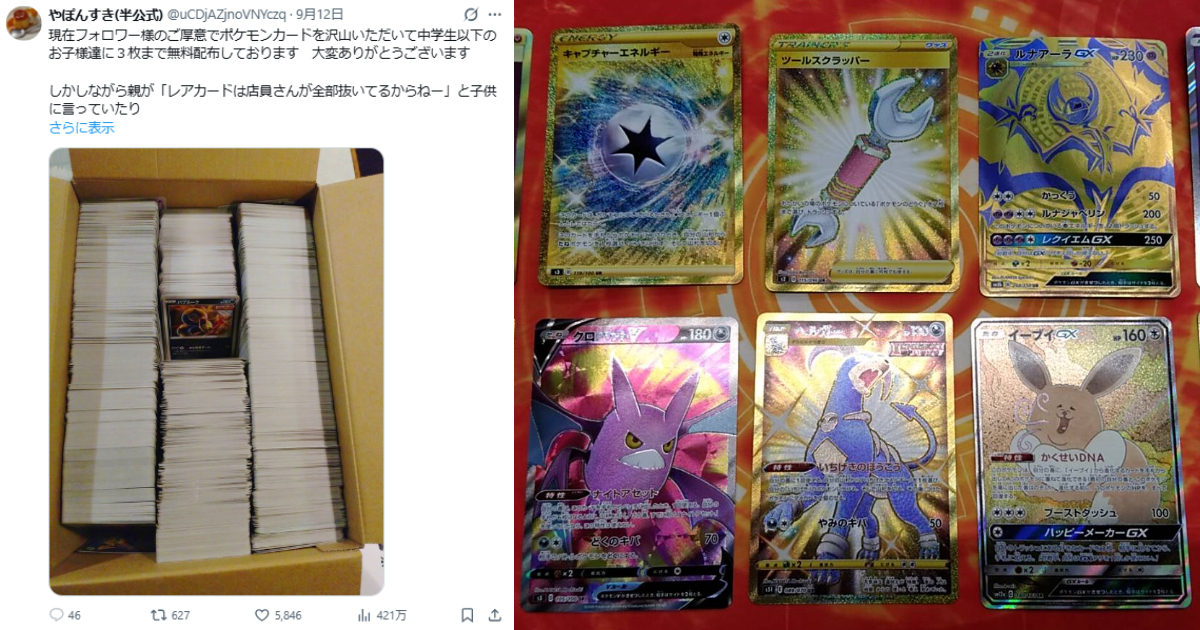
According to the organizer, he had received a large collection of Pokémon cards through the generosity of his followers and had been offering them for free at the steakhouse he runs to children of middle-school age and younger. Each child could choose up to three cards. He stressed that rare cards were included and regularly replenished, contrary to claims that “the staff had already removed all the rare cards.”
During the giveaway, however, he witnessed behavior from some parents that left him stunned. Some told their children, “The staff have already taken out all the rare cards,” while others searched for cards that appeared to be valuable and said, “This one is worth money.” They would pretend to select the card for their child, only to keep it for themselves.
What finally pushed the organizer to end the giveaway was an adult asking him directly, “This one is worth money, so can I take it?” He also saw parents happily using Google Lens to check card prices while telling their children, “This one is worth money!” After repeatedly witnessing such behavior, he wrote, “I’m ending the free giveaway. I’m tired.”
He reiterated that the giveaway had always been “for the children”—not for adults and certainly not for people looking for cards to resell. He warned that if people continued taking cards with resale in mind, he would no longer be able to include rare cards among those being given away.
The incident prompted widespread discussion on X. Some users noted that Pokémon cards are now enjoyed across multiple generations, so their collectability and market value are hardly surprising. Even so, they argued that adults should not bring up how much a card could be sold for when someone is offering it to children out of goodwill.
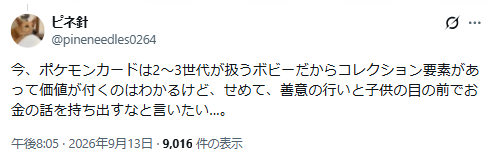
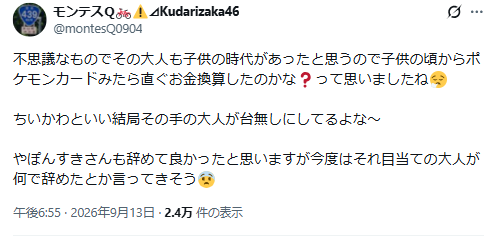
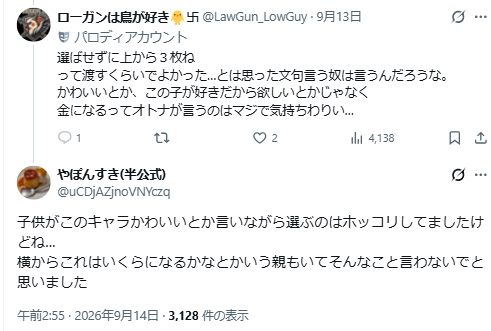
Others suggested handing each child the top three cards from the pile instead of letting them choose, which might have prevented adults from deliberately searching for higher-value cards.
The organizer responded that watching children choose their favorite cards while saying things like “This character is cute” had originally been a heartwarming part of the giveaway. However, some parents would stand beside them and ask how much a particular card could be sold for, turning what should have been a pleasant moment into a disheartening one.
One user lamented what they saw as a decline in public manners in Japan. The organizer nevertheless emphasized that the “overwhelming majority of children” were genuinely delighted to receive the cards.
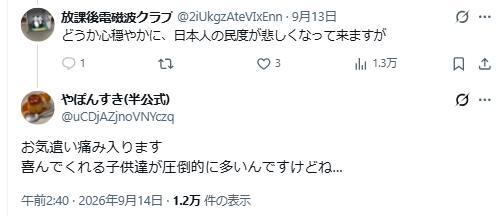
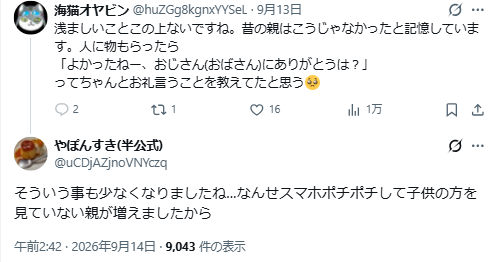
Another user argued that when a child receives something from another person, a parent should teach them to express gratitude by saying something like, “That’s great—now remember to say thank you.” The focus should not immediately shift to how much the card might be worth. The organizer agreed, lamenting that this kind of guidance seemed less common today and that some parents were too occupied with their phones to pay attention to their own children.
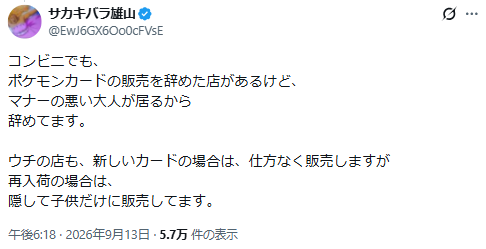
One commenter also shared their experience working at a convenience store, saying that some stores had stopped selling Pokémon cards because of the behavior and poor manners of certain adult customers. At their store, newly released cards were still sold as usual, but restocked packs were kept out of sight and sold only to children.
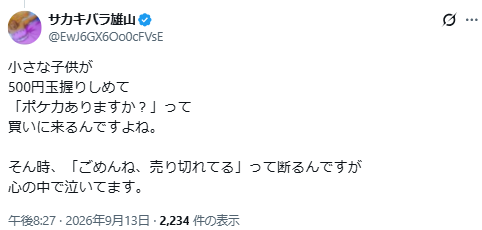
The commenter added, “Small children come in clutching a 500-yen coin and ask, ‘Do you have any Pokémon cards?’ When I have to tell them, ‘Sorry, we’re sold out,’ I’m crying inside.” The story left many users saddened, with some arguing that products meant to let children enjoy collecting and playing have become harder for them to obtain because of stockpiling, resale and profit-driven behavior by some adults.
The incident has once again fueled discussion about the Pokémon card market. There is nothing inherently wrong with collectible cards having market value. However, treating cards purely as products for profit—and potentially reselling them—during a free giveaway created specifically to make children happy clearly goes against the organizer’s original intentions.
As the popularity and profitability of Pokémon cards continue to grow, it is disheartening to see an act of generosity end by leaving the person behind it exhausted and discouraged.