

When it comes to different languages, even the simplest words or particles can create wildly different impressions depending on tone, pitch, and cultural norms.
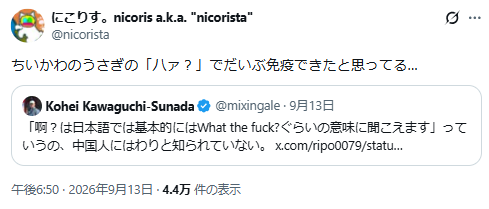
A recent discussion on X in Japan has been digging into why some Japanese people find native Chinese speakers to sound "a little scary." Some users believe the issue might boil down to two very common Chinese expressions: "Ah?" and "Huh?"

The user who sparked the conversation, @ripo0079, posted on X that they believe "Ah?" is responsible for 95% of the reason why Japanese people say, "I don't know why, but Chinese speakers sound a little scary."
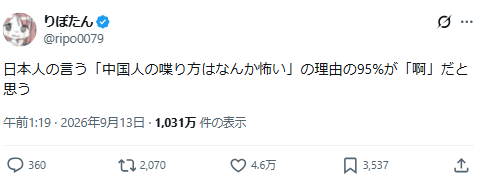
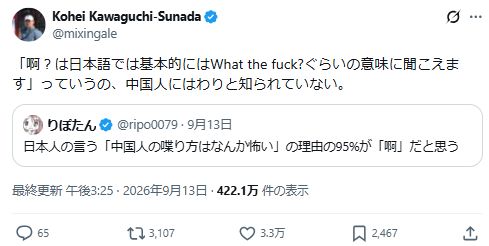
The post quickly ignited a discussion. Another user from Hong Kong explained that in a Chinese context, "Ah?" is usually just a casual way to ask a question again or indicate that you didn't hear something. But from a Japanese linguistic perspective, it can easily sound like a very aggressive "What the fuck?"
They pointed out that most Chinese speakers are unaware of this difference in perception, leading to situations where no offense is intended, yet one party is left feeling suddenly tense.
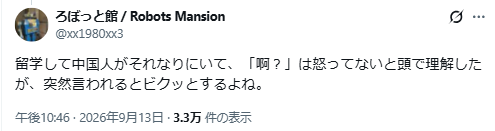
Many Japanese users chimed in, saying they "totally get it." One person shared that during their time studying abroad, they were surrounded by many Chinese speakers. Even though they knew "Ah?" didn't mean the person was angry, their body would still instinctively jump if someone said it loudly and suddenly.
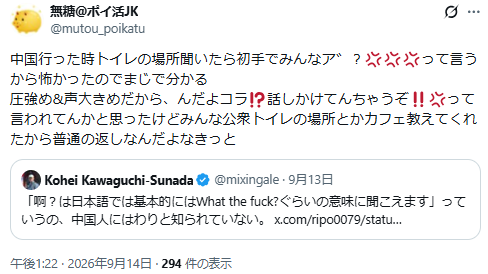
Another user recalled asking for the restroom while traveling in China. The person they asked responded with a sharp "Ah?!," making the traveler initially think they were being challenged with a "What's your problem?"
However, the person immediately followed up by calmly giving directions to both a public restroom and a nearby coffee shop. This made the traveler realize that the person was simply asking "What?" in a completely normal way.
Of course, this isn't limited to mainland China. Users noted similar experiences in Taiwan. For Chinese-speaking countries, "Ah" and "Huh" are common conversational particles, but in Japanese, they carry a distinctly unfriendly vibe.
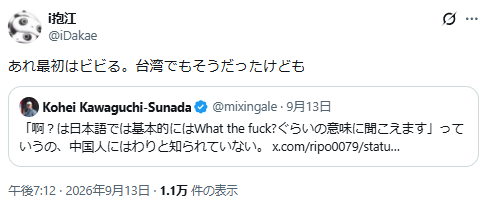
Another user described the Chinese "Ah?" as being similar to the Japanese "Eh?," which itself carries no particular hostility. The problem lies in the different tonal habits of the two languages.

In modern Japanese, "Ha?" and "A?" often carry strong connotations like "What did you just say?" or "Are you picking a fight with me?" Because of this, when Japanese people hear the Chinese "Ah?," their emotional response might be to wonder, "Are they angry?" even if they logically know no harm is meant.
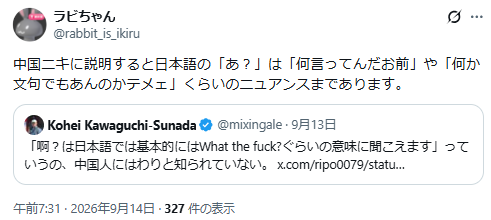
Interestingly, the discussion also drew in many Chinese speakers. After reading the explanations, some replied with a simple "Ah?," while others commented in Chinese, "Ah? So that's how it is," demonstrating that many were genuinely unaware their common utterance could be interpreted so differently.

On the other hand, some Chinese users explained that "Ah" is often used to express surprise, not anger, and provided examples to illustrate the intended tone.
This led some Japanese users to have a "so that's how it is" moment, recognizing it as a classic example of a tonal gap in cross-lingual communication.

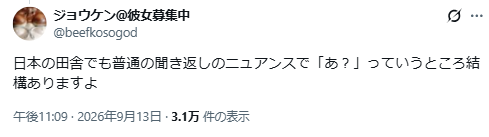
Fascinatingly, the conversation also revealed that the same misunderstanding can happen within Japan itself due to regional dialects. One Japanese user pointed out that in some rural areas, "A?" is the standard way to say "What?" or "What did you say?".
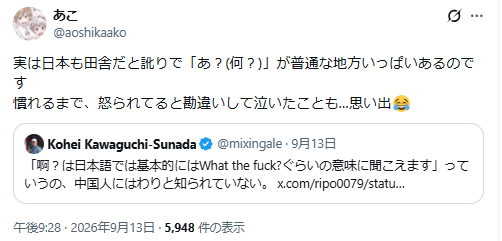
Someone else recalled being unfamiliar with a local dialect as a child and misinterpreting an elder's "A?" as a scolding, which even brought them to tears. Other users mentioned that similar tonal patterns exist in the Tohoku region, the Tsugaru dialect, and the Nagoya area.
Additionally, some brought up Usagi from *Chiikawa*, who frequently lets out a "Huh?"-style cry, joking that they might have developed a sort of "immunity" to this kind of aggressive-sounding question after watching so much of the character.
This whole exchange has made many users realize that the "meaning" of language and how it "sounds" are two different things.
This unexpectedly viral discussion has become a fun case study in cross-cultural communication. Sometimes, the reason you think "Why is that person talking so aggressively?" isn't because they're actually angry, but simply because your two cultures interpret the exact same sound in completely different ways.