

The Computer Entertainment Supplier's Association (CESA) released its annual report, "CESA Game Industry Report 2026 Preview Edition," on September 17, analyzing the current state and market trends of the Japanese game industry.
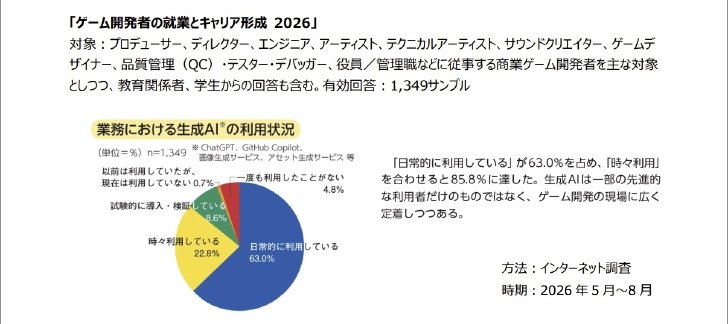
For the first time, this report includes an independent survey conducted by CESA on the use of generative AI within the industry. The results show that 85.8% of game developers are already using generative AI in their work. The report's analysis states: "Generative AI is no longer just a tool adopted by a few advanced users; it is rapidly becoming widespread in game development."
In addition to over 80% of game developers already using generative AI in their work, a significant proportion of respondents—63.0%—stated they "regularly use it," while 22.8% reported "occasionally using it."
CESA also surveyed its member companies, asking about their expected benefits from implementing generative AI. The most frequently chosen answer was "improving work efficiency and productivity," selected by 38 companies. This was followed by "reducing development time" (30 companies) and "lowering development and operational costs" (29 companies).
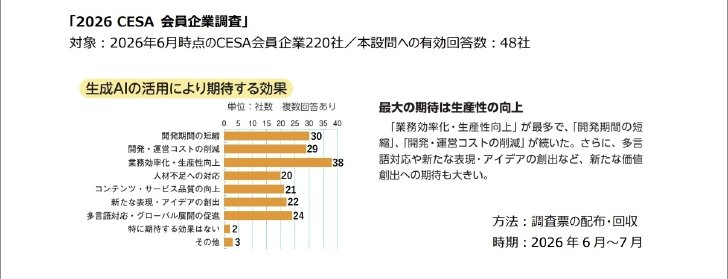
Furthermore, many companies anticipate that generative AI will bring new value beyond just efficiency improvements, including "multi-language support and promoting global market expansion" and "creating new forms of expression and ideas." In other words, the industry's expectations for generative AI extend beyond saving time and reducing costs; they also include assisting in overseas market expansion and generating new, previously difficult-to-achieve creative ideas and expressions.
The "AI / Generative AI Initiatives" page also revealed other survey findings. Approximately 70% of companies, including those still in the proof-of-concept phase, have already adopted AI technologies other than generative AI, an increase from about 50% in the previous year.
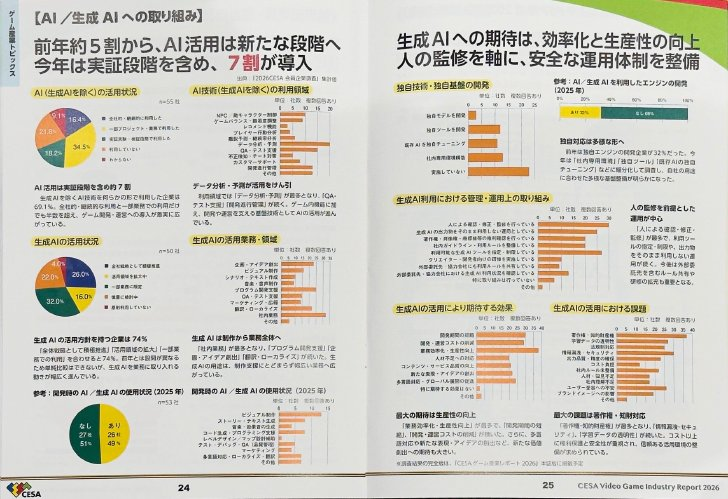
Regarding the management and operational measures for generative AI, the most common response from companies was "human verification, modification, and review." On the other hand, "copyright and intellectual property rights" ranked as the top challenge faced when using generative AI.
This indicates that while the application of generative AI continues to expand within the game development industry, companies still need to address issues related to copyright and intellectual property rights, as well as the importance of human verification and review, during practical implementation.