

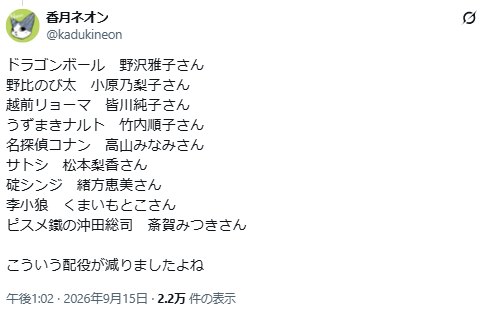
Female voice actors playing young boys has long been common in Japanese anime, with famous examples including Goku in Dragon Ball, Naruto Uzumaki in Naruto, and Conan Edogawa in Detective Conan.
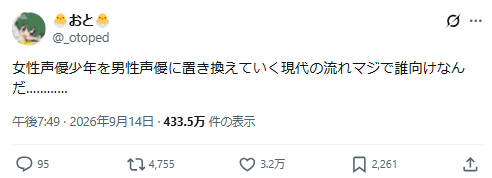
Recently, however, a post on Japan’s X drew attention to the growing number of boy characters being voiced by male actors, sparking an online debate over whether female actors are getting fewer opportunities to voice young boys.

The X user behind the discussion questioned the apparent trend of recasting boy characters previously played by women with male voice actors, bluntly asking, “Who is this even supposed to be for...?”
The post quickly attracted a wide range of opinions, with the conversation expanding beyond vocal styles to casting decisions, marketing strategies for female-oriented titles, and the commercial considerations behind in-person events.
Many users argued that boys voiced by women have a distinctive charm. This is especially true for characters who have yet to go through puberty, as female voice actors can often deliver a blend of youthfulness, cuteness, and coolness that cannot be replicated simply by raising the pitch.
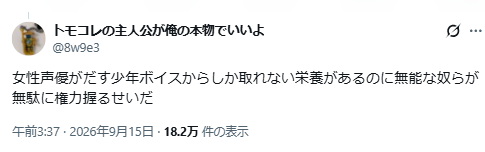
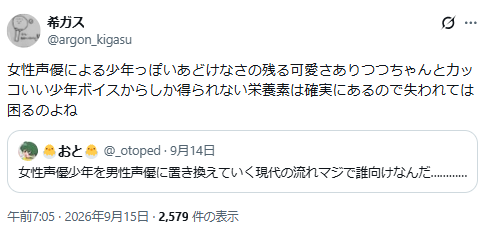
Some users said female voice actors bring a particular quality to young male characters, allowing even the coolest boys to retain a sense of immaturity. Others argued that no matter how much adult male voice actors adjust their delivery, the underlying vocal quality of a grown man can sometimes still be heard.
The discussion also highlighted several classic performances, including Masako Nozawa as Goku in Dragon Ball, Junko Takeuchi as Naruto Uzumaki in Naruto, and Minami Takayama as Conan Edogawa in Detective Conan. For many viewers, female actors voicing young male heroes have become an inseparable part of their shared anime memories.
Others saw no issue with male voice actors playing young boys. Some argued that the shift simply reflects a growing number of male performers capable of delivering convincing youthful voices, creating a wider range of options. Others noted that since the characters themselves are male, casting male voice actors is hardly inappropriate.
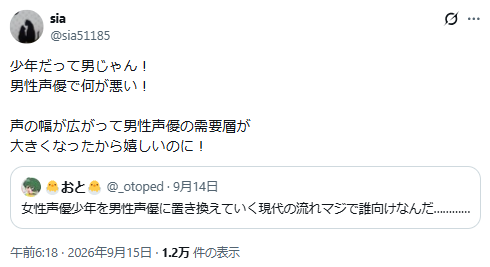
Some users also argued that casting should not be judged by gender alone. After all, real-life boys and girls do not necessarily sound like their typical anime counterparts. In the end, the choice comes down to personal preference and how well the voice fits the character.
Meanwhile, some viewers questioned the practice of having female voice actors continue playing male characters well into adulthood. They argued that a character’s voice should naturally change as he grows up and goes through puberty, pointing to Goku in Dragon Ball and Monkey D. Luffy in ONE PIECE as examples.
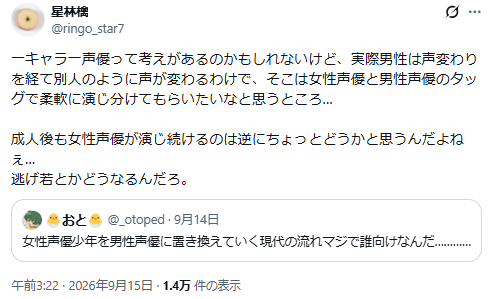
Beyond vocal performance, some users focused on the business model of the voice-acting industry.
Some speculated that casting male voice actors as young boys may be tied to the female-oriented market and in-person voice actor events. For fans who buy merchandise or attend live events, the performer’s gender and public image may also influence purchasing decisions.
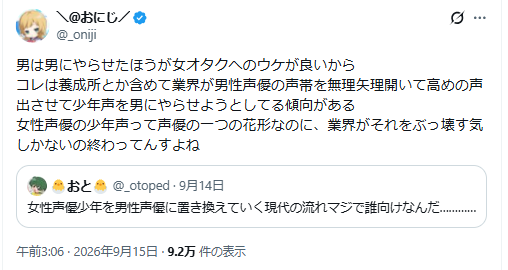
Related comments noted that some female-oriented titles hold cast meet-and-greets, stage shows, and other live events, while the promotion of male voice actors as idol-like personalities can also become part of a project’s marketing strategy. In such cases, casting male actors as the story’s young male characters may help keep the voice cast aligned with the lineup appearing at promotional events.
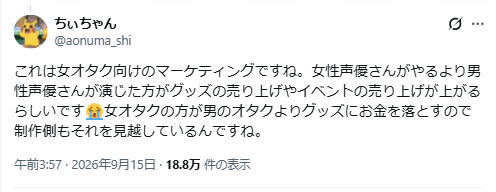
The debate among Japanese users also shows that audiences do not share a single expectation for how young male characters should sound. Some value the youthful quality and vocal tone female actors bring to these roles, while others prefer boys voiced by men or believe male actors should take over once the characters grow older.
From classic anime to more recent productions, there has never been just one approach to casting young male characters. A voice actor’s gender, the character’s age, the performance itself, and the needs of the production can all shape the viewing experience. If nothing else, the debate proves that what kind of voice best suits a young male character remains an enduring topic among anime fans.