

We've all been there—staring at a food item that's just past its expiration date, wondering if it's worth the risk. Most of us operate on the "a little bit over is probably fine" rule.
But one user on X in Japan took this to a whole new level. A user named "Bi" went viral after revealing he ate a bento box that was a full 17 hours past its use-by date. Instead of panicking, he launched into a rigorous (and hilarious) scientific defense, using chemistry, biology, and physics to argue that the bento wasn't *technically* expired. The mix of high-level nerdery and sheer recklessness had users praising his experimental spirit.
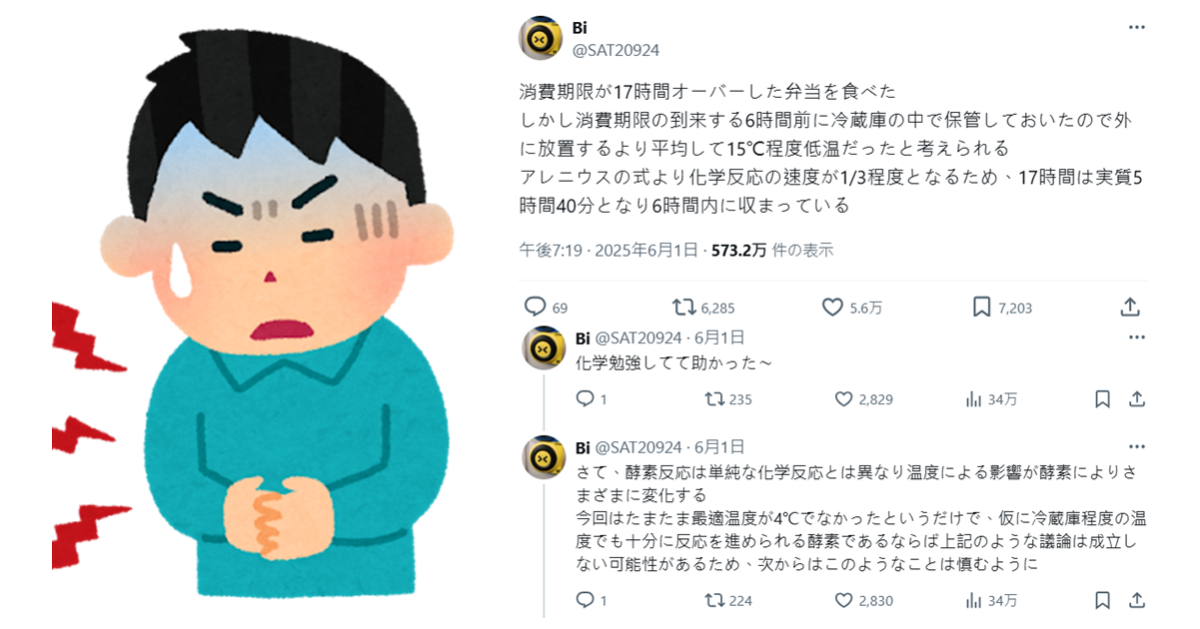
Here's how it went down. Bi explained that he had placed the bento—17 hours past its prime—into the refrigerator 6 hours *before* it was set to expire. He noted that the fridge's temperature was about 15°C lower than room temperature.
He then invoked the Arrhenius equation to calculate the decrease in the rate of reaction. "Chemical reactions slow down at lower temperatures, to about 1/3 of their normal speed. That means only 5 hours and 40 minutes have effectively passed, which is still within the 6-hour window!"
He followed up with a triumphant: "See? Studying chemistry really pays off. It's a huge help."
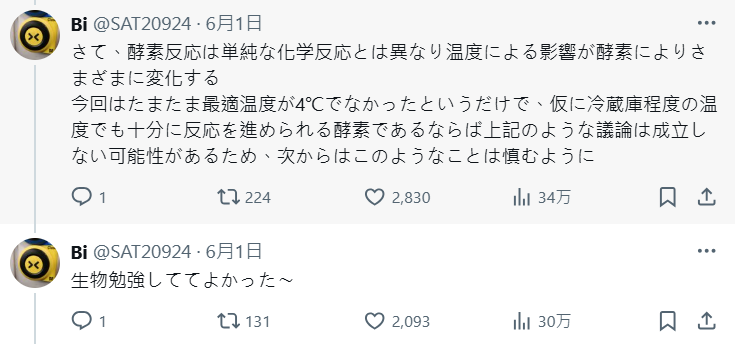
But Bi immediately began to challenge his own hypothesis. "However, enzyme reactions don't always follow simple chemical logic. Enzymes have their own optimal temperatures, and if the fridge's temperature also allows them to function, then my previous argument is invalid... I should be more careful next time."
He quickly added: "So glad I studied biology, too~"
He continued his internal debate: "Then again, if the enzyme reaction rate is similar in both cold and warm temperatures, the rate might be dominated by 'molecular collision frequency,' which brings us right back to the Arrhenius equation..."
And another pat on the back: "It's a good thing I studied both biology and chemistry~~~"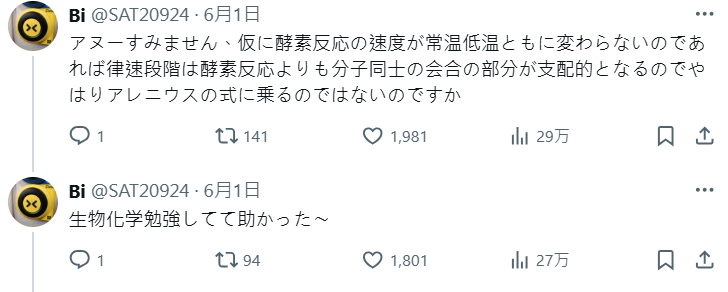
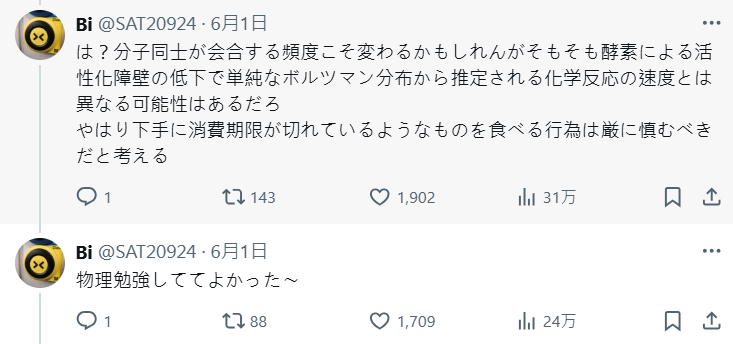
Digging deeper, he mused: "But then again, while molecular collision frequency changes, the way enzymes lower the activation energy barrier might mean the actual reaction rate differs from the theoretical one. Anyway, the main takeaway is you probably shouldn't eat expired food."
His final self-congratulatory remark: "Thank goodness I also studied physics."
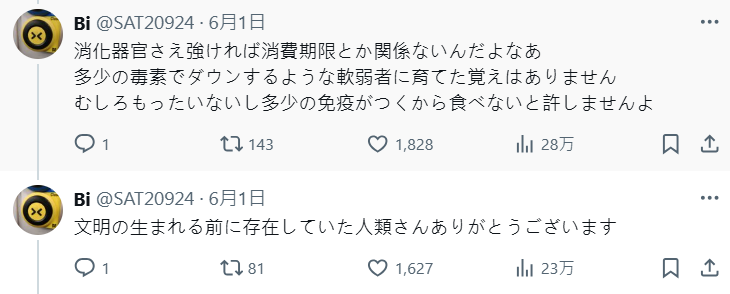
After a whirlwind of scientific self-owns, Bi threw logic to the wind and declared: "As long as your stomach is strong enough, use-by dates don't matter. Don't be one of those weaklings who gets sick after one bad bite! Eating this prevents waste and builds immunity. You have to eat it!"
He even gave a shout-out to our ancestors: "Thankful for the human instinct to eat things that existed long before civilization~"
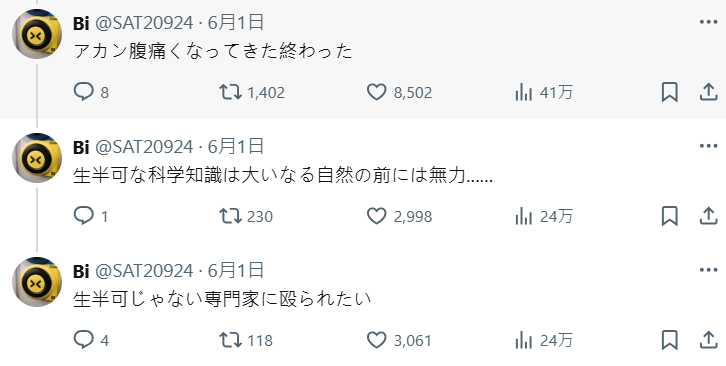
Less than 20 minutes later, Bi posted a grim update: "Oh no, my stomach is starting to hurt. I'm done for." He concluded with a moment of clarity: "Half-baked scientific knowledge is no match for nature... I really want a professional to come punch me right now." In the end, his intellectual victory lap was cut short by the raw power of an old bento.
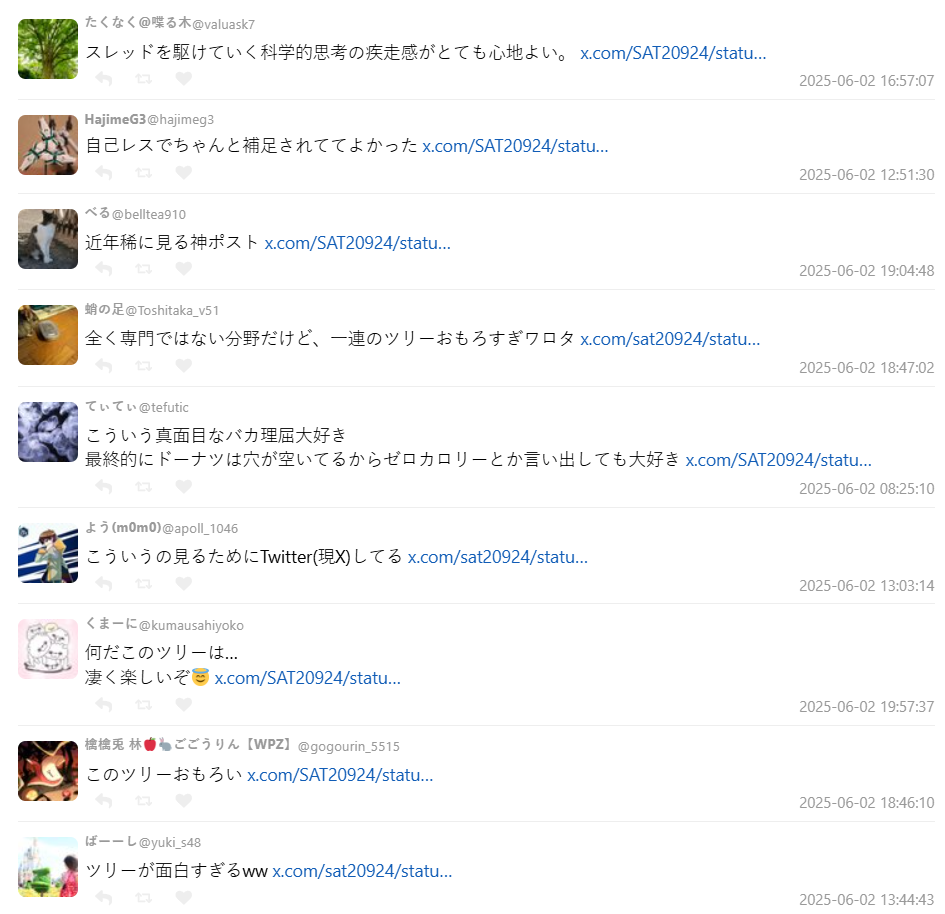
The thread, which read like a serialized scientific drama followed by a spectacular failure, left netizens in stitches. "I live for these kinds of seriously argued stupid theories," one user wrote. Another commented, "That whole train of thought was a wild scientific ride, so smooth and satisfying." Others chimed in: "This is exactly why I'm on X," and "He goes through all that science just to eat it based on willpower? What a plot twist."
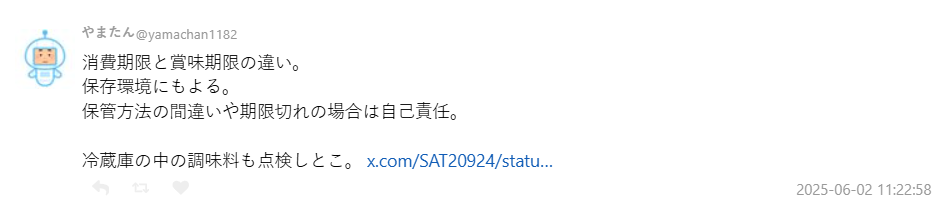
Of course, some offered more sensible advice: "The use-by date is a guarantee *under the specified storage conditions*. Don't test fate with your own body."
For those wondering, here's a quick PSA on Japanese expiration dates:
Use-by Date (消費期限): This indicates the final date the food is considered "safe to eat." It's typically used for fresh items like bento boxes and sandwiches.
Best-before Date (賞味期限): This is the recommended date for "optimal flavor and quality." The food isn't necessarily spoiled after this date, but the taste might decline.
Proper storage is key, of course. As for our hero's experimental approach, while it was certainly a questionable life choice, it undeniably made for some top-tier internet content. www
via: togetter