

When it comes to ACG characters, the "large bust" attribute has always been incredibly popular, and that holds true for both the two-dimensional and three-dimensional worlds. Of course, there's also a camp that prefers "small breasts," proving that all sizes have their devoted fans.
Recently, a tweet on Japan's X (formerly Twitter) about breast aesthetics unexpectedly blew up. When the original poster confidently declared, "Small breasts have never been popular in human history, not for a single second!" the comments section instantly transformed into an academic battlefield, flooded with historical facts and obscure trivia. It was like a history forum sprung to life, leaving many netizens absolutely stunned.

It all started with this X post discussing breast aesthetics. Amidst the "large vs. small" debate, one user dropped a bombshell, proclaiming: "In all of human history, small breasts have never, not for a single second, been socially accepted."
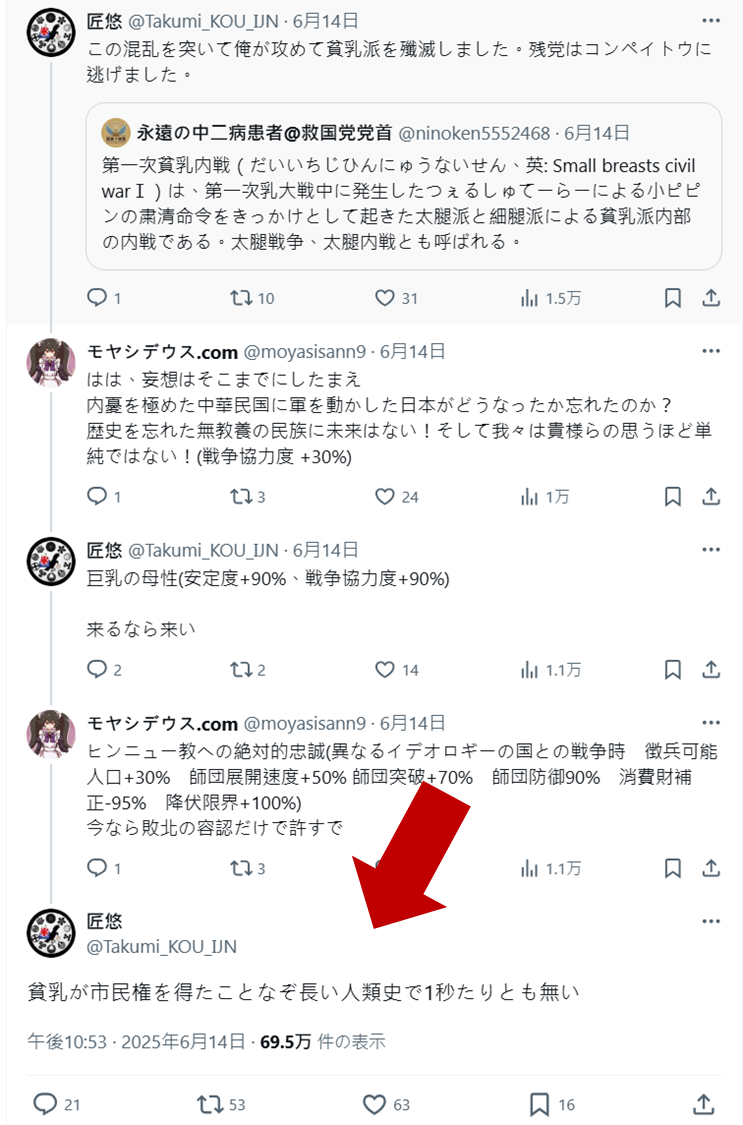
In response to this bold claim, another user, つぇるしゅてーらー (@TwitteeJapan), retweeted with a counter-argument:
They pointed out that in Japan's Edo period, a preference for smaller chests was actually quite prevalent, even more so than large busts. Citing the historical research book "Iro no Jiten" (Dictionary of Hues), they noted that society at the time generally believed women with smaller chests were more sensitive in romantic encounters. There was even a prejudice that "large breasts equal less intelligence." Consequently, many women would use a cloth called "nyu-nuno" (breast cloth) to flatten their chests, a practice that reportedly continued until the 1960s.
The user then expanded the scope to other parts of the world: In Medieval Europe (5th to 10th centuries), influenced by Christianity, prominent breasts were considered "immodest." This even led to the development of "corsets for binding," and cleavage was famously referred to as "the devil's hiding place." There's also a theory that people at the time would apply hemlock (a highly poisonous plant) to young girls' chests, hoping to prevent them from developing large breasts later in life.
Ancient China also represented a culture where "the flatter the chest, the more noble" the woman. Chest-binding garments like "moxiong," "dudou," and "xiaomajia" were all popular. During the Cultural Revolution, young women even self-imposed the flattening of their chests, emphasizing the suppression of female body lines.
Other netizens agreed with this perspective, noting that the Heian period in Japan was similar. Especially when wearing kimonos, smaller chests were less likely to strain the garment, allowing for a better fit that aligned with the aesthetic ideals of the time. Many women actually wished for smaller breasts.
One netizen jokingly added, "So the Edo period's small-bust culture really existed! It wasn't just made up for the manga 'Manyu Hiken-chō' (lol)."
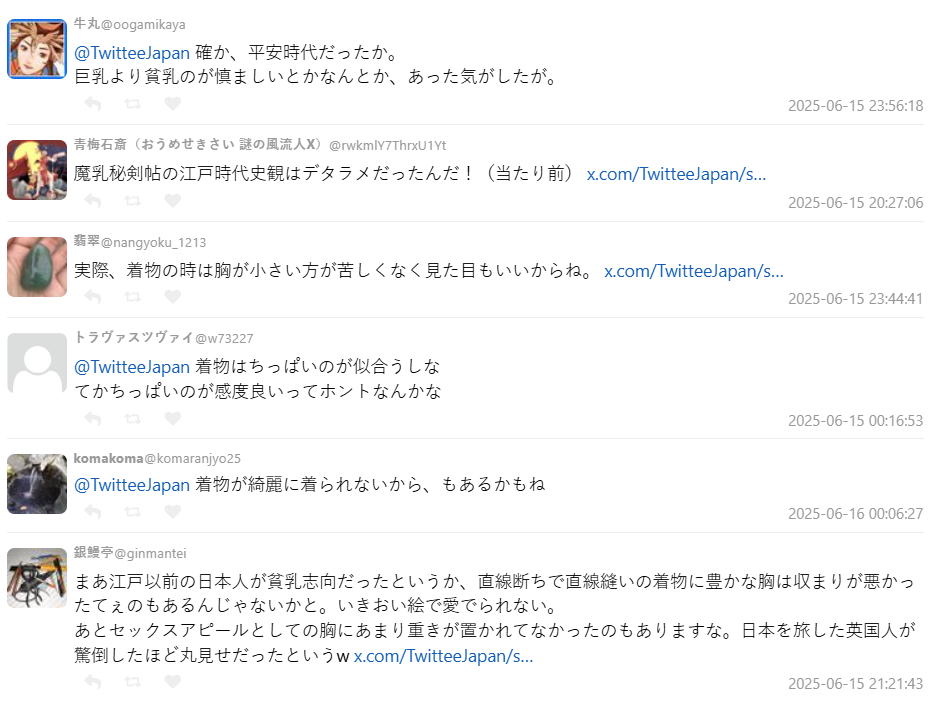
Many users were astonished that a simple discussion about breast size could unleash such a torrent of historical evidence from various countries, all to refute the claim that "small breasts have never been popular in history."
The comment thread wasn't just packed with incredible knowledge; it also featured plenty of witty remarks: "This is the first time I've seen someone write such a long historical analysis about breast size... I'm speechless," and "Cleavage as 'the devil's hiding place' – that phrase absolutely cracked me up, haha," and "It's insane how much historical knowledge people have about something like this."


Of course, whether you're a fan of "large breasts" or "small breasts," it's ultimately just a preference. But no matter your taste, be careful about making sweeping historical claims like "it's never been this way," because the internet always has a few research fiends just waiting to drop a history lesson on you! LOL.
via: togetter