Veteran illustrator and manga artist Hisashi Eguchi, a creative force since the late 1970s known for his manga and iconic album cover art, has been at the center of a major online controversy. Back in October, allegations surfaced that his illustrations for corporate and government clients involved the "unauthorized use" or "copying of others' photos," sparking a firestorm online that led the artist to admit to the issue.
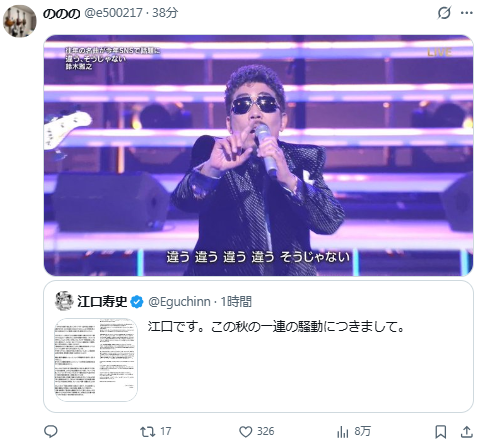
Today (December 30), Eguchi broke his silence on X (formerly Twitter), posting a lengthy statement to address the controversy and explain the full story.

After nearly three months, he began his post by stating:
"Regarding the social media chaos and commotion sparked by my own post on October 3rd this year. It has taken a significant amount of time to coordinate with all parties involved, and only now am I able to explain things in my own words. I am truly sorry for causing everyone to worry during this period."
Addressing the root of the incident, he explained: "While creating the poster for this fall's 'LUMINE Ogikubo Chuo Line Culture Festival,' I referenced a profile photo publicly posted on Instagram by Ms. Kyu Kanai without adequate consideration for her. Shortly after the poster was released, LUMINE was contacted by Ms. Kanai, and I immediately reached out to her via direct message to apologize. We have since reached a settlement through our lawyers."
He extended another apology to those affected: "I once again offer my deepest apologies to Ms. Kyu Kanai, LUMINE, the related staff, and everyone who was looking forward to the event for the trouble this has caused. At the same time, this incident has also cast a shadow on my past works, affecting related companies and individuals, and for that, I apologize as well."
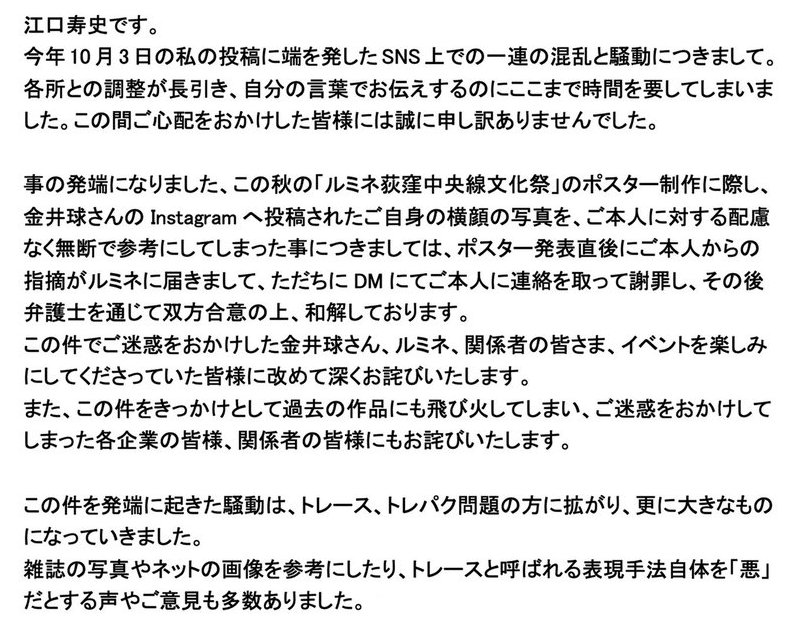
In the wake of the controversy, many online users pointed to long-standing accusations of Eguchi's use of "tracing." He addressed this head-on:
He noted that many online voices view "referencing magazine photos or online images" and "the technique of tracing itself" as inherently "evil," and he wanted to take the opportunity to share his own perspective on the matter.
"Tracing is a legitimate step in the drawing process," he emphasized. "It's not as simple as 'tracing = theft = bad,' nor is it a case of 'if you trace, it's automatically plagiarism.' For me, it's merely the very first step of a rough draft."
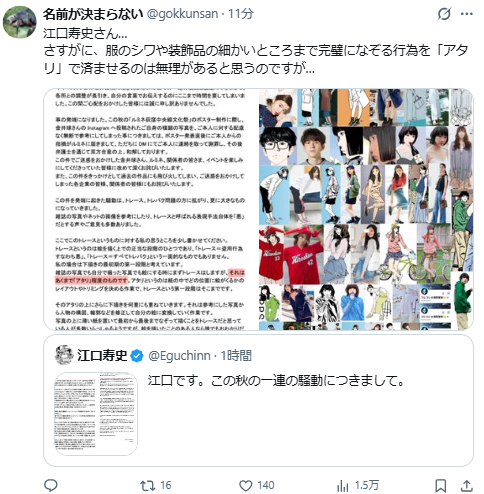
Eguchi explained that whether he's using a magazine photo or one he took himself, he often starts by tracing. However, he clarified that this is only to establish "atari" (positioning)—a rough guide to determine the composition, placement of the character on the page, and cropping. From there, he builds upon it with multiple drafts, refining the character's composition and silhouette to transform it into his own style. He also pointed out that many people assume tracing is simply "placing a thin sheet of paper over a photo and copying it line for line," but anyone who actually draws knows that this method could never result in one's own unique work.
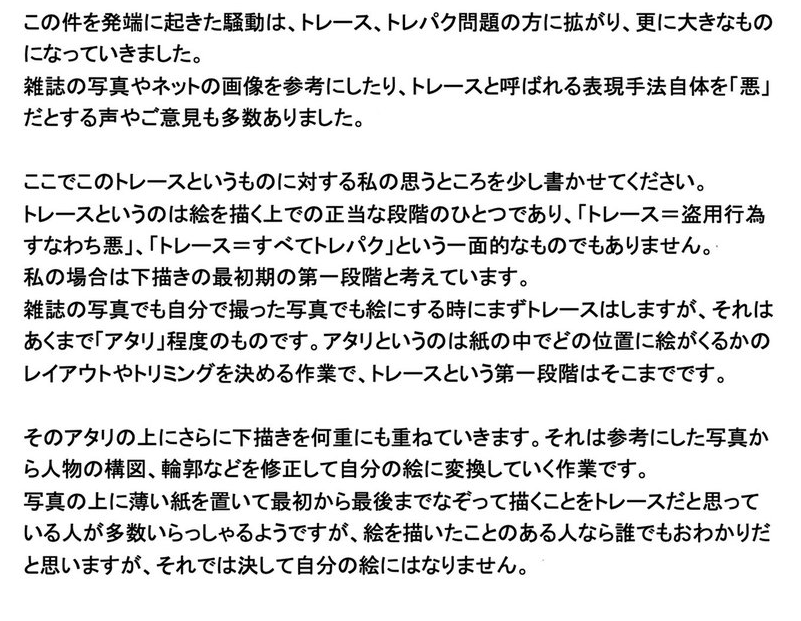
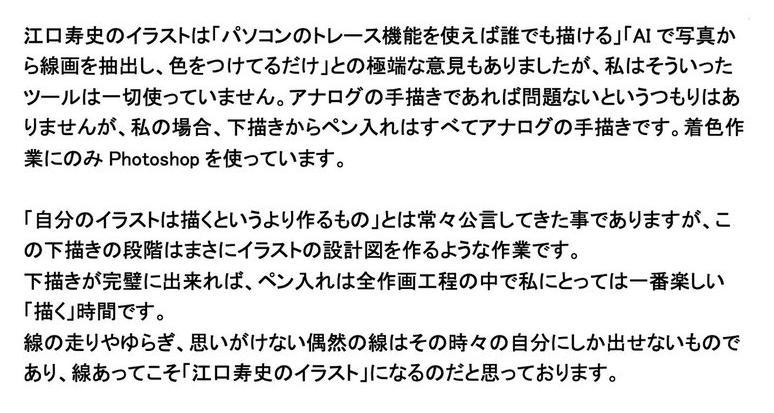
In response to online criticism like "anyone can do that with a computer's tracing function" or "he just uses AI to turn a photo into line art and then colors it," Eguchi denied using such tools. He added, "I'm not saying that drawing by hand automatically makes it okay, but in my case, everything from the rough draft to the final line art is done by hand. I only use Photoshop for coloring."
He reiterated his creative philosophy: "I've always said that my illustrations are more 'made' than 'drawn.' The drafting stage is like creating a blueprint. Once the draft is complete, the inking process is actually the part of the workflow I enjoy the most—the purest 'drawing' moment for me." He stressed that the flow, the slight wavers, and the accidental lines are unique to him in that moment, and it's these lines that make a piece "a Hisashi Eguchi illustration."
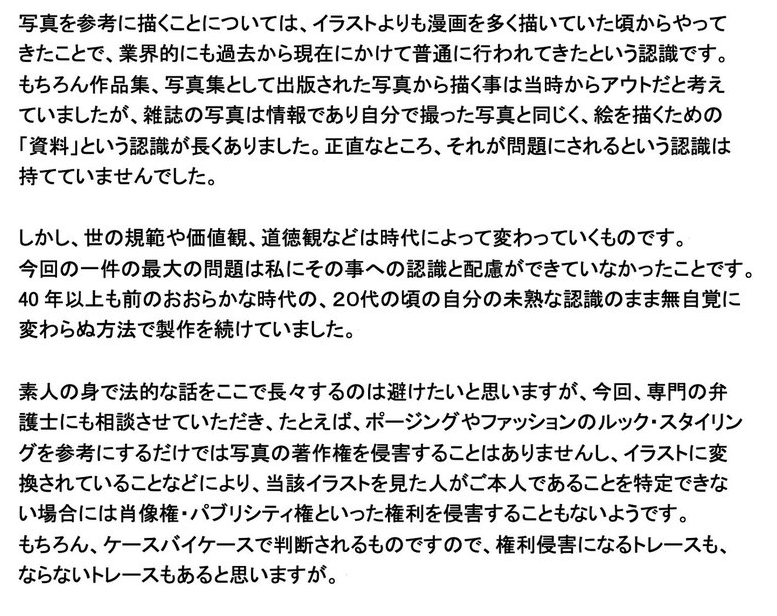
Regarding the practice of referencing photos, he stated that he has been doing it since his early days as a manga artist, and it has long been considered standard practice in the industry. However, he admitted that his understanding at the time was that "photos from published photo books couldn't be used, but magazine photos were considered information, just like photos I took myself—they were all reference material for drawing." He confessed that he honestly didn't realize this would become an issue.
"But social norms, values, and morals change with the times," he reflected. "The biggest problem in this incident was my failure to keep up with these changes. The times have long since changed, yet I was still creating with the same relatively lax mindset I had in my 20s, over 40 years ago, without any self-awareness."
On the legal front, he stated he is not an expert and wouldn't elaborate, but he did consult a lawyer. He mentioned that merely referencing a pose or clothing style doesn't necessarily constitute copyright infringement, and if an illustration is transformed to the point where a specific person is no longer identifiable, it may not infringe on portrait or publicity rights. However, he acknowledged that even if it's legally sound, the people in the reference photos are real. It's natural for them to feel uneasy or uncomfortable seeing a drawing that resembles them without their knowledge, and he admitted his consideration in this area was lacking.
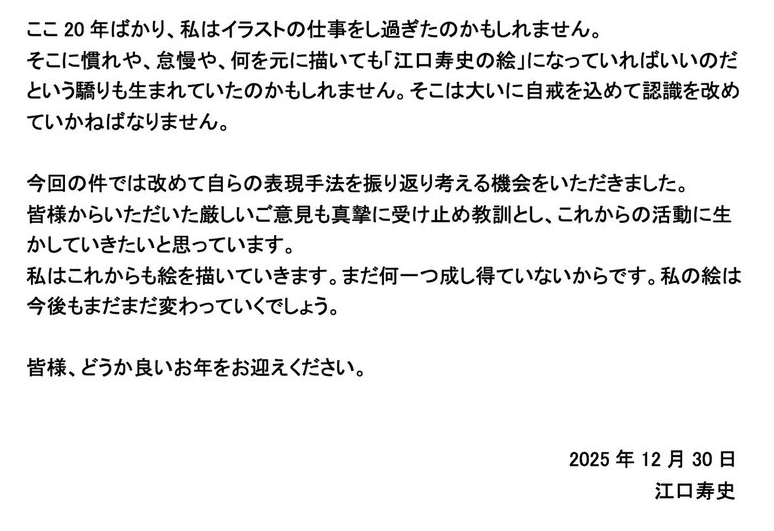
Looking back on his career over the past 20 years, Eguchi confessed, "Perhaps I took on too much illustration work, which led to habit, laziness, and even an arrogance of 'as long as it looks like a Hisashi Eguchi piece, it's fine.'" He stated that this is something he must deeply reflect on.
He concluded his message by writing: "This incident has forced me to re-examine my methods of expression. I will sincerely accept the harsh feedback I've received and use it as fuel for my future creations. I will continue to draw, because I haven't accomplished anything yet, and my art will surely continue to change."
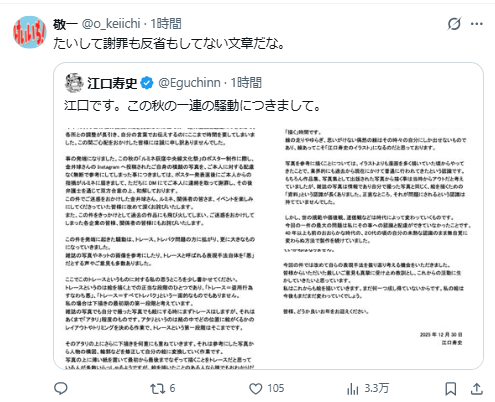
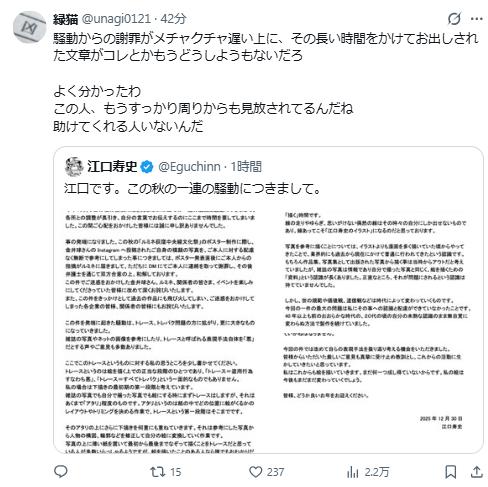
However, this lengthy explanation failed to win over many online users. Critics felt that Eguchi was sidestepping the core issues of "unauthorized use" and "copying photos," framing it all as part of a creative process. This perceived lack of accountability from a veteran illustrator has only fueled further dissatisfaction.
The backlash to his statement suggests that this incident may cause significant damage to Hisashi Eguchi's reputation in the industry, potentially reigniting the firestorm he had hoped to extinguish after months of silence.