

Tsuburaya Productions, renowned for the "Ultraman" series, announced on May 21 via a press release on its official website that it has won a lawsuit concerning the overseas usage rights of early "Ultraman" series works. The statement, titled "Regarding the Judgment of Victory in the Lawsuit for Confirmation of Non-Existence of Usage Rights for the '1976 Document'," confirms their success in the long-running legal battle.
The statement details that the "Lawsuit for Confirmation of Non-Existence of Usage Rights" filed by Tsuburaya Productions against UM Co., Ltd. (hereinafter referred to as UM) concerned the use of early "Ultraman" series works outside of Japan. The Tokyo District Court delivered its judgment on May 14, 2026, fully upholding Tsuburaya Productions' claims and ruling in their favor, thereby confirming the reclamation of overseas rights to these early works.

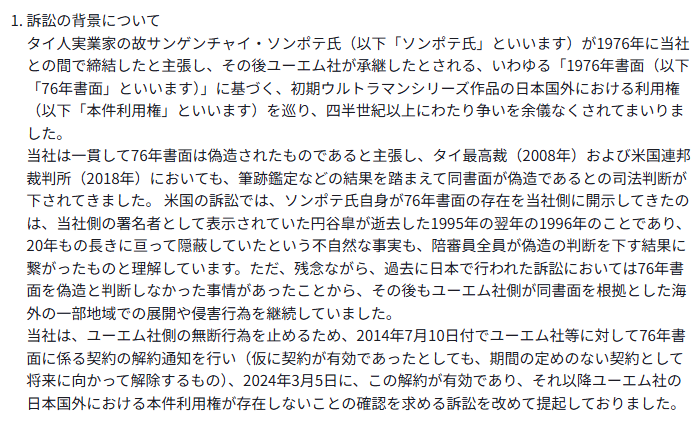
The background of this lawsuit dates back to a disputed document known as the "1976 Document (or '76 Document')." Tsuburaya stated that in late 1995, days after the passing of then-chairman Noboru Tsuburaya, Thai director Somphot Saengdueanchai claimed to have signed a contract with Tsuburaya in 1976. Saengdueanchai alleged that Noboru Tsuburaya had borrowed 200 million yen from him, and in return, demanded the indefinite transfer of global copyrights for nine "Ultraman" series works outside of Japan to Saengdueanchai.
After 2008, these global copyrights were purportedly transferred to the Japanese company UM. For decades, both parties have been embroiled in disputes over the overseas usage rights of early "Ultraman" series works. However, Tsuburaya Productions has consistently maintained that the "'76 Document is a forgery." Indeed, both the Supreme Court of Thailand in 2008 and a U.S. Federal Court in 2018 previously ruled the document to be a forgery, based on evidence such as handwriting analysis.
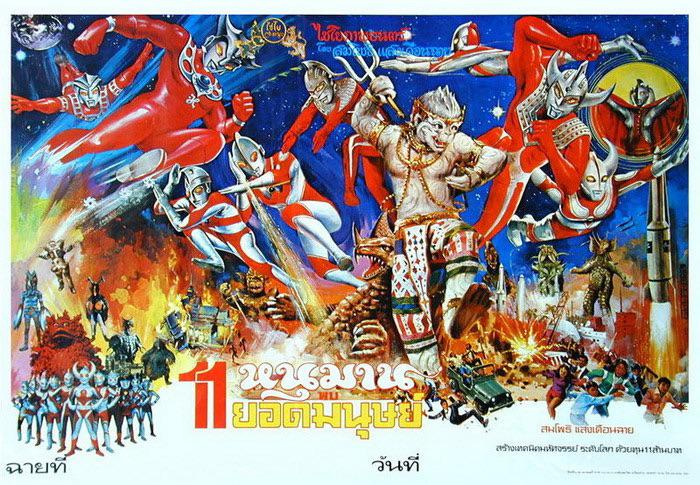
(Note: Somphot Saengdueanchai directed the 1974 "Ultraman" film "The 6 Ultra Brothers vs. the Monster Army," a collaboration between Tsuburaya and Thailand.)
▼ The 1974 "Ultraman" film "The 6 Ultra Brothers vs. the Monster Army," a collaboration between Tsuburaya and Thailand.
Tsuburaya further explained that during the U.S. litigation, Saengdueanchai himself only disclosed the existence of the "'76 Document" to Tsuburaya in 1996 – the year after Noboru Tsuburaya, the purported Tsuburaya signatory on the document, had passed away. The court found the document's concealment for over 20 years to be highly unnatural, a key factor in the jury's unanimous decision that the document was a forgery.
However, because some past lawsuits in Japan did not rule the document a forgery, UM continued to conduct related business activities and alleged infringement in certain overseas regions based on this document.
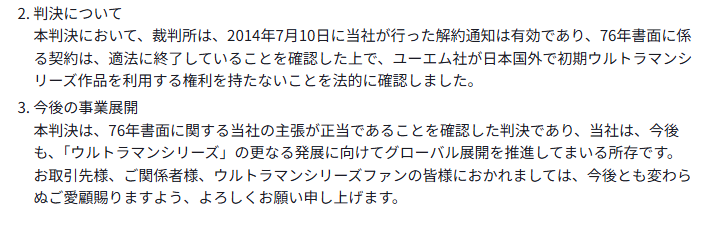
This overseas copyright dispute has dragged on for decades. The latest court ruling officially recognized that the termination notice issued by Tsuburaya in 2014 was valid, and that the contract related to the "'76 Document" has been legally terminated. Consequently, UM no longer possesses the rights to use early "Ultraman" series works outside of Japan.
The company also emphasized its commitment to continuing the global expansion of the "Ultraman" series. It extended gratitude to its partners, stakeholders, and all "Ultraman" fans, expressing hope for their continued support for the series in the future.
via: 円谷プロダクション