

Japanese media outlet Fuji News Network recently reported the arrest of a 32-year-old woman suspected of repeatedly placing and then canceling massive orders on publisher Shueisha's official online store. Over two years, the alleged value of these "phantom orders" reached a staggering 4.3 billion yen. Police apprehended her on charges of obstruction of business, citing severe disruption to the company's normal operations.
The news quickly sparked a frenzy on Japanese X (formerly Twitter), with many netizens expressing disbelief at the sheer volume of orders accumulated before her arrest. Commenters suggested that such an act was beyond the scope of an ordinary individual, leading to speculation that she might be a professional scalper or reseller.

The arrested woman, whose primary occupation is a restaurant employee, is accused by police of placing numerous product orders on Shueisha's official online store between 2024 and 2025, only to cancel them later. This forced employees to process a vast number of invalid orders, significantly impacting the company's regular business functions.
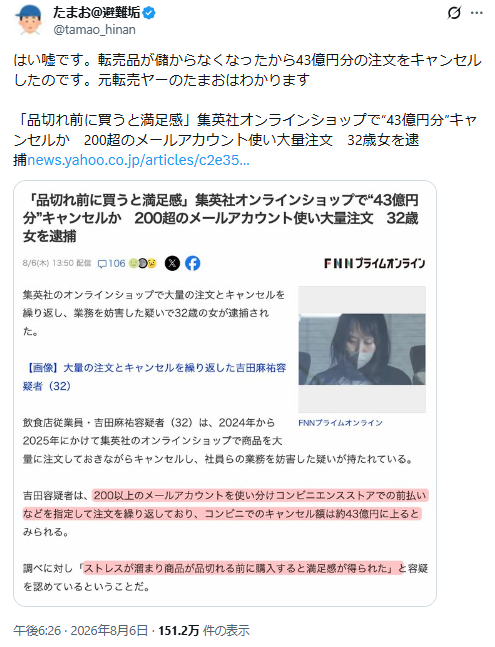
Investigations revealed that the suspect allegedly used over 200 email accounts and opted for convenience store pre-payment methods to repeatedly execute these large orders. Police estimate that the cumulative value of orders placed and then canceled via convenience store payments amounted to approximately 4.3 billion yen. During police questioning, she admitted to the charges, stating, "I was under a lot of stress, and I felt a sense of satisfaction just being able to secure items before they sold out."
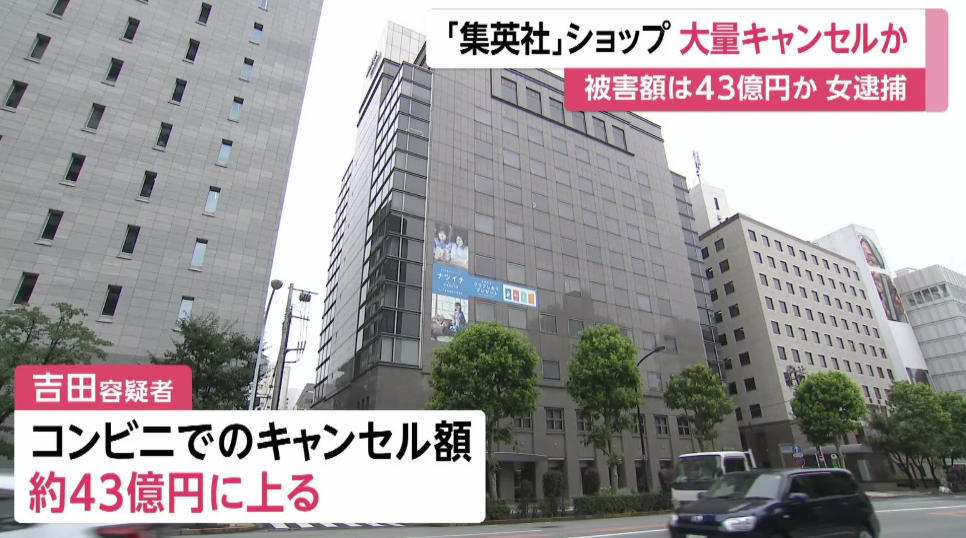
However, upon the news breaking, many netizens were baffled by how a restaurant employee could manage to operate over 200 accounts to manipulate orders, deeming it an extraordinary feat. Such actions caused official products to temporarily appear "sold out" due to the overwhelming number of orders. The malicious use of the convenience store payment system also resulted in related cost expenditures and losses for logistics companies, warehousing operators, and other associated businesses.
While her stated motive was "a sense of satisfaction from securing items before they sell out," many questioned if this was merely a public excuse. It's speculated that she might have used mass orders to temporarily deplete stock, then monitored resale platforms for items being sold at inflated prices. She would then only pay for and acquire items that could be profitably resold, canceling all other non-lucrative orders. This method is indeed feasible.
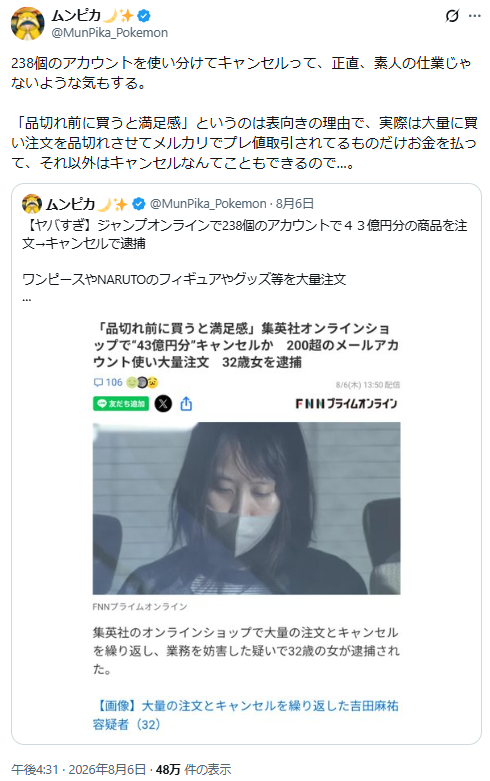
Further fueling the speculation, a netizen claiming to be a former scalper pointed out that this order-and-cancel tactic is a standard scalping practice, admitting to having used it themselves in the past. This individual suggested the suspect was essentially a "colleague" in the illicit trade.
The ability to single-handedly manage over 200 accounts and repeatedly execute such complex order manipulations seems improbable for an individual in her stated profession. The actual circumstances, of course, remain subject to ongoing investigation by Japanese police, with current discussions largely based on netizen speculation.
Note: Financial figures and earnings forecasts should be confirmed through the company’s official announcements.
via: フジニュースネットワーク