

In recent years, Japan has been all-in on using anime, games, and other pop culture to drive regional revitalization. Towns like Washinomiya in Saitama, Oarai in Ibaraki, and Numazu in Shizuoka are often hailed as the poster children for successful collaborations between anime and local tourism.
However, a recent discussion among Japanese fans on X (formerly Twitter) suggests that the success of these locations hinges on a unique set of conditions that can't simply be replicated by any town that lands an anime collaboration. Many attempts fizzle out once the anime's initial hype dies down. The conversation also delved into why a phenomenon like Girls und Panzer in Oarai became such an enduring success.
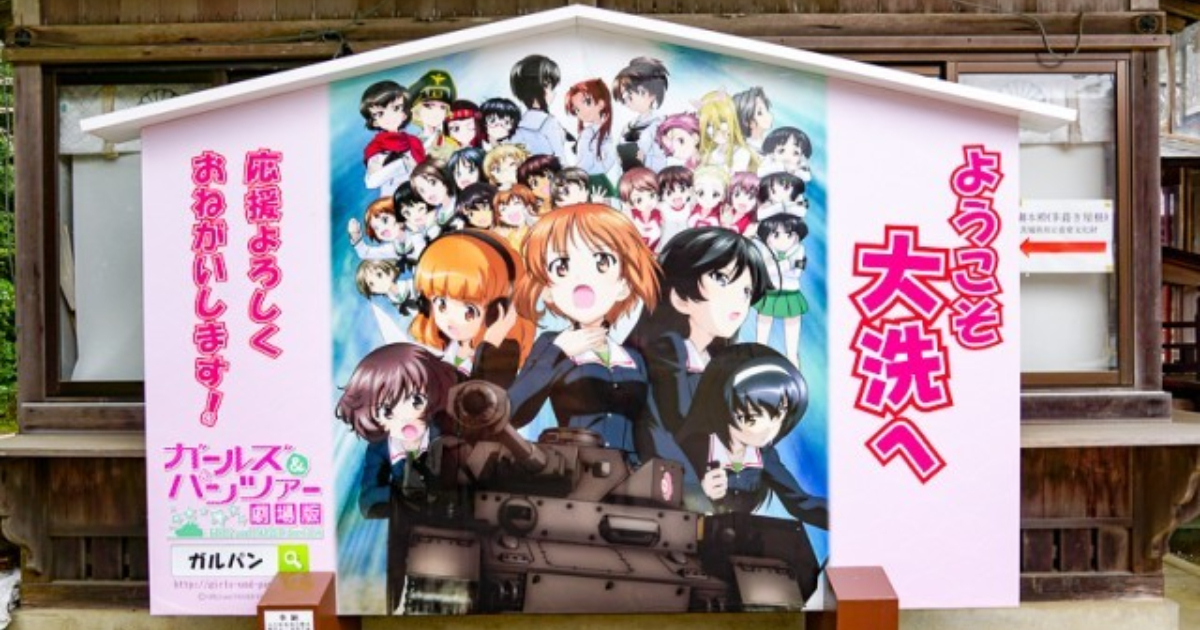
The user who kicked off the discussion noted that when it comes to "fan-driven local revitalization," Washinomiya and Oarai are the go-to examples. But both places, they argue, had exceptionally skilled champions leading the charge. These leaders didn't just see fans as a source of revenue; they started by "understanding the fans" and "helping local residents understand the fans."
This, the user bluntly stated, is why the Washinomiya and Oarai case studies "can't really be used as a direct reference." It looks like something anyone could do, but in reality, it's far from it.
The post sparked a massive debate, with many agreeing that the success of Oarai, Washinomiya, and Numazu was the result of a "miraculous combination" where every single condition fell perfectly into place.
One user pointed out that even if you study successful examples, you can't just copy-paste the formula. Every region has its own unique character, every anime has a different fanbase, and factors like city size and the show's world-building all play a role. Instead of mimicking others, towns should develop a strategy based on their own strengths. Furthermore, building understanding between locals and anime fans is a gradual process that takes time.
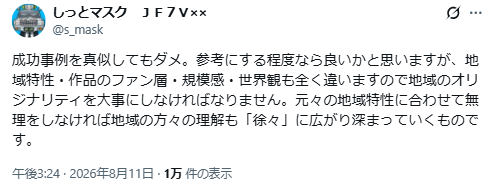
"If you're not in it for the long haul, it's probably not going to work," another user commented. They cited the relationship between the anime Please Teacher! and Lake Kizaki in Nagano as a worthy model. Instead of chasing an overnight explosion in popularity, they've maintained a more relaxed, long-term connection.

When the topic turned to Oarai, many argued that its success couldn't be solely attributed to the influx of Girls und Panzer fans.
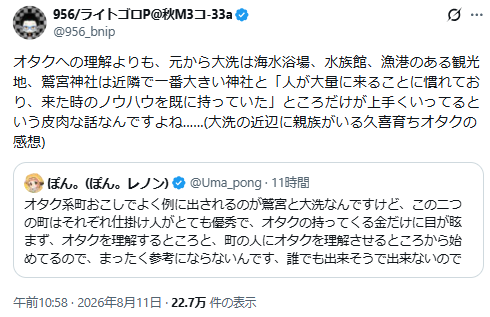
Oarai was already an established tourist destination with beaches, an aquarium, and a fishing port, meaning it had decades of experience handling visitors. Back when beach holidays were all the rage, the town welcomed huge crowds from across the Kanto region, so it already had the infrastructure and know-how to manage large-scale tourism.

One commenter even noted that Oarai boasts one of the largest parking lots in the country, with accessibility on par with some major transportation hubs. These pre-existing advantages are difficult for other towns to replicate.

Washinomiya, the pilgrimage site for Lucky Star, has a similar backstory. The Washinomiya Shrine was already a major local landmark for worship and tourism, drawing large numbers of visitors for years. As a result, the local community was already accustomed to welcoming outsiders. As one user sarcastically put it, maybe the truly successful towns aren't the ones that "get otaku culture," but the ones that are simply used to "a ton of people suddenly showing up" and naturally have the capacity for tourism.
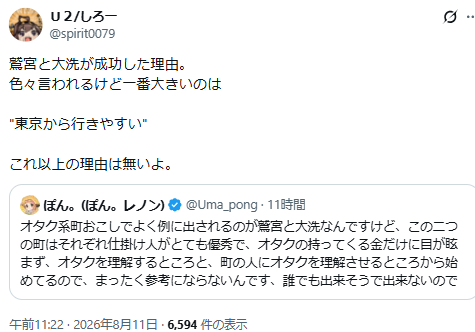
Others pointed out another very practical advantage that Washinomiya and Oarai share: "They're easy to get to from Tokyo." Their proximity and convenient transport links allow fans from the massive Tokyo metropolitan area to make the trip easily, a crucial factor in sustaining a pilgrimage site.
Some in the discussion argued that the real genius of Oarai and Washinomiya lies in how they treated fans as more than just "consumers" or "tourists." Local residents and businesses welcomed new fans with a comfortable sense of distance, gradually coming to see long-time visitors as part of the community.

As a result, one user explained, visitors often leave with more than just an "anime pilgrimage" experience; they build deeper emotional connections with the locals and fellow fans.
One fan even shared a personal story: when they first visited Oarai a decade ago during a low point in their life, they received help from both local residents and other visiting fans. This created a special, lasting bond with the town. Another user summed it up perfectly: the real strength of Oarai and Washinomiya is that "it didn't just end when the show ended; the town embraced the fans as partners."
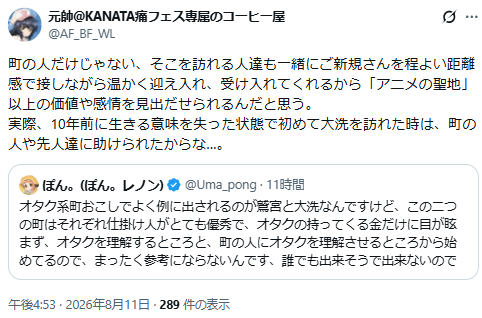
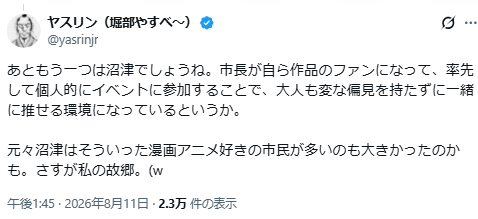
Besides Washinomiya and Oarai, the city of Numazu in Shizuoka, the setting for Love Live! Sunshine!!, is another frequently cited success. A user pointed out that the mayor of Numazu is a fan of the series and personally participates in related events. This leadership helps local residents move past stereotypes about anime and fosters an environment where "everyone supports the work together."
Moreover, Numazu already had a significant population of manga and anime fans, allowing the series to integrate more naturally with the local culture.
Of course, Japan has many other successful examples, though they may not get as much media or online attention as the big three.
Examples include:
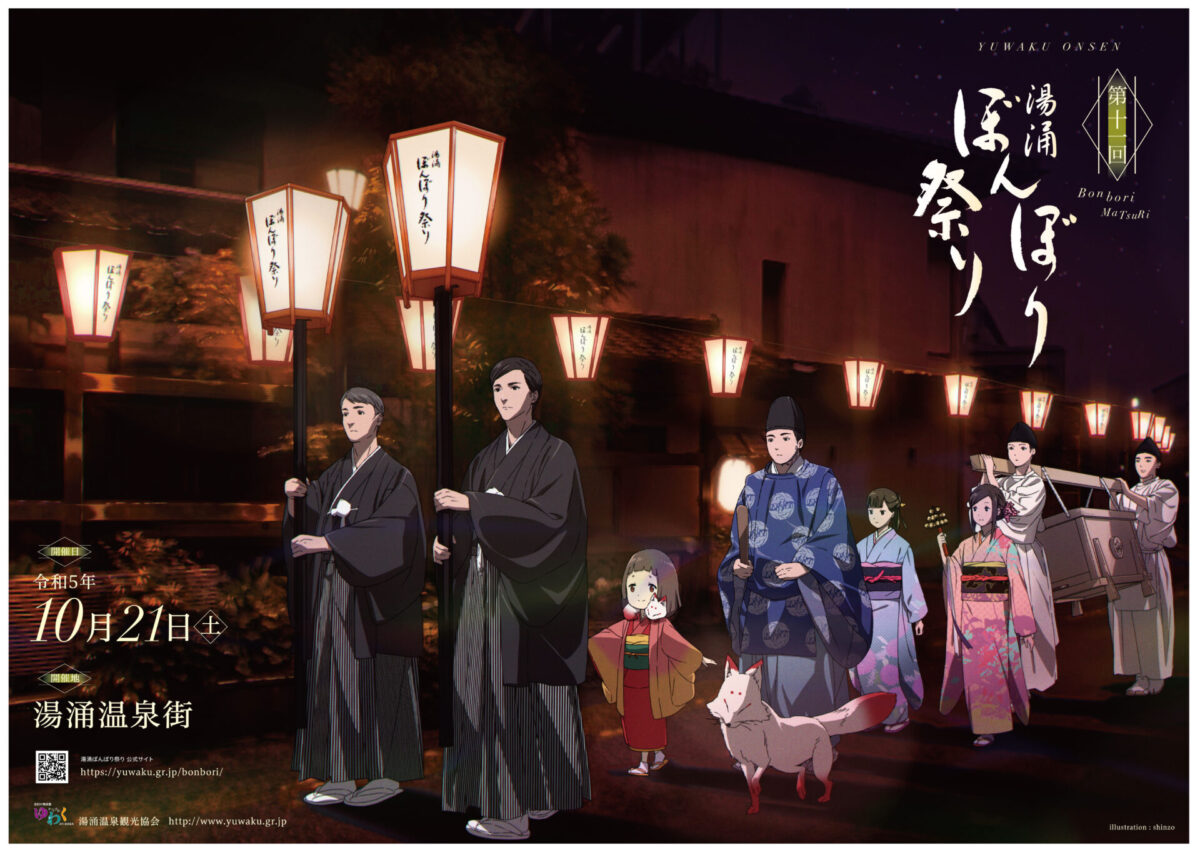
Yuwaku Onsen, Ishikawa: Hanasaku Iroha
Takehara City, Hiroshima: Tamayura
Hanno City, Saitama: Encouragement of Climb
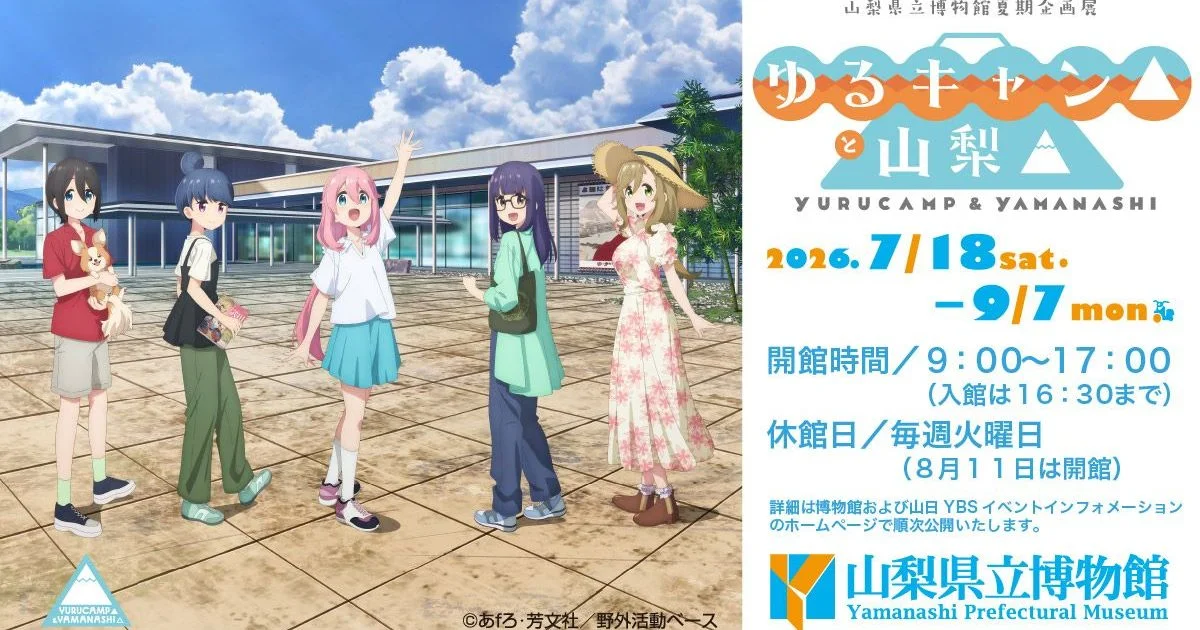
Yamanashi Prefecture: Laid-Back Camp
Saga Prefecture: Zombie Land Saga
Among these, the "Yuwaku Bonbori Festival" in Kanazawa's Yuwaku Onsen, inspired by Hanasaku Iroha, drew particular praise from fans. Even though the anime aired nearly a decade ago, the town continues to hold the event. Some see this model of "slowly nurturing the connection after the show ends" as a true benchmark for successful anime-driven revitalization.
Yamanashi Prefecture was also highlighted for its relaxed, sustained approach to promoting the region through Laid-Back Camp without being overly aggressive.
Meanwhile, it was noted that the highest levels of the Saga prefectural government were themselves supporters and drivers of the Zombie Land Saga collaboration. This top-down understanding from local leaders can also be a key ingredient for success.

In other words, if a town relies too heavily on one-off events, it's difficult to create a sustainable tourism cycle. The real reason these places succeeded is a virtuous cycle formed over time through the interplay of the anime itself, local charm, accessibility, tourism resources, resident attitudes, IP holder cooperation, and fan culture.
For other cities hoping to revitalize through anime, instead of asking, "How can we copy Oarai?" the more important questions might be, "What are our town's existing strengths?" and "Are we willing to spend years slowly building a relationship with the series and its fans?" Anime can be the spark for local revitalization, but what keeps a "holy site" alive in the long run is never just a single event—it's the town's commitment to playing the long game and walking alongside the fans.