

Lately, shopping malls and street corners across Japan have seen an explosion of large-scale "gacha specialty stores." These spaces, often entire floors packed with hundreds of capsule toy machines, have become a hot topic online.
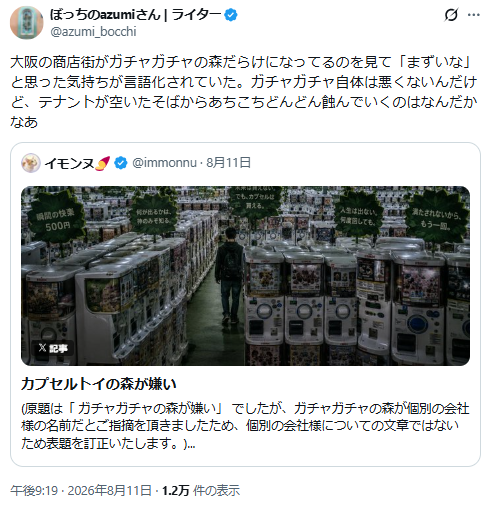
A Japanese user on X recently ignited a firestorm with a post titled "I Hate Gacha Gacha no Mori" (a popular chain of gacha stores), criticizing the proliferation of these gacha-filled spaces in malls. The user argued that the trend reflects a fundamental shift in Japanese consumer culture, sparking widespread debate and commentary.
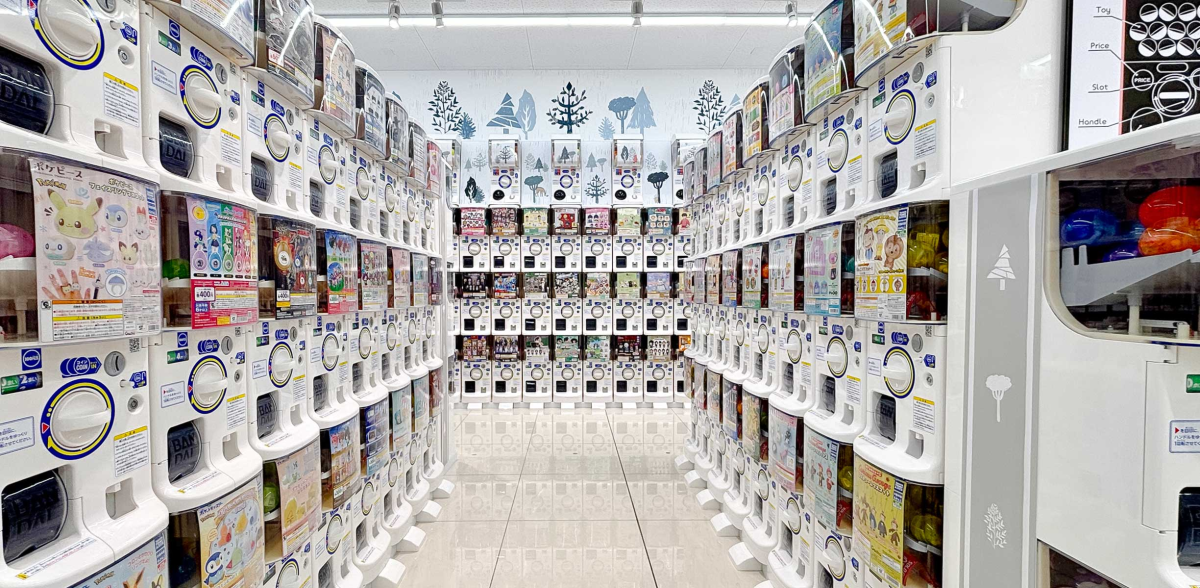
The original poster clarified that they don't hate gacha itself. The childhood memory of clutching a 100-yen coin, filled with anticipation for a random toy, is a fond one. However, the modern reality—where any vacant retail space is immediately filled with rows upon rows of gacha machines—feels like something else entirely.
The core issue, they argue, is the near-total absence of "gameplay." There's no skill, knowledge, or effort required; no learning curve or strategy to master. You just insert a few hundred yen, turn a crank, and get a result in seconds. If you don't get what you want, you just feed the machine more money. The post describes this as an extremely compressed loop of "anticipation → payment → result → disappointment or satisfaction."
The post suggests that the rapid spread of gacha might be linked to the current economic climate. Houses are expensive, cars are expensive, travel is expensive, and education costs are high, while real wages have stagnated. In this environment, making large purchases for the future feels increasingly risky. But 500 yen? That's manageable. For 500 yen, you can buy the thrill of "what will I get?" You turn the crank, open the capsule, and feel a rush of joy if you get the desired item. If not, you just spend another 500 yen.
This, the poster concludes, reflects a society where "in a world where you can't afford grand happiness, joy itself has been repackaged into micro-transactions." They draw parallels to cheap carbs, endless phone scrolling, and in-game purchases in mobile games: all low-cost ways to receive constant, short-term stimulation. "You fill your stomach, kill your boredom, and satisfy your urge to gamble, but your life itself doesn't become any richer."
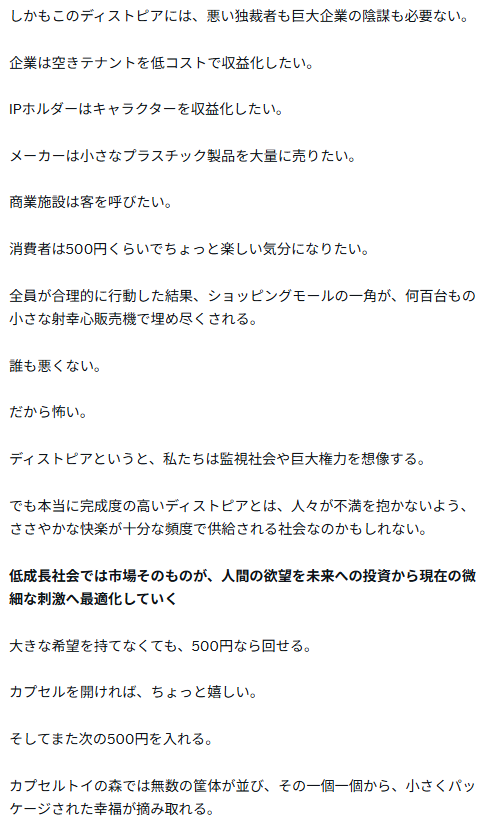
The most discussed part of the thread is its "dystopian" framing. The author argues that this reality doesn't require an evil dictator or a massive corporate conspiracy. Companies want to fill vacant storefronts cheaply; IP holders want to merchandise their characters; manufacturers want to sell mass-produced plastic trinkets; malls want to attract foot traffic; and consumers just want to buy a little bit of happiness for 500 yen.
Everyone is acting rationally in their own self-interest, yet the outcome is a "corner of a shopping mall filled with hundreds of machines selling tiny jolts of stimulation." The truly scary part, the author writes, is that "no one is doing anything wrong." People often imagine dystopias as surveillance states or oppressive regimes, but perhaps a truly advanced dystopia is one that "provides micro-doses of happiness just frequently enough to keep people from feeling dissatisfied."
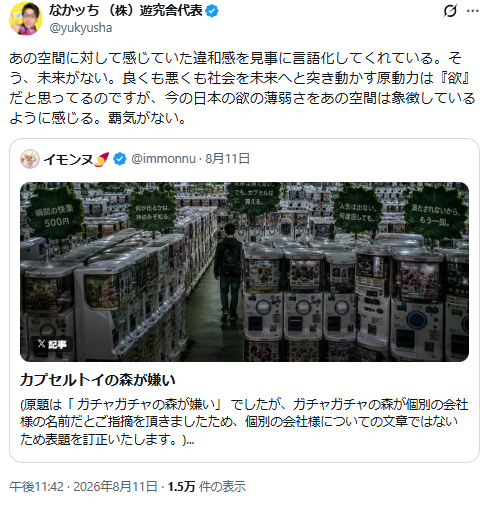
The post resonated with many users. One commenter said it "perfectly articulated the sense of unease I've always felt in those spaces," adding that "the desires of Japanese people today are becoming weaker and thinner," with gacha stores symbolizing this trend.
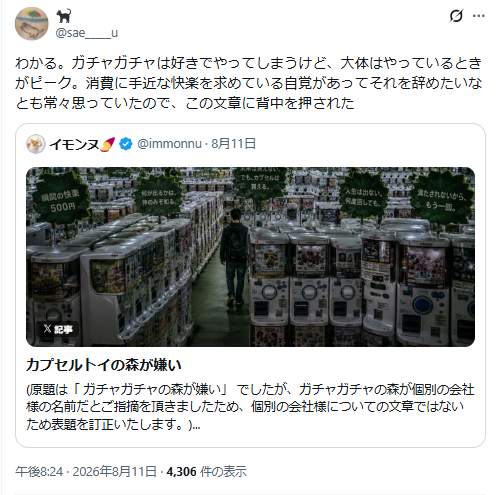
Another user admitted they love gacha but realized "the most exciting part is the moment you're playing," making them conscious that they were chasing easily accessible pleasure and wanted to change that habit.
Others expressed disappointment when multiple gacha zones pop up in a single mall, or a feeling of "strong nihilism" and the sense that "the economy must be really bad" when they see a closed store replaced by a wall of capsule machines.
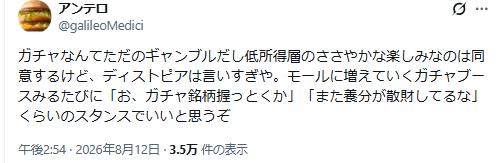
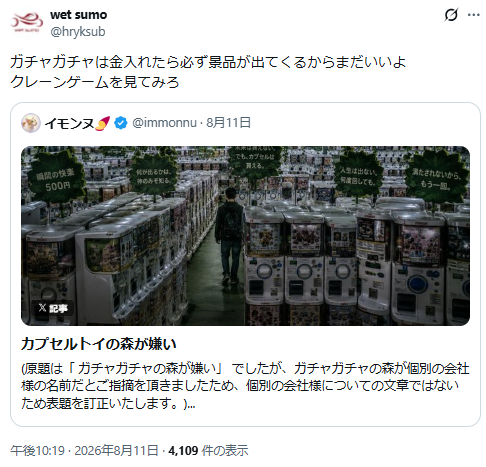
On the other hand, many disagreed with the critique. Some felt that while gacha has a gambling-like quality and serves as a small indulgence for those with less disposable income, calling it "dystopian" was a huge stretch. Another user shot back, "At least with gacha, you're guaranteed to get *something* for your money. Go look at the claw machines." They argued that claw machines are far more likely to leave you empty-handed after spending a lot of money.
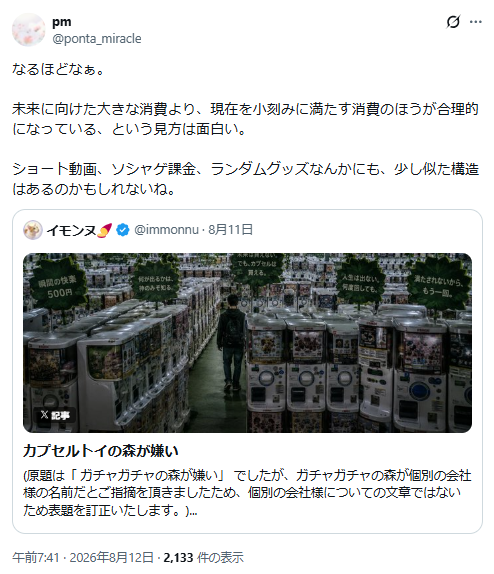
The discussion also expanded to other modern consumption patterns. Commenters pointed out that short-form videos, mobile game microtransactions, blind boxes, prize raffles, and claw machines all share a similar structure: they don't require a large upfront investment but provide instant stimulation in small, repeatable increments.
Another user argued that gacha itself isn't the problem, but the idea that "fleeting happiness" is becoming the default mode of daily consumption is certainly something worth thinking about.
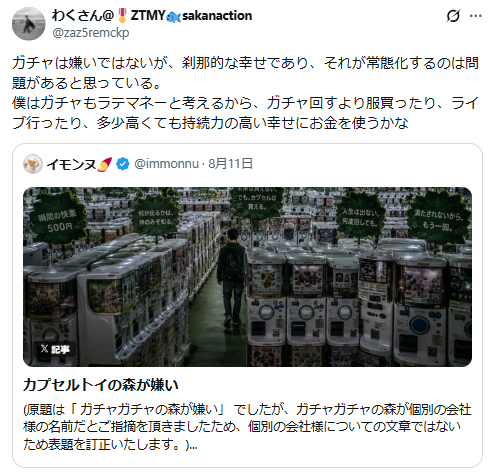
While the debate has no clear answer, the rapid rise of gacha specialty stores in Japan's malls has forced a moment of reflection. As people find it harder to afford "large, future-oriented purchases," are they turning to one 500-yen hit of instant joy after another? And does this shift reflect the psychological state of modern society?