

“Which part of a woman's body do you find most attractive?” It's the kind of question that occasionally comes up in casual conversation, and one of the most familiar versions of the debate is simply: “breasts or buttocks?” Of course, a person's overall attractiveness can never be reduced to a single body part. Still, the question of which aspects of female body shape have the greatest influence on perceived attractiveness has long been a subject of psychological research.
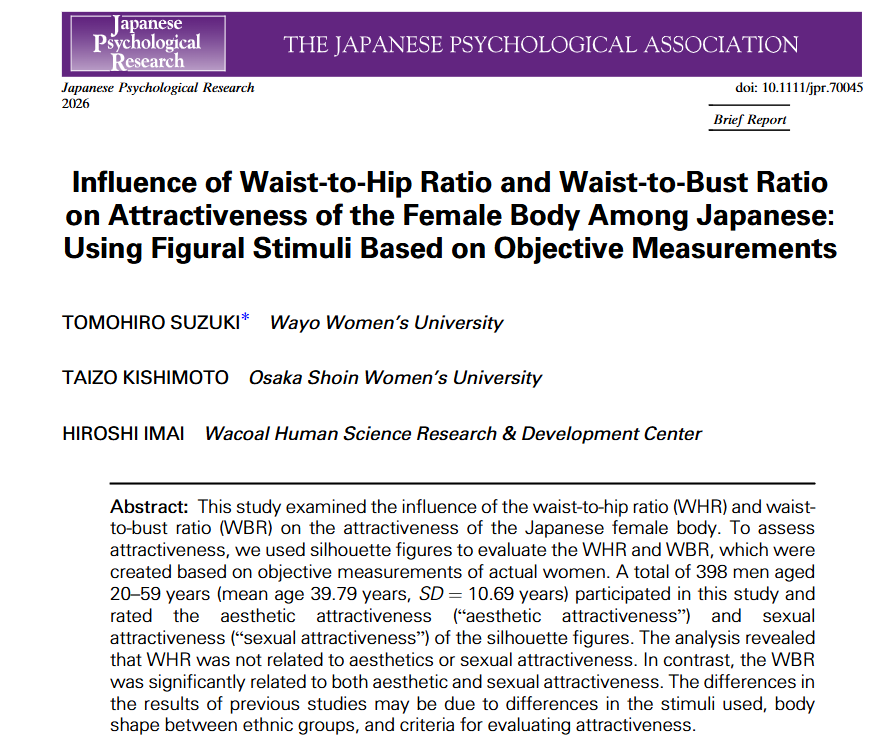
Recently, a research team led by Professor Tomohiro Suzuki of Wayo Women's University, working together with the Wakayama Human Science Research and Development Center, investigated which characteristics of the female body Japanese adult men perceive as attractive. The study used body figures reconstructed from actual measurements of Japanese women. The findings were published in the Japanese Psychological Association's academic journal Japanese Psychological Research and have recently attracted attention on X in Japan as well.

The study, titled “Influence of Waist-to-Hip Ratio and Waist-to-Bust Ratio on Attractiveness of the Female Body Among Japanese: Using Figural Stimuli Based on Objective Measurements,” notes that previous research into female body shape and attractiveness has often focused on the relationship between the waist and hips. One of the most widely used measures is the waist-to-hip ratio (WHR), calculated by dividing waist circumference by hip circumference. A lower WHR indicates a narrower waist relative to the hips.
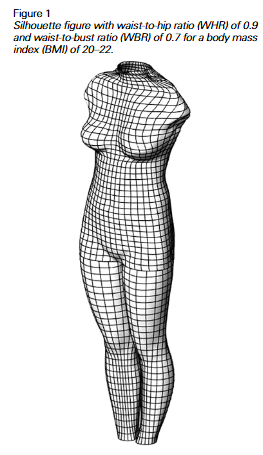
In addition to WHR, the study examined the waist-to-bust ratio (WBR), calculated by dividing waist circumference by bust circumference. A lower WBR indicates a larger bust relative to the waist. The researchers set both WHR and WBR at four levels—0.6, 0.7, 0.8 and 0.9—creating 16 different female body figures.
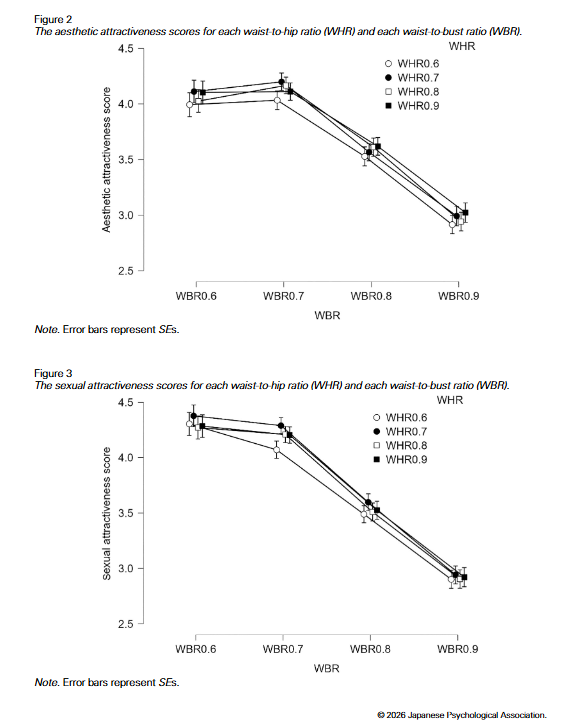
The analysis found that WHR had only a very small relationship with ratings of aesthetic or sexual attractiveness. WBR, by contrast, showed a clear association with both measures. In other words, in this experiment—where body shapes were based on actual measurements of Japanese women and evaluated by Japanese adult men—the ratio between the waist and bust had a greater influence on attractiveness ratings than the ratio between the waist and hips.
Although changing WHR did produce statistically detectable differences, the size of those differences was extremely small, leading the researchers to conclude that the practical effect was close to negligible. Under the conditions of this experiment, altering the waist-to-hip ratio made very little difference to how attractive Japanese male participants found the figures.
WBR, meanwhile, produced a much more pronounced effect. Figures with WBRs of 0.6 to 0.7 received higher ratings, while both aesthetic and sexual attractiveness ratings gradually declined as the ratio increased to 0.8 and 0.9.
Put another way, among the Japanese adult men participating in this experiment, the waist-to-bust ratio had a stronger impact on perceived attractiveness than the waist-to-hip ratio.
For some perspective, a WBR of 0.6—the ratio that received relatively high ratings—would correspond to a bust measurement of roughly 108 centimeters if the waist measured 65 centimeters. According to the researchers, women with proportions like these are actually quite uncommon in Japan. In other words, the male participants were not simply choosing the body type they were most accustomed to seeing in everyday life as the most attractive.
This led the authors to raise another possibility: the female body shapes people encounter through television, advertising and fictional media may influence their standards for what constitutes an “attractive” figure. The apparently distinctive Japanese pattern prompted some users online to wonder, “Could anime have something to do with it?” Another jokingly declared, “This is all thanks to ONE PIECE.”
However, the study did not examine what kinds of media the participants regularly consumed. As a result, it cannot currently be concluded that media exposure caused the observed preference involving WBR. For now, that remains a hypothesis requiring further investigation.
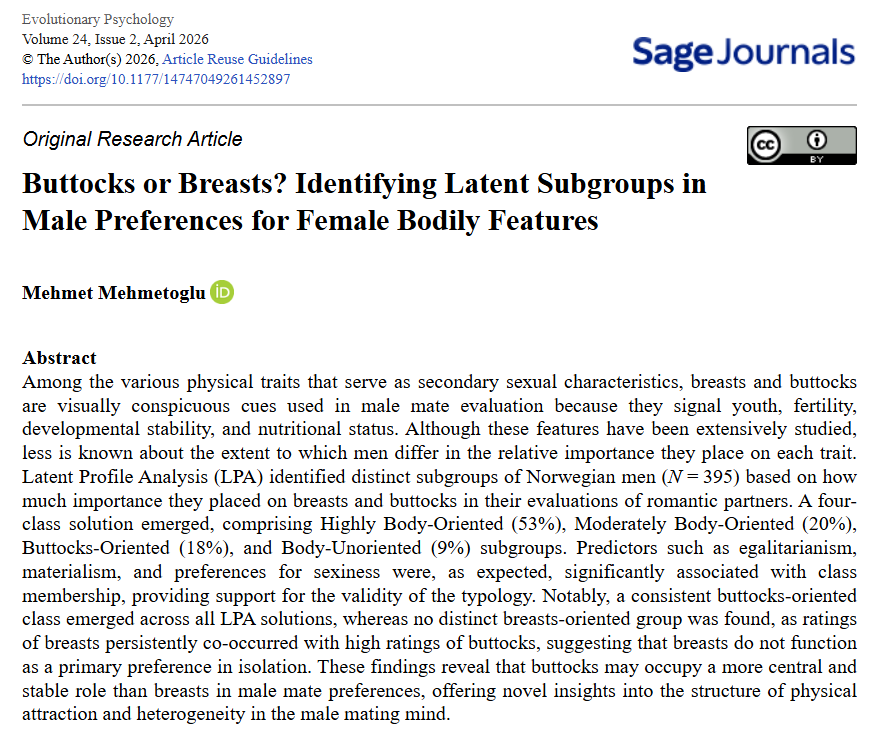
The results from the Japanese study also make for an interesting contrast with separate research conducted overseas. A Norwegian study published around the same period, “Buttocks or Breasts? Identifying Latent Subgroups in Male Preferences for Female Bodily Features,” found that male participants rated the importance of breasts at an average of 3.37 out of 5, compared with 3.91 for buttocks, giving the latter a higher overall rating.
A subsequent latent profile analysis found that 53% of participants placed a high level of importance on both breasts and buttocks, while another 18% formed a distinct “buttocks-oriented” group. However, researchers did not identify a corresponding group that placed a strong emphasis on breasts alone. Because a buttocks-oriented group repeatedly emerged across different analytical models, the Norwegian study argued that this preference appeared to represent a relatively stable pattern.
That certainly hasn't settled the argument online in Japan, where both the “butt guys” and the “boob guys” continue to defend their respective camps.


Then a third faction entered the debate, arguing that if anime and other fictional media are part of the conversation, the “thigh camp” deserves recognition too. After all, thighs have long been an attraction category of their own in anime and character fandom.

Some people may wonder whether studying something as seemingly trivial as “breasts or buttocks?” is really worthwhile. Yet researchers across different countries have continued investigating such questions for decades, reflecting the fact that the perception of bodily attractiveness has long been a genuine topic of psychological research.
And preferences may vary not only across countries and cultures, but across different eras as standards of beauty change. Buttocks or breasts—or perhaps an ever-growing list of other contenders—the debate over which camp reigns supreme may simply be one of those arguments that never truly ends.
via: ナゾロジー