

Expo 2025 Osaka kicked off on April 13, launching a six-month-long global event expected to draw massive crowds from around the world to its spectacular international pavilions.
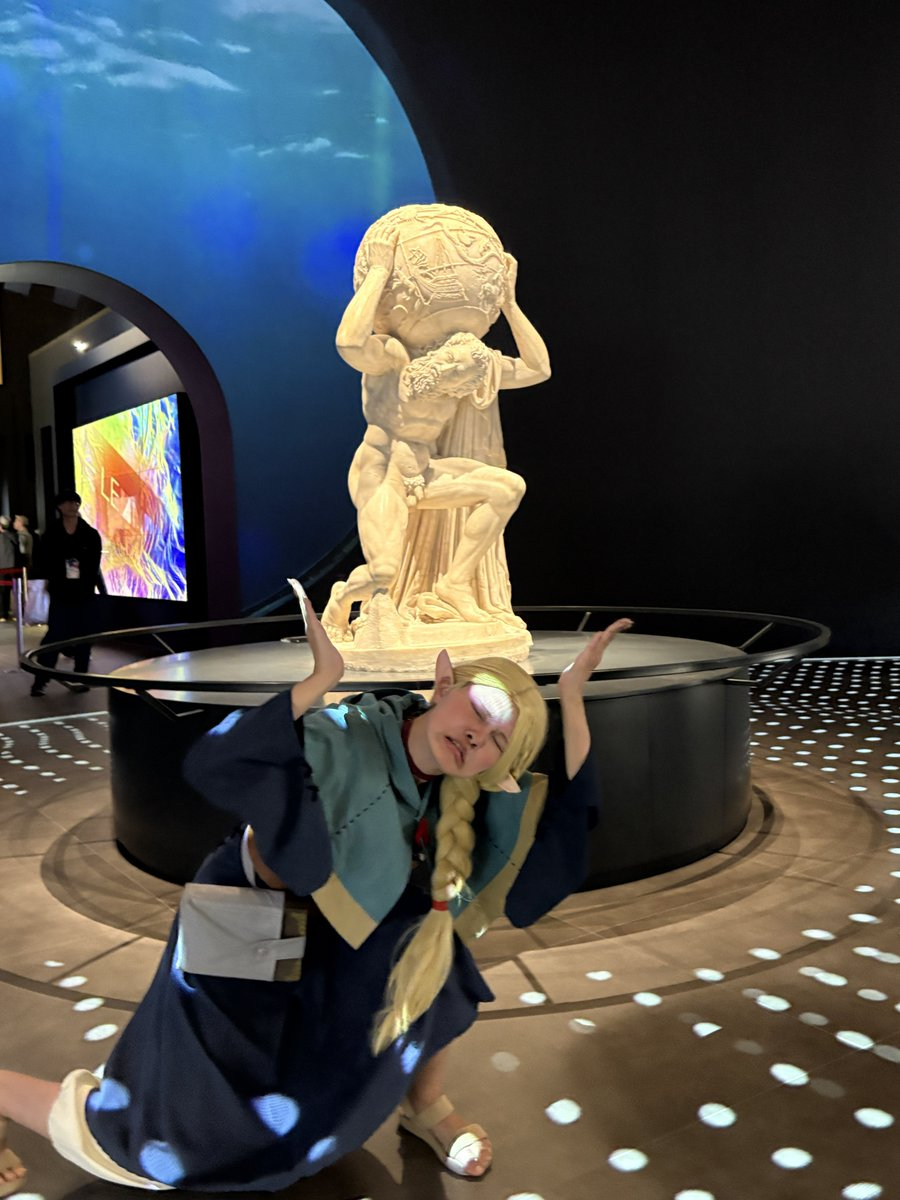
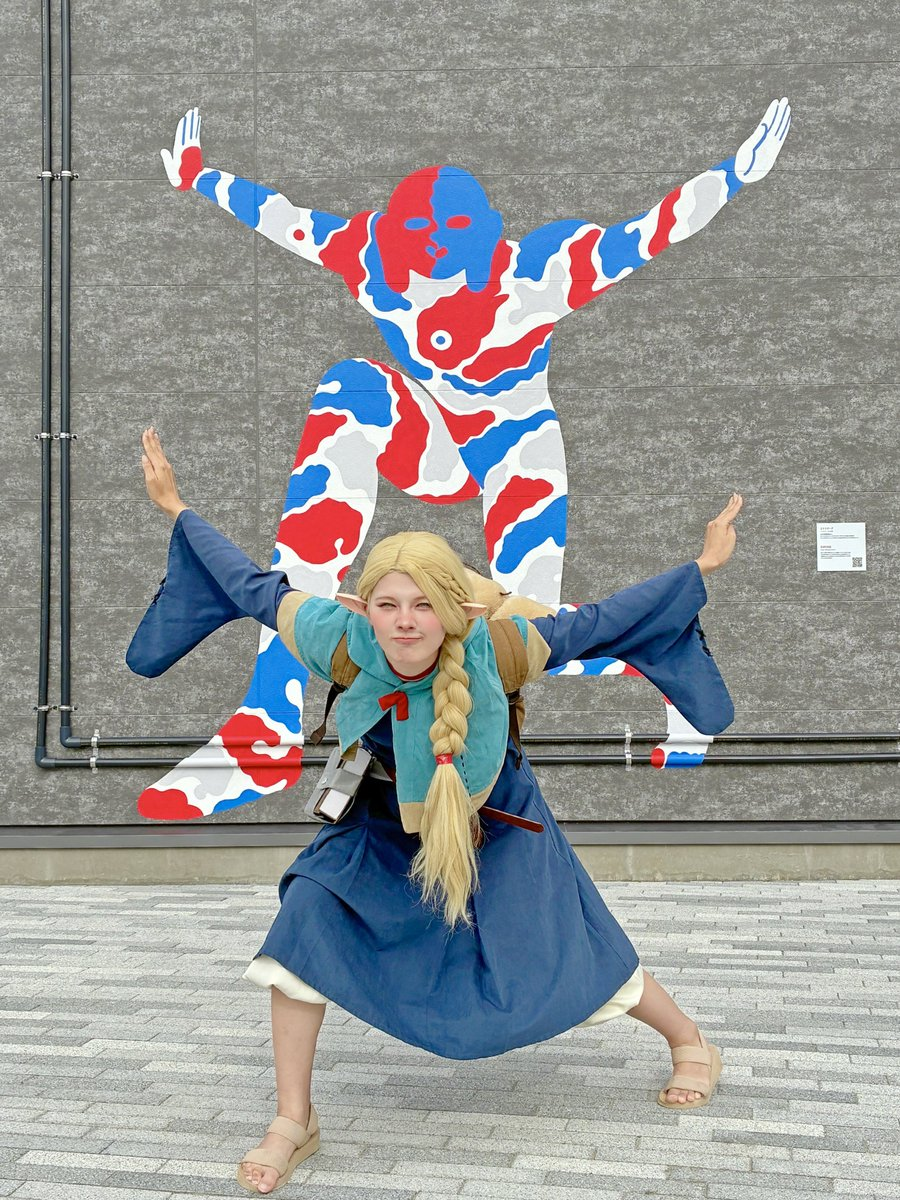
Amid the excitement, Japanese cosplayer Shikano Tsuno (@shikano_tsuno_), who previously went viral for her incredible Marcille cosplay from Delicious in Dungeon at Comic Market (C104), decided to visit the Expo in full costume. Her appearance quickly became a hot topic, but it also ignited a fierce online debate. While many found it awesome, a vocal contingent slammed the move, arguing "this isn't a cosplay event" and even raising concerns about potential copyright infringement.
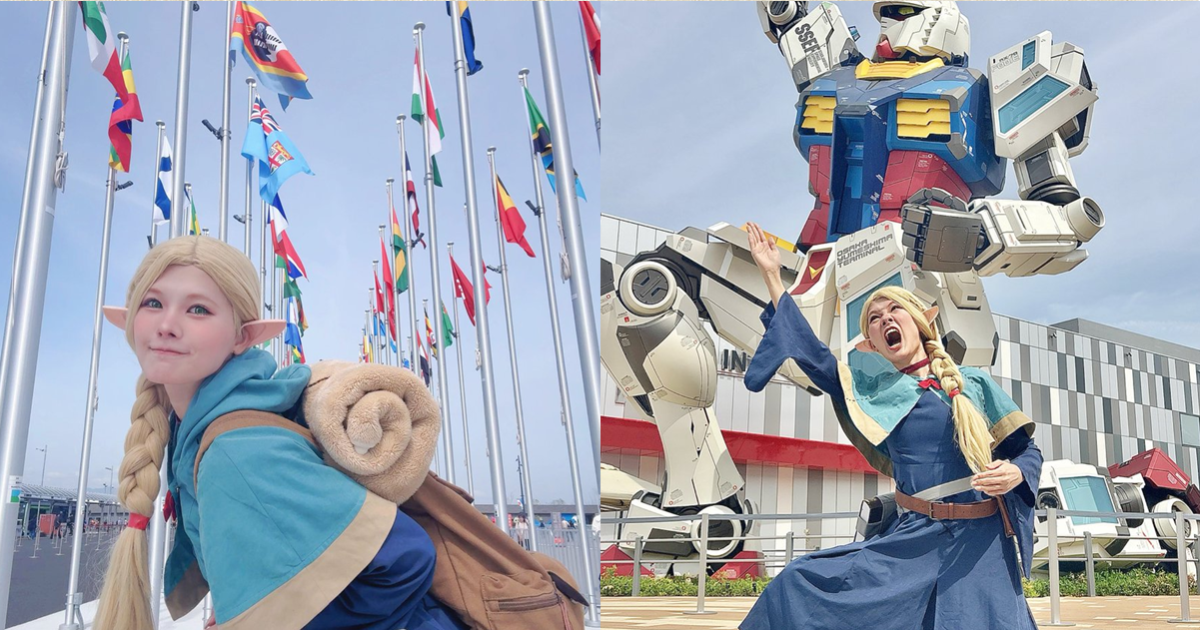
The controversy began on April 23, when Shikano Tsuno shared her experience of cosplaying at the Expo the day before, addressing questions about whether it was even allowed. She pointed out that the official Expo website actually permits costumes (as long as they don't violate the list of prohibited items) and offered some practical tips for fellow fans:
"There are no changing rooms on-site, and you can't use the restrooms to change. The safest bet is to get ready at your hotel and take a taxi. While there are no explicit rules on which series you can cosplay from or how revealing your outfit can be, that doesn't mean 'anything goes.' If you cause trouble for others, it could impact how cosplay is tolerated in the future."
Her post exploded, racking up over 9,000 retweets and nearly 20,000 likes. Many commenters found her advice helpful and said it made them more interested in visiting the Expo. However, the backlash soon followed. Critics fired back with comments like: "When did 'it's not explicitly forbidden' become the standard for cosplay?" "Cosplay belongs at cosplay events. The fact that they don't provide changing rooms is a soft no, so what's the deal with encouraging people to show up in costume via taxi?" and "Are you all forgetting that cosplay can constitute copyright infringement?"
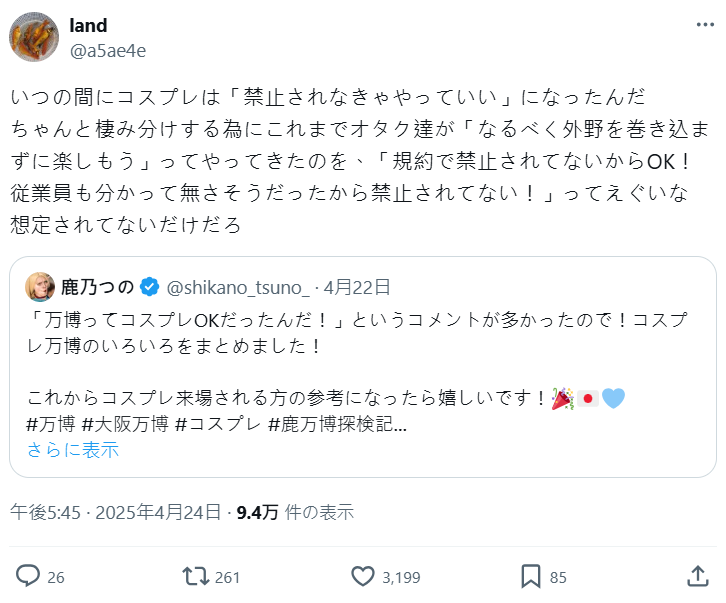
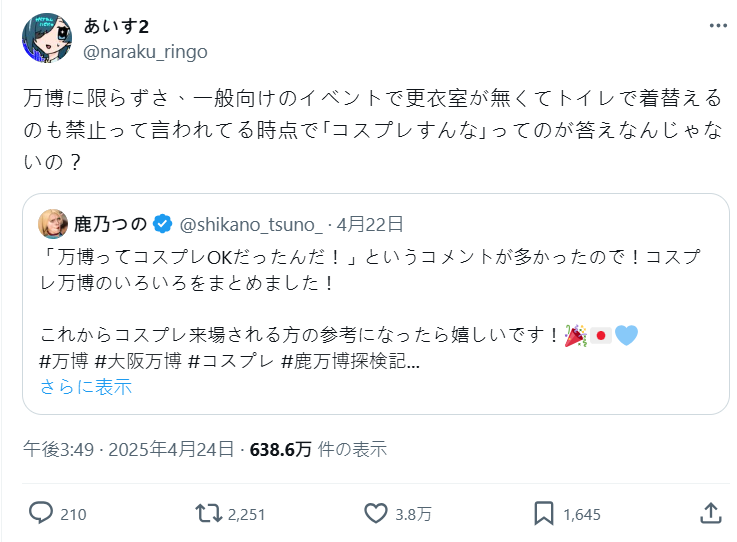
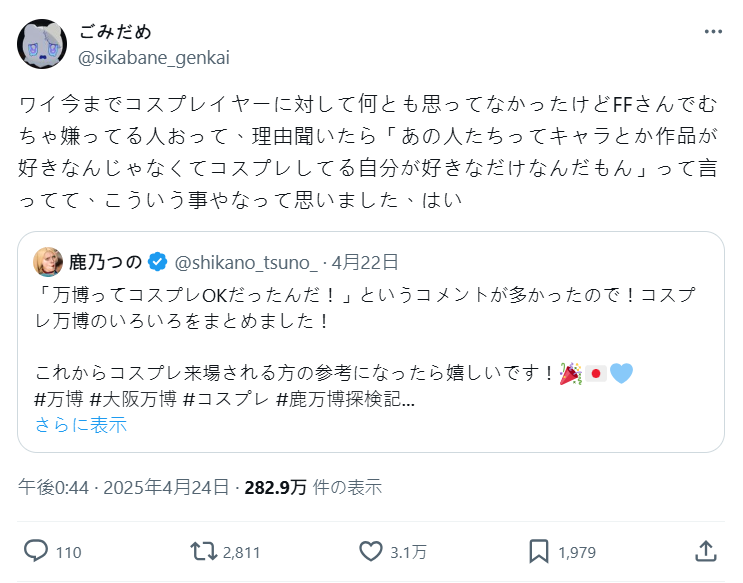
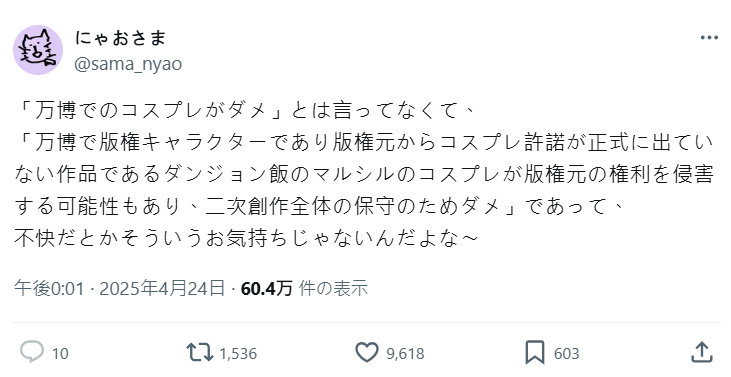
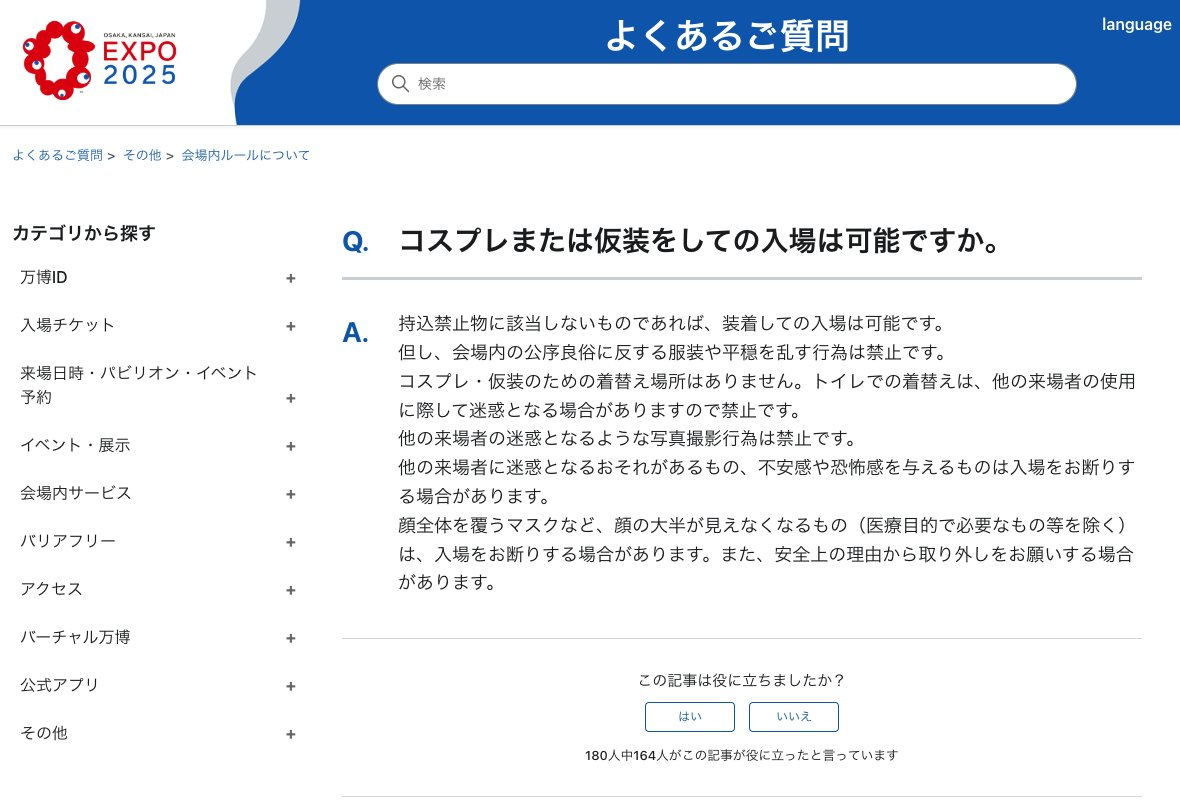
In Japan, it's generally uncommon for people to cosplay outside of designated events, a cultural norm rooted in a collective desire to avoid inconveniencing others. However, a quick check of the official Expo 2025 Osaka Q&A confirms that attendees are permitted to enter in costume, though it explicitly states that restrooms cannot be used for changing—leaving the logistics up to the individual.
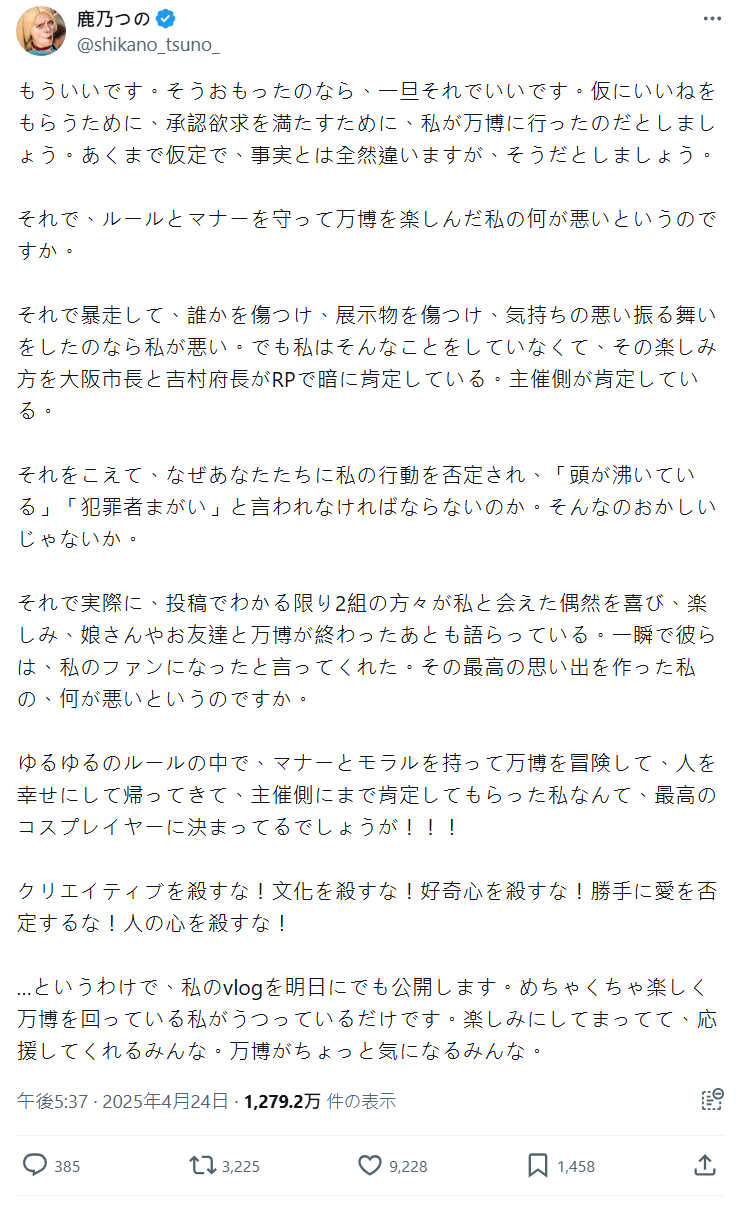
Facing the wave of criticism, Shikano Tsuno posted a follow-up, addressing accusations that she was just doing it for likes and validation. She countered that this couldn't be further from the truth.
She explained that she followed the rules, was polite, and had a wonderful time at the Expo. Her visit was even quietly acknowledged with retweets from the Mayor of Osaka and the Governor of Osaka Prefecture, suggesting a tacit nod of approval from the organizers themselves. "So what exactly did I do wrong?" she asked. "Why am I being attacked and called 'brain-dead' or a 'near-criminal' for this? Isn't that completely out of line?"
She argued that she was simply exploring the Expo within a loose set of rules, acting respectfully, and bringing a bit of joy to the event—an effort seemingly validated by the organizers. She expressed confusion over the attacks, especially those coming from fellow cosplayers, questioning why they would want to stifle creativity and culture or dismiss her love for the character as mere clout-chasing.
As the debate raged on, Shikano Tsuno sat down for an interview with Japanese media outlet Encount to address the core issues head-on.
While acknowledging that cosplay exists in a legal gray area, she emphasized, "If the original creator is against it, we should respect their wishes and stop. But that decision rests with the creator, not with random bystanders." She lamented that many still view cosplay as a fringe subculture. "It's such a wonderful form of creation, but it's constantly held back by old-fashioned ideas. Is that really fair?"
She suggested that this controversy is a valuable opportunity for society to rethink and redefine what constitutes "reasonable derivative work." Through open discussion, she believes, cosplay and doujin culture can move from the margins into the mainstream.
She also stated that if clear legal regulations were ever introduced to prohibit cosplay, fans would undoubtedly protest. "This isn't just a hobby; it has become a part of many people's cultural lives."
"Every perspective holds infinite possibilities," she concluded. "Instead of finding reasons to restrict things, let's think together about how to make the world more interesting! Finding constructive ways to figure out 'what we *can* do'—I think that's what's cool."
On April 25, she even appeared on a livestream with Tabino Sora, a VTuber and former war correspondent who had returned from Ukraine, to discuss her perspective, earning praise for directly confronting the criticism.
The incident has pushed a necessary conversation into the spotlight, forcing people to grapple with differing views on copyright, public spaces, and cultural expression. Perhaps, as Shikano Tsuno's experience shows, sometimes it takes someone willing to step out and spark a debate for society to truly confront these complex issues.