

Following the appointment of Sanae Takaichi, Japan's 42-year-old Minister of State for Economic Security, Kimi Onoda, has also become a major topic of conversation—thanks to her past experience in the game industry.
According to a report by *Sankei Shimbun*, Minister Onoda stated in the National Diet that the Japanese government's current budget for the content industry is far too small. She pointed out that the funding is severely lacking compared to other nations, despite the immense strength of Japan's creative exports. Her argument has resonated with countless netizens, who are now highlighting the strange state of Japan's content industry.

Minister Onoda, who said her time in the industry left her feeling "genuinely helpless" about the situation, isn't just speaking from experience.
The Cabinet Office confirmed the numbers: Japan's government budget for the content industry is approximately ¥25.2 billion. In stark contrast, the U.S. allocates a staggering ¥617.6 billion, China ¥123.8 billion, and South Korea ¥76.2 billion. The disparity is obvious.
One Japanese netizen summed up the frustration perfectly in a post that went viral: "Japan's exports are propped up 60% by games and 30% by anime, but in meetings, their voices are drowned out by professionals from theater, domestic film, and music. The needs of the industries that actually earn foreign currency are never heard." He also stressed that without a budget adjustment, the anime and game industries will be choked to death by a lack of manpower.
This viewpoint gained widespread support, with many agreeing that while anime and games are the real money-makers, the government budget is consistently snatched up by domestic film and theater.
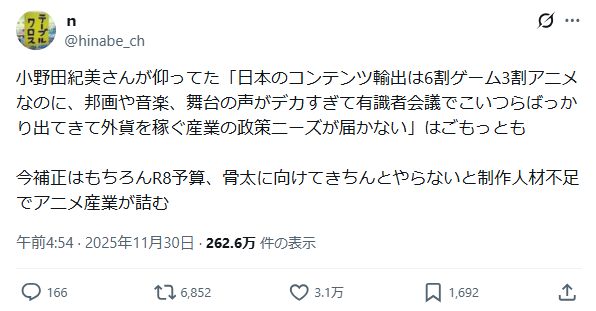
Because the netizen's wording was particularly sharp, Kimi Onoda herself jumped into the replies: "I did bring up the issue of imbalanced representation, but I didn't call them 'these guys' lol (´・ω・`)"
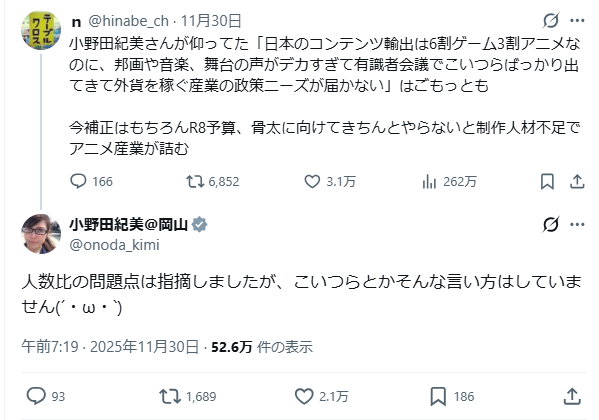
Her response opened the floodgates for even more discussion:
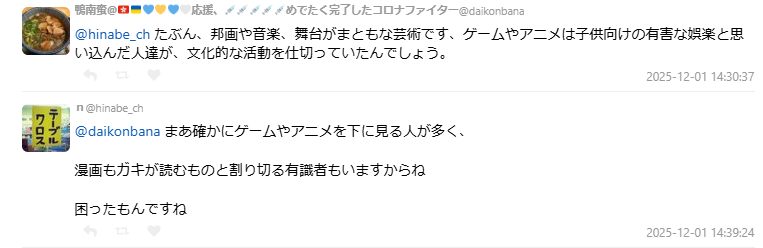
One user pointed out that many still view games and anime as "things for kids," while considering film and theater to be legitimate art. As a result, it's always people from the latter industries who show up at cultural policy meetings.
Another person quipped, "If Yoshimoto Kogyo can get ¥50 billion, then Nintendo and Bandai Namco should be getting ¥200 billion, right?"

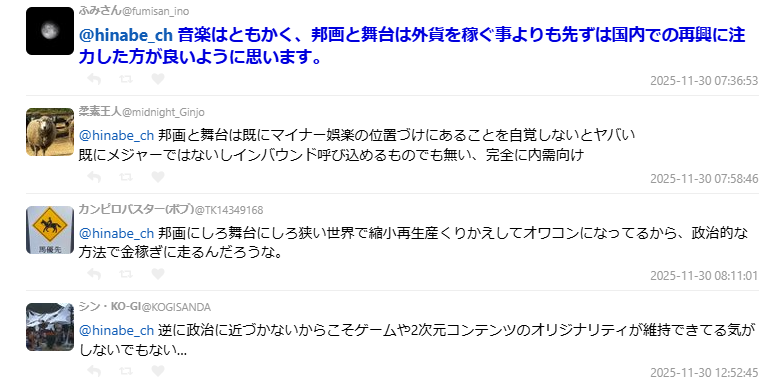
Others complained that Japan's film and theater industries are too insular, endlessly recycling content within their own small circles. This has caused their market to shrink, forcing them to rely on political connections for resources.
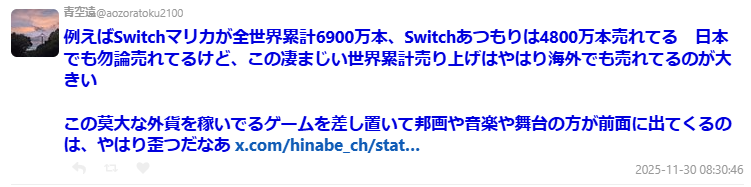
Many netizens pointed to Nintendo's global sales figures as proof:
Mario Kart has sold 69 million units worldwide.
Animal Crossing has sold 48 million units worldwide.
They argued, "The foreign currency brought in by these titles alone is more than what Japanese film, theater, and music make combined. But government policy often moves in the complete opposite direction."
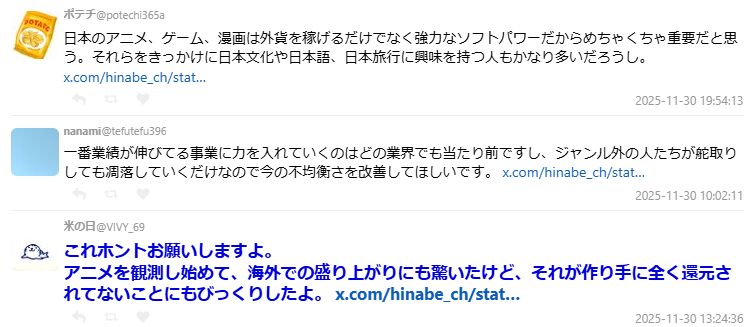
Others also chimed in: "Film and theater should probably focus on reviving the domestic market before they even talk about exports." "The quality of anime and games keeps getting better, but creator compensation isn't keeping up." "Japan's IPs (anime, games, manga) are powerful cultural weapons. They're the reason foreigners want to learn Japanese and visit Japan in the first place."
This debate highlights Japan's conservative approach to budgeting for its content industry. The issue isn't that theater, film, and music are undeserving of funding, but when it comes to exports, these sectors currently lack the power to deliver strong results. The future of the content industry may depend on whether the Japanese government is willing to allocate a larger budget to strengthen its most dominant cultural forces.
via: togetter