

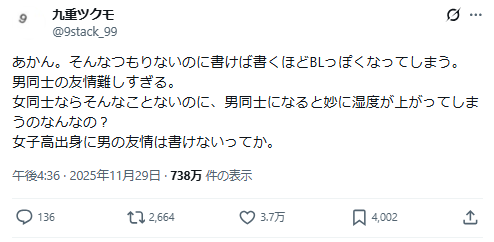
A recent post on Japan's X (formerly Twitter) by novelist Tsukumo Kokonoe about her creative struggles has struck a major chord with countless netizens. She confessed that despite having no intention of writing BL (Boys' Love), whenever she tries to depict male friendships, they inevitably become "super humid," making her exclaim, "Just how hard is it to write friendships between guys?!"
This situation has garnered significant attention, highlighting what seems to be a distinct difference in how female creators perceive male friendships.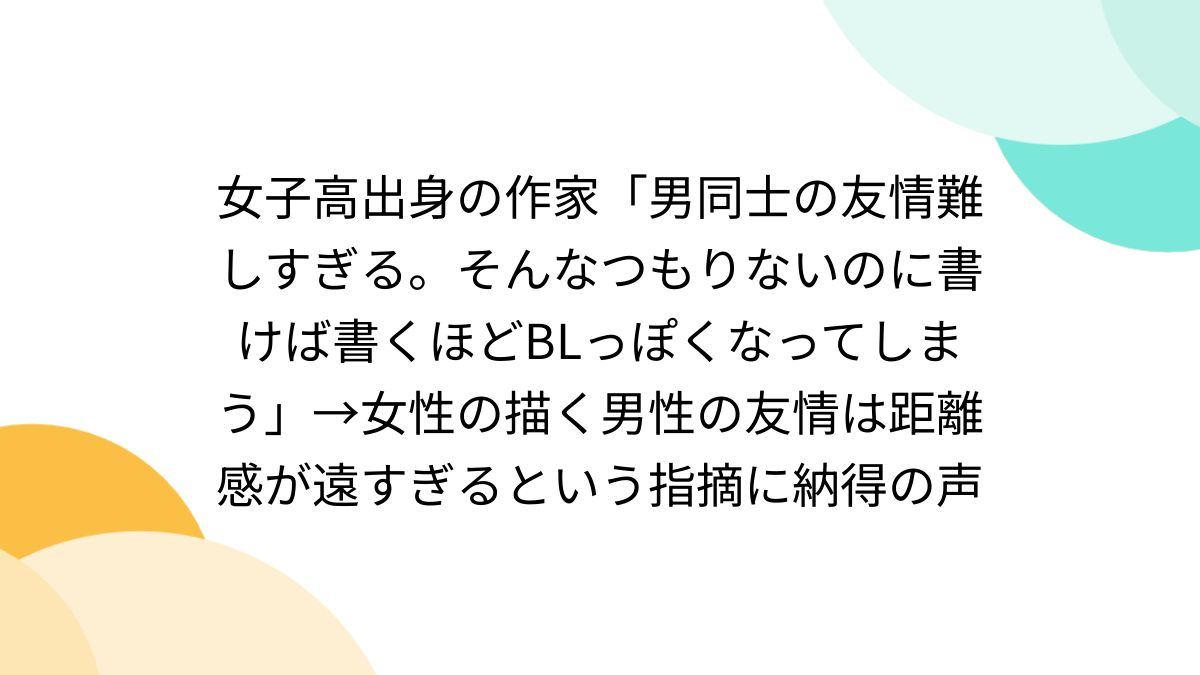
Kokonoe Tsukumo, a novelist who graduated from an all-girls high school, currently writes fantasy romance in an alternate world. She revealed that she's working on a backstory for two older male characters who are rivals in the main story, focusing on their student days. Her original intent was simply to show "something that vaguely resembled friendship back then," but she found the narrative veering off course. "It's not like this with girls, so why does it get so complicated when it's guys?" she mused with a wry smile.
Her post immediately sparked a lively discussion, with many readers offering their insights, turning the thread into a massive "Male Friendship Research Group."
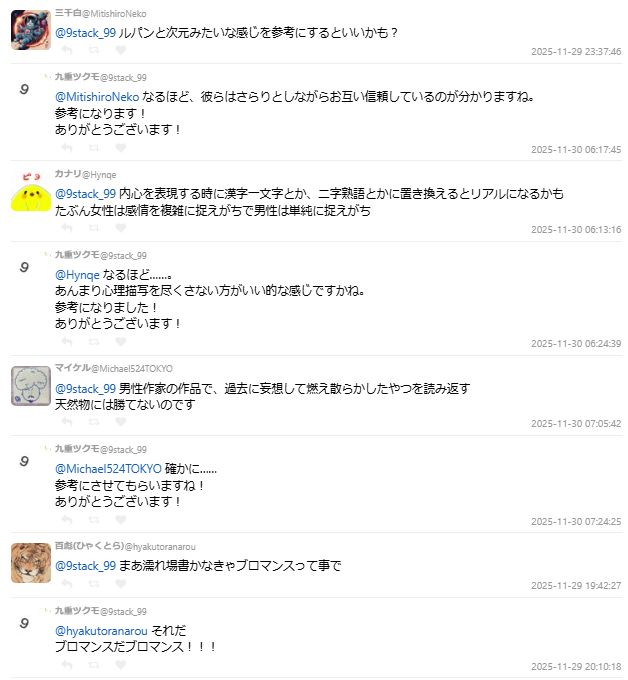
Plenty of people offered concrete advice, such as: "Look at Lupin III and Daisuke Jigen from 'Lupin the 3rd'": they trust each other implicitly but don't say much – that's essentially how male friendships are. Others pointed out that women tend to describe emotions with nuanced detail, while men are often more direct and simple. They suggested that if she "toned down the internal monologues" for male characters, it would feel much more natural.
Some netizens also recommended revisiting "friendships written by male authors" for a simpler, direct observation without overthinking it. Kokonoe Tsukumo replied to everyone's comments, laughing that she'd try her best to "scream 'it's not BL!' until it sticks."
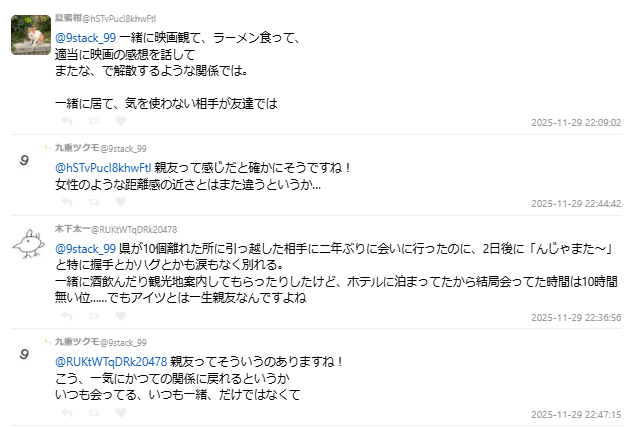
The post also drew out many men sharing their real-life experiences, with the most frequently mentioned characteristics including:
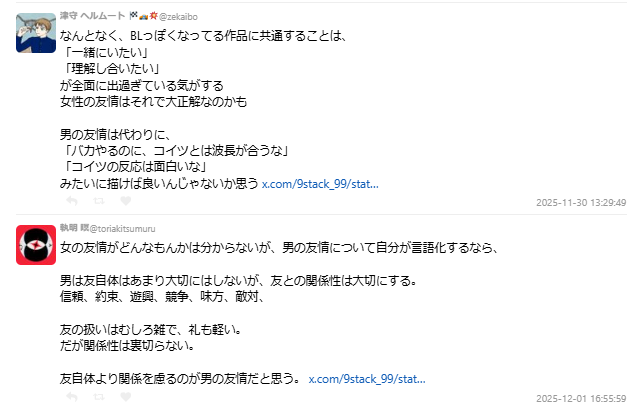
Male friendships are actually very "dry," but the trust between them is incredibly strong.
"Watch a movie together, grab ramen, chat for a bit, then 'see ya,' and that's friendship."
"Haven't seen each other in two years, reunite for 10 hours, say 'later,' and go separate ways, but still best buds."
Some noted that the core of male friendship isn't about "wanting to understand each other," but rather: "This guy's as chuunibyou as I am, we're on the same wavelength." or "We have great chemistry when we're messing around together." There aren't as many complex psychological considerations; essentially, if you click, you're good friends. There's no need to constantly keep in touch or have that "spiritual closeness."
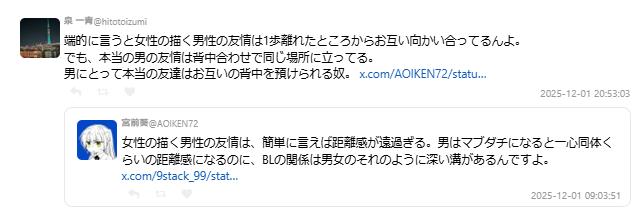
One netizen described it perfectly: "Female-written male friendships often look like two guys standing a meter apart, staring at each other. But real male friendship is two guys standing shoulder-to-shoulder, facing the same direction."
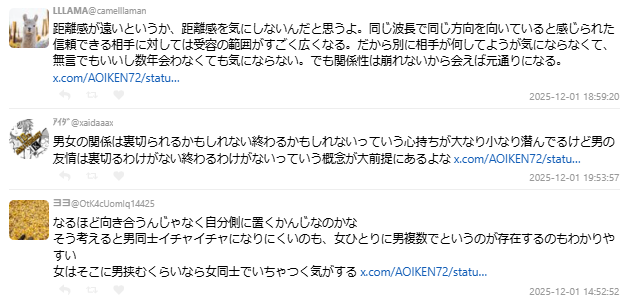
Many pointed out that when women write friendships, they naturally tend to incorporate elements like "mutual respect" or "spiritual connection," which can make the emotional distance feel closer to romance.
However, male friendships are often: not overly intimate, don't require constant contact, yet possess an unbelievably strong bond of trust and camaraderie, sometimes even reaching the depth of "sworn brothers" or "family." Perhaps this kind of relationship is harder for female creators to imagine.
The entire discussion ultimately evolved into a large-scale cultural study. Kokonoe Tsukumo thanked everyone for their insights, saying she might now understand her blind spot and will strive to write male friendships that won't be mistaken for BL. Perhaps this difference in perspective between genders is indeed the root of such a cognitive gap.
via: togetter