

KADOKAWA announced its full-year financial results for the fiscal year ending March 2026 on May 14, revealing that consolidated operating profit nearly halved from JPY 8.9 billion in the previous year to just JPY 4 billion. Notably, its core publishing business swung from a JPY 3.2 billion profit to a JPY 1 billion operating deficit.
The company's analysis points to an over-concentration on specific genres, particularly those from "Shosetsuka ni Naro" (Let's Become a Novelist) and Isekai (otherworld) themes, as a primary reason for the increasing difficulty in generating profit across the enterprise.
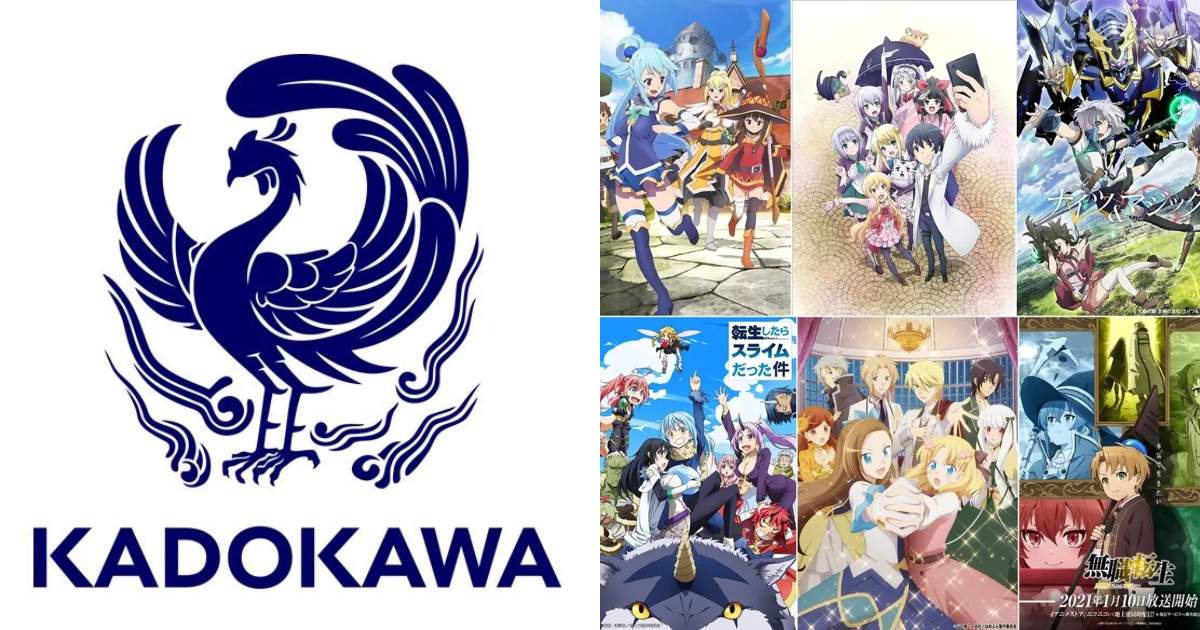
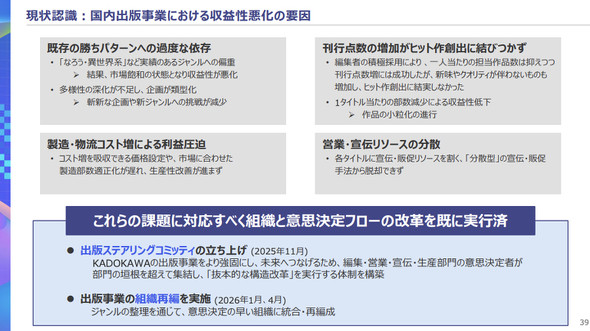
In its financial report, KADOKAWA explicitly stated that one of the reasons for the deteriorating profit was "over-reliance on existing success models." The company explained that a long-term focus on established genres like "Shosetsuka ni Naro" and Isekai themes has led to market saturation and formulaic planning, resulting in a decline in the freshness and challenging nature of its works.
Furthermore, despite actively expanding its editorial staff and increasing publication volume, many titles failed to meet quality and innovation standards. This prevented the creation of new hit works and led to a continuous decline in per-title sales.
(Note: "Shosetsuka ni Naro" refers to a Japanese user-generated content website where authors can freely publish novels. Many popular works originated from this platform, including "Mushoku Tensei: Jobless Reincarnation," "That Time I Got Reincarnated as a Slime," and "Re:ZERO - Starting Life in Another World.")
KADOKAWA also cited several other factors contributing to the profit squeeze, including: marketing and promotional resources overly dispersed across various titles, rising manufacturing and logistics costs, and price adjustments being unable to fully absorb cost increases. To address these issues, the company established a "Publishing Operations Committee" in November 2025 to implement structural reforms.
This cross-departmental organization, comprising decision-makers from editorial, sales, marketing, and production departments, aims to drive structural reform within the publishing business. Concurrently, KADOKAWA reorganized its publishing division in January and April 2026, hoping to accelerate decision-making and improve organizational efficiency by streamlining genre classification.
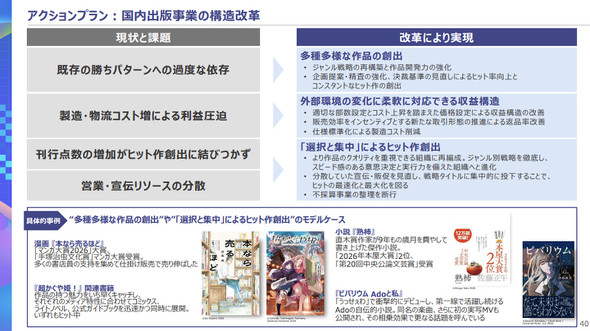
Regarding the direction of these reforms, KADOKAWA highlighted several works as "structural reform model cases," such as "Hon Nara Uru Hodo," which won the "Manga Taisho 2026," and "Atsugaki," a novel by a Naoki Prize author. These titles deliberately avoid the Isekai trend, aiming to expand into more diverse genres.
Meanwhile, the anime and live-action adaptation businesses are also struggling, reporting an operating loss of JPY 465 million, officially turning to a deficit.
The company attributed this to a lack of major hit works capable of driving revenue, as well as increased investment in anime studios and an expanded production system, which led to significantly higher costs. Additionally, the disappearance of the high-earning rebound from major titles like "Oshi no Ko" in the previous year also contributed to the decline.
For its anime business, KADOKAWA plans to enrich its content lineup by actively promoting sequels to new anime aired in the fiscal year ending March 2026, in addition to existing popular series. The company also intends to expand its in-house anime studio production capacity and strengthen intra-group collaboration.
In live-action adaptations, KADOKAWA will continue to pursue large-scale projects, focusing on adapting its own original works into live-action films. However, the company acknowledged that profitability is likely to remain low for the next two years as it prioritizes rebuilding its business foundation, with the goal of restoring this segment to stable profitability thereafter.
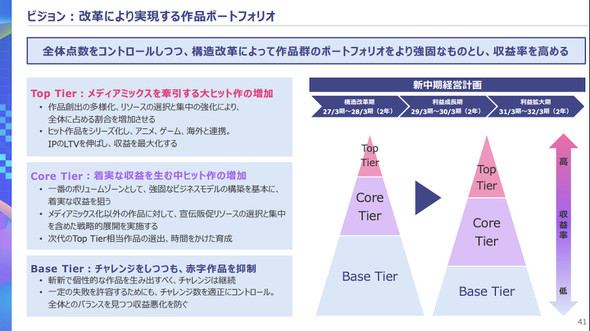
The financial report also disclosed that the previous mid-term management plan did not meet its targets. Consequently, KADOKAWA has formulated a new mid-term plan covering the fiscal years from March 2027 to March 2032.
The first two years (2027-2028) are positioned as a "structural reform period," focusing on portfolio restructuring and cost optimization. This will be followed by a "profit growth period" and a "profit expansion period," with the objective of achieving an average annual operating profit growth rate of 24.7% in the publishing and IP creation segments from fiscal year 2026 (considered the bottom) to fiscal year 2032.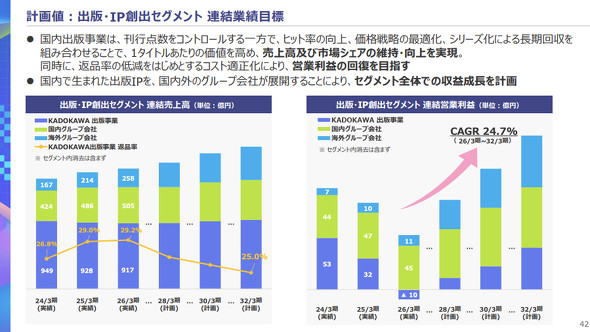
Note: Financial figures and earnings forecasts should be confirmed through the company’s official announcements.
via: KADOKAWAグループ ポータルサイト