

Epic Games CEO Tim Sweeney has once again taken aim at Valve, accusing Steam of using Steamworks to create a closed social ecosystem that makes it difficult for players to connect across platforms. He went so far as to claim that “Valve has held gaming back for years,” reigniting debate over Steam’s revenue cut and cross-platform features.

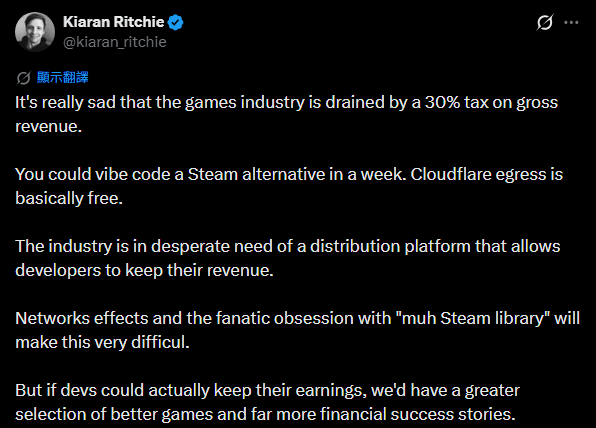
The controversy began when Kiaran Ritchie, a former principal animation programmer at Epic Games, criticized Steam’s 30% cut of game sales in a post on X (formerly Twitter).
Ritchie argued that a rival storefront could be built through vibe coding in just one week, while Cloudflare’s data-transfer costs would be virtually negligible. If developers could keep more of their revenue, he said, the market would produce more great games and financial success stories. However, players’ attachment to their Steam libraries and the platform’s established network effect remain formidable barriers for new competitors.
After users pointed to the mixed response surrounding Epic Games’ recently launched, vibe-coded launcher, Ritchie fired back: “Client software is basically irrelevant these days. Anyone could build something better than Steam, and it wouldn’t even be difficult.”
He explained that he only brought up the client because people often defend Steam by citing the quality of its software, as though building storefront software were still a major technical challenge. In his view, Steam’s accumulated player network—not its technology—is what makes the platform difficult to replace.
Ritchie also questioned why Valve does not allow developers to purchase individual Steamworks services based on their actual needs. “They won’t do it because nobody would voluntarily pay anything close to 30% for those services,” he said.
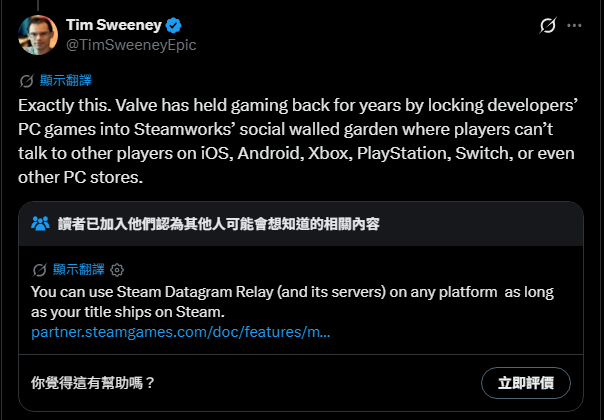
Sweeney responded that Ritchie was “exactly right,” adding: “Valve has held gaming back for years by trapping developers’ PC games inside Steamworks’ closed social ecosystem, preventing players from communicating with people on iOS, Android, Xbox, PlayStation, Nintendo Switch or even other PC storefronts.”
An X Community Note challenged the claim, explaining that many games use Steamworks only for authentication while developers implement the remaining systems themselves, allowing cross-platform play. In other words, using Steamworks does not inherently prevent players on different platforms from interacting.
Sweeney dismissed the note as “fake,” arguing that the Steam Datagram Relay service was unrelated to the social features and cross-platform player communication he had criticized.
The following day, Sweeney acknowledged that Valve does not force developers to adopt Steamworks, but argued that avoiding it entirely is difficult in practice. By comparison, Epic Games offers Epic Online Services for free, providing social and matchmaking features that developers can use on platforms beyond the Epic Games Store. The dispute has once again fueled debate over Steam’s market power and the value of its platform services.
This is far from Sweeney’s only criticism of Valve. He previously targeted Steam’s AI disclosure policy, accusing Valve of forcing developers to disclose their use of generative AI and describing the requirement as a “political act.”
Under Steam’s current rules, developers must disclose AI-generated content that players will directly experience, including artwork, audio, narrative text and localization. AI tools used solely to improve development efficiency are not subject to the same requirement.

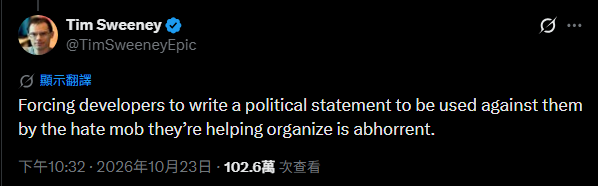
“Forcing developers to write political statements that can then be weaponized against them by hate mobs Valve is helping organize is abhorrent,” Sweeney wrote. He also compared AI disclosure requirements to forcing developers to reveal their political views or voting records, arguing that such information could be used to launch boycotts that damage game sales and developers’ livelihoods.
Epic Games, meanwhile, has been aggressively embracing AI-assisted development. In addition to using vibe coding to build a new version of the Epic Games Launcher, the company has organized Unreal Engine development competitions. Sweeney also recently revealed that Epic Games had begun a major strategic shift aimed at accelerating its adoption of AI technology across the board.
Valve has yet to respond to Sweeney’s latest round of criticism. Steam, meanwhile, set another all-time concurrent-user record earlier in October, reaching 43.5 million users and underscoring its continued dominance of the PC gaming market.
via: PC Gamer