
The final battle for the title of the world's strongest beetle is on!

Perhaps it's due to the pandemic, but the beetle craze seems to be making a major comeback.
In Japan, we've seen a ton of new Ichiban Kuji prizes and Gashapon series dedicated to them.
Among them is this particular Gashapon line, which Bandai is clearly using to flex its incredible manufacturing technology.
The moment I saw the announcement for this wave, I didn't hesitate for a second—I pre-ordered the entire set.
The Hercules Beetle was an icon for kids in the 90s.
If you had a Hercules Beetle, you were the coolest kid in class.
It's a piece of nostalgia, a romantic memory from a bygone era.
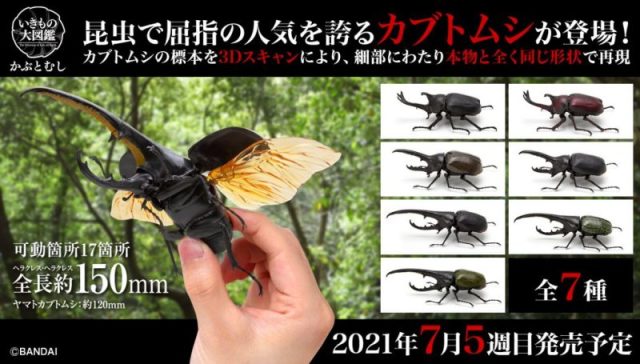
This new Rhinoceros Beetle series features a full lineup of 7 figures:
The Japanese Rhinoceros Beetle in two color variations.
The *Dynastes bleuzeni* Hercules Beetle (DHB or DB) in two color variations.
The *Dynastes hercules hercules* (DHH subspecies) in three color variations.
Just a quick note to head off any arguments:
The DHB has since been classified as its own species, *Dynastes bleuzeni* (DB).
However, a lot of online resources still refer to it as DHB.
So, to cover all bases, I'm just listing both names here.
Now, let's dive right into the unboxing.
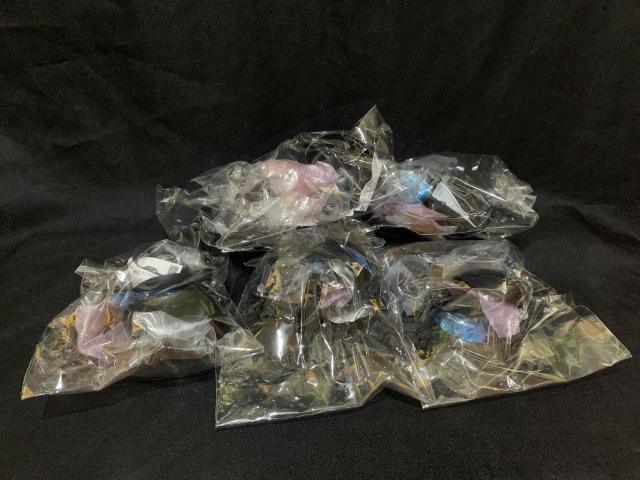
I pre-ordered the complete set all at once.
Awesome. Perfect.
Japanese Rhinoceros Beetle (*T. d. septentrionalis*)

Japan's strongest, the great general, the champion—the Yamato Kabutomushi.
This is one of the most symbolic insects in Japan.
You could even call it the national insect of Japan and you wouldn't be wrong.
This Gashapon release includes two common real-world color variants:
Black and a deep reddish-brown.
I'll be using the red version to showcase the details below.


The sculpt was created from a 3D scan of an actual specimen, which means it's incredibly accurate.
Aside from a few minor details that might be slightly off due to unavoidable factors in the production process (like mold release distortion or Bandai reusing parts),
the overall model is a near-perfect recreation.

One small trade-off is that to accurately replicate the sharp spines on the legs, the tarsus and tibia are now molded as a single, non-articulated piece. It's a minor shame, but understandable.


The abdomen and unfolded wings feature a paint application that is even more realistic than the previous wave.

*Dynastes bleuzeni* Hercules Beetle

Native to eastern Venezuela, the elytra (wing covers) of this species are a deeper shade of red compared to the DHH subspecies.
I personally haven't handled a live *D. bleuzeni*, so my knowledge is limited. If any experts in the comments have more info, please share!
Just like the Japanese Beetle, the *D. bleuzeni* comes in two versions:
One with the standard deep reddish-brown elytra, and another with black elytra, which mimics the color change the beetle undergoes in humid environments.
(This is a signature trait of the *Dynastes* genus.)
I'll be using the standard reddish-brown version for the detailed shots.


Even though I've never worked with this species before, this figure is surprisingly my favorite of the entire set!
The reddish-brown elytra give it an elegant, mysterious, and dignified presence.
The relatively short head and thoracic horns also give it a compact and somewhat cute appearance.

It would be hilarious if this Gashapon figure ends up getting me into collecting the real DHB. (But can you even find them?)


Hercules Beetle (Nominate Subspecies)
*Dynastes hercules hercules*

The strongest beetle in the trees, the Hercules Beetle.
The god of strength, the champion, the biggest and the best.
As the largest member of the Scarabaeidae family, and possibly the largest of all Coleoptera,
the *D. h. hercules* has always been incredibly popular among breeders.
Countless bloodlines have been developed, and its media exposure is second only to the Japanese Rhinoceros Beetle.
It is, without a doubt, the king of all beetles.
Naturally, DHH couldn't be absent from this Gashapon lineup.

This release includes three DHH variants:
One with black elytra, representing its humid state.
One with the common yellow-brown elytra.
And a rare blue-green variant (a color that can appear in captive-bred specimens, or by exposing a preserved specimen to UV light).
The photos below will focus on the blue-green and yellow-brown versions.

A comparison of the two elytra colors.
Personally, I prefer the classic yellow-brown look.

The mold line on the thoracic horn is a little unfortunate,
but you won't really notice it unless you're looking for it.


The abdomen detail is, once again, excellent.

So, who is the true king of beetles?

Final Thoughts
In my opinion, the sculpting and paintwork on this Rhinoceros Beetle series far exceed what you'd expect for a 500 yen price point.
It's classic Bandai—they'll phone in a high-end action figure but pour their hearts and souls into a Gashapon release.
If you're a fan of biological models, you should definitely consider picking these up if you get the chance.
I'm also hoping they'll continue the line with beetles from the *Chalcosoma*, *Megasoma*, and *Xylotrupes* genera, as well as some giant stag beetles.
I'd love to see a Sumatran Stag or a Japanese Stag Beetle.
Imagine those massive mandibles scaled up to this size... it would be absolutely incredible.
