

As generative AI technology continues to advance, a growing number of AI-generated videos and images have used celebrities' faces and voices without permission. Voice actor Kenjiro Tsuda recently took legal action at the Tokyo District Court after his voice was allegedly imitated without authorization using generative AI. The resulting ruling found that voices may qualify for protection under publicity rights, establishing an important legal basis for protecting voice actors' voices.
The Japan Actors Union, also known as JAU, has now published new guidelines on the use of performers' voices with generative AI. The rules require prior written consent from the performer before AI can be trained on or recreate their voice, or before AI-generated speech can be used in a production. Consent is generally valid for no more than one year, while compensation for AI use must be paid separately rather than bundled into standard performance fees.
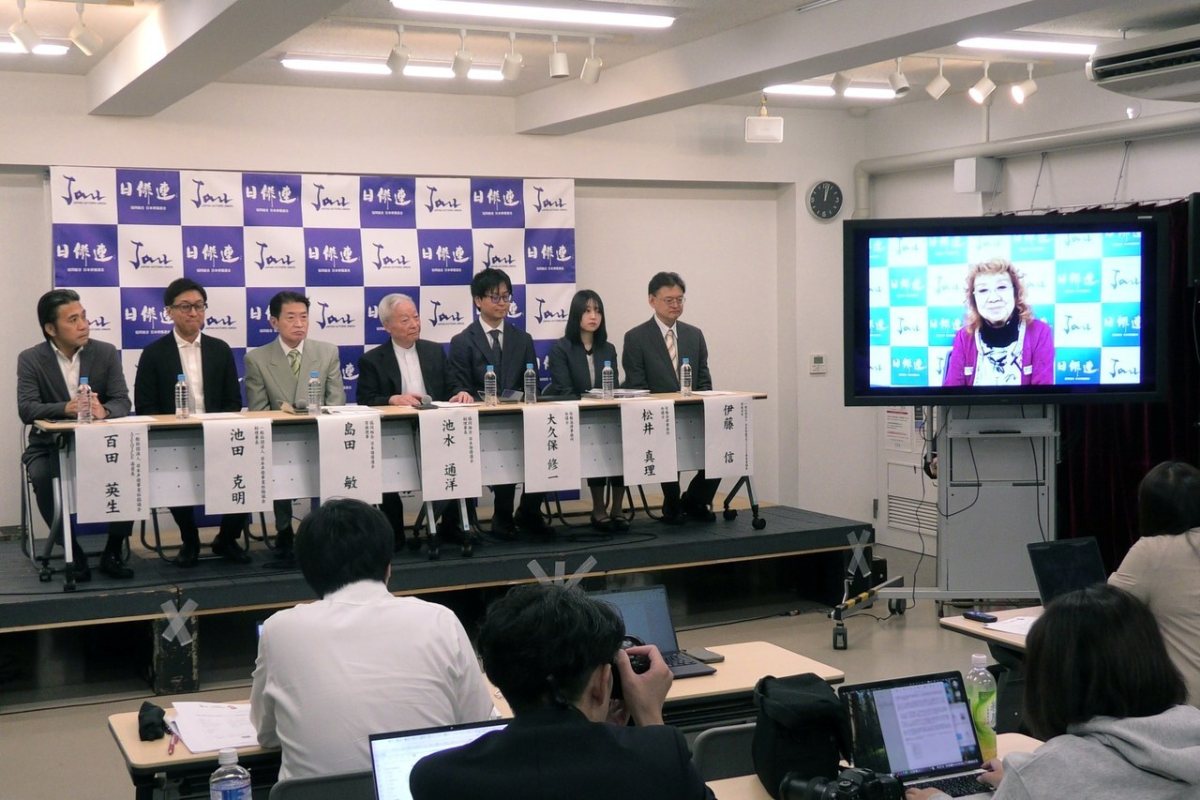
The Japan Actors Union represents approximately 2,600 actors and voice actors. Its newly released Guidelines on Generative AI Use of Voices are voluntary standards aimed at production companies, AI developers, and other industry stakeholders. The union says that Japan currently has no law offering comprehensive protection for an individual's voice itself, making unauthorized AI training and voice generation an urgent issue.
Under the full guidelines, separate written consent must be obtained from the performer before voice data can be supplied for AI training, an AI model capable of recreating the performer's voice can be developed, or generated speech can be used in a production. The guidelines also prohibit blanket permission under a single contract for voices to be used in future projects or new installments.
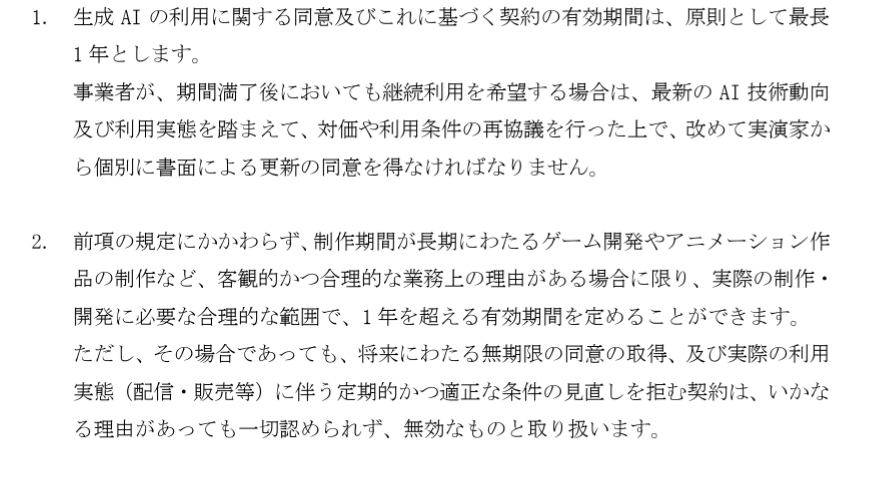
Consent and contracts should generally remain valid for no more than one year. Any continued use requires the terms to be renegotiated. Projects with longer production cycles, including games and animation, may use contracts lasting more than one year when there is a reasonable justification. Compensation must also be negotiated separately for AI training and development, generative AI usage, additional uses such as advertising, and multilingual versions, on top of standard performance fees. If the parties cannot agree on the terms and compensation, AI cannot be used.
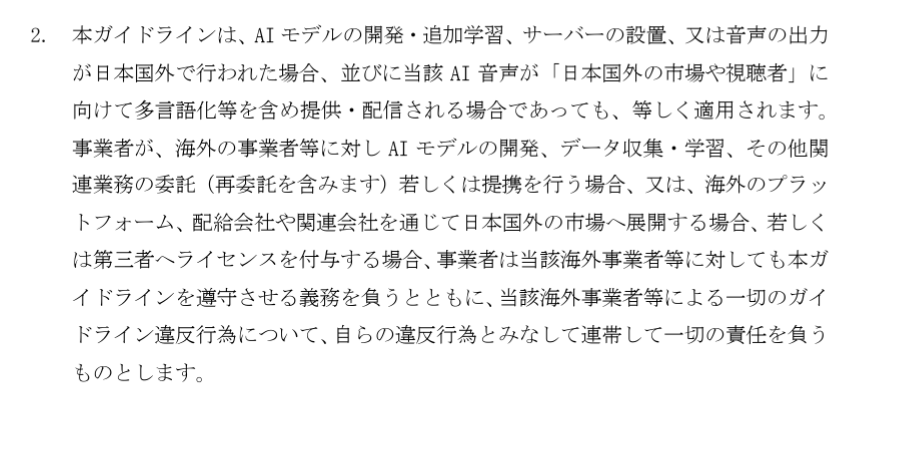
When AI is used to convert a Japanese-language voice performance into other languages for international distribution, the performer's consent must be obtained separately for each target language. The guidelines also prohibit changes that significantly undermine the tone, emotional delivery, or cultural context of the original performance.
Productions using AI-generated speech must disclose that the voice was generated by AI, identify the AI system used, and name the performer who provided the original voice. Performers may, however, request that their names not be disclosed.
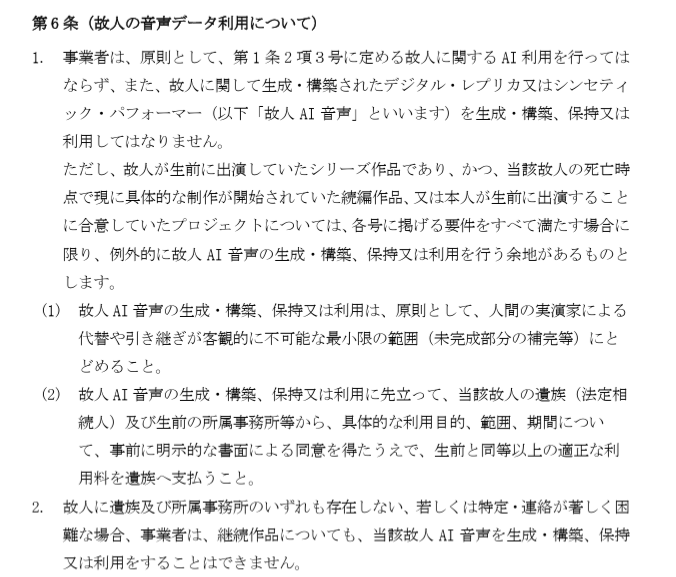
The guidelines generally prohibit using AI to recreate the voices of deceased performers. Exceptions are limited to projects the performer agreed to participate in before their death and continuations of series that were already in production when they died.
Even when an exception applies, the use must be kept to the narrowest possible scope, such as completing unfinished material that cannot reasonably be performed by another living actor. Written consent must also be obtained from the performer's family and relevant parties, including the agency that represented them during their lifetime. The family must receive a usage fee no lower than the amount the performer would have received while alive.
Alongside the Kenjiro Tsuda ruling, which established that voices may fall under publicity-rights protection, the Japan Actors Union hopes its new guidelines will serve as a reference for government agencies and lead to more comprehensive safeguards in future cases.