

Anime has become a global powerhouse, expanding far beyond Japan and Asia as the once-niche medium moves firmly into the mainstream. Yet manga does not appear to be enjoying quite the same momentum.
“Young people don’t read manga anymore.” It is a claim that comes up every now and then. With smartphones swallowing more time through videos and social media, it is easy to assume that younger audiences have fewer opportunities to read manga. However, the recently released “2026 Manga Awareness Survey” from Japanese manga company comici, Inc. suggests the situation is not nearly that simple.

The “2026 Manga Awareness Survey” polled 3,000 people aged 15 to 69 across Japan, examining their manga-reading habits, preferred formats, and how they discover new titles.
The results suggest that readers are developing a new kind of relationship with manga, one that cannot be explained away with a simple claim that young people have stopped reading it.

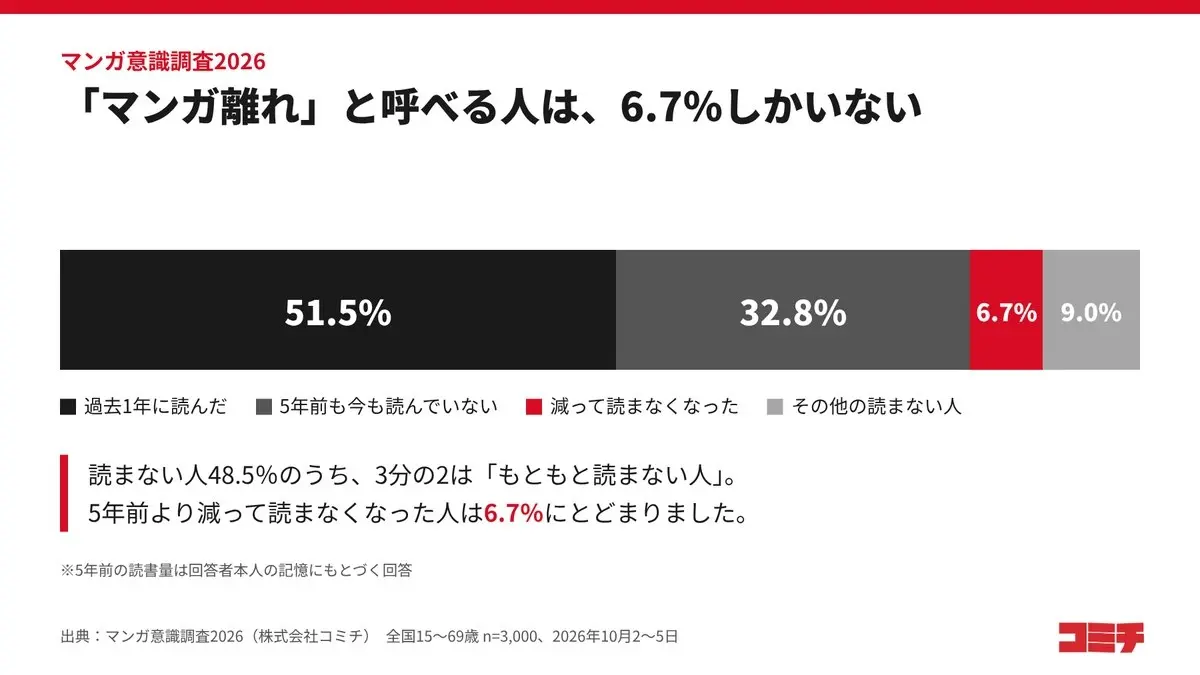
According to the survey, 51.5% of respondents had read manga within the past year, while 48.5% had not. At first glance, the number of non-readers may seem surprisingly high, but a closer look reveals a more interesting picture.
Those who said they had “not read manga at any point over the past five years” accounted for 32.8% of all respondents. By comparison, only 6.7% said they “read less manga than they did five years ago or had stopped reading it altogether.”
In other words, a large share of people who currently do not read manga never had much of a manga-reading habit to begin with. Of course, some current readers may still be reading less than they once did. This survey alone cannot prove that younger generations are not drifting away from manga, but it does offer a reason to reconsider whether the number of non-readers has truly increased.
Another notable finding involves the changing formats people use to read manga.
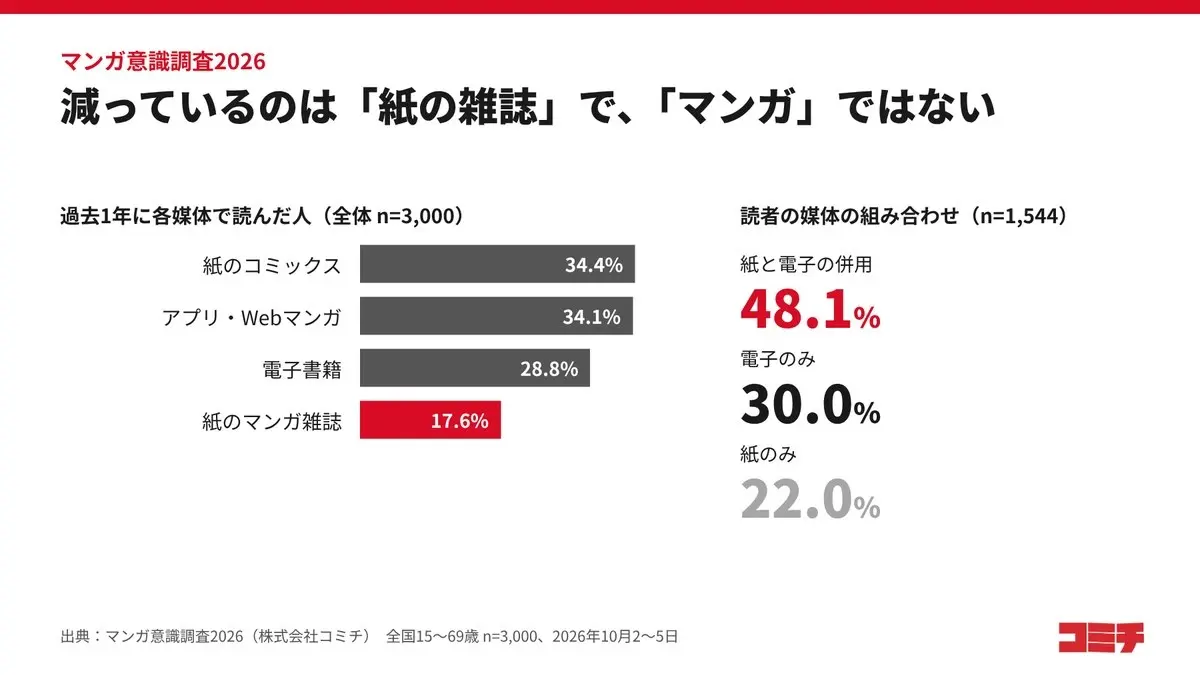
Over the past year, 34.4% of respondents had read print manga volumes, while 34.1% had read manga online through apps or websites, putting the two formats nearly level. Meanwhile, only 17.6% had read print manga magazines. Manga magazines may once have been the heart of the medium’s culture, but collected volumes and smartphone-based reading have now become far more common.
That does not mean digital manga has completely replaced print, however.
Among manga readers, 48.1% used both print and digital formats, compared with 30.0% who read only digital manga and 22.0% who stuck exclusively to print. That nearly even split points to a familiar hybrid approach: reading casual picks on a phone while buying physical copies of favorite series for the shelf.
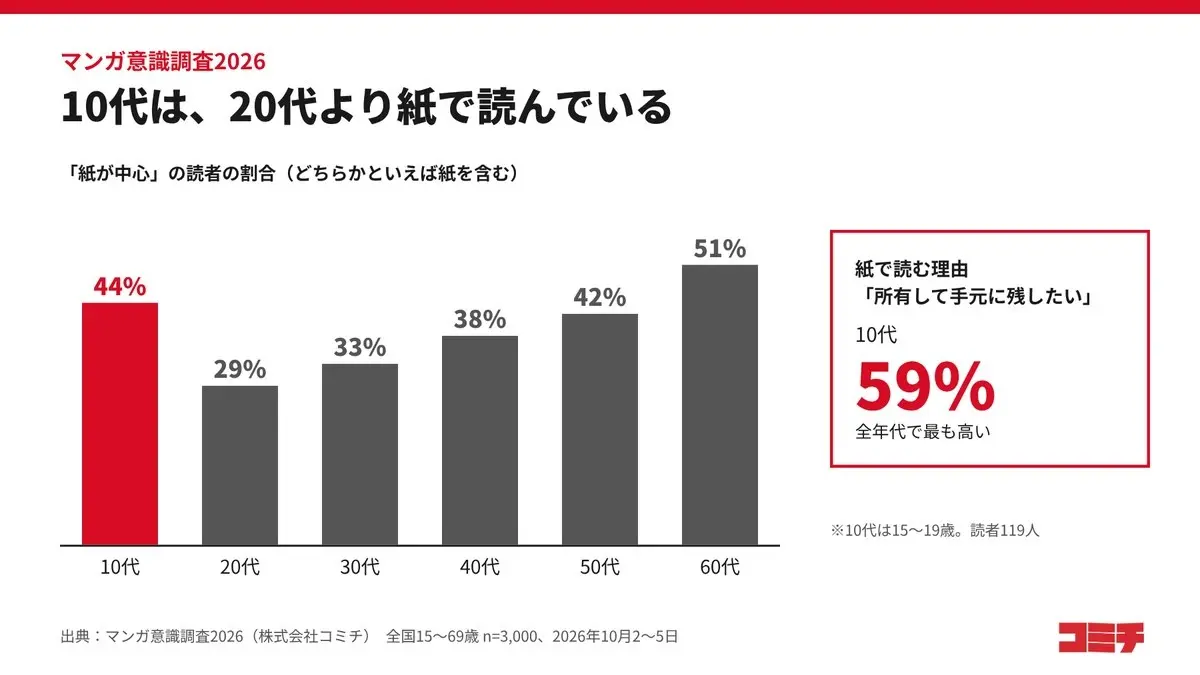
More surprising still is how strongly younger readers favor print. Among respondents who said print was their primary format, 29% were in their twenties, while the figure climbed to 44% among teenagers.
When asked why they chose print manga, 59% of teenage respondents said they “wanted to own physical books and keep them close at hand,” the highest percentage of any age group.
Apparently, growing up as a digital native does not mean wanting to do everything through a smartphone. There may still be something irreplaceable about lining up favorite series on a bookshelf or physically turning the pages of a manga volume. That said, the survey received 119 valid responses from teenage manga readers, so future findings will be worth watching.
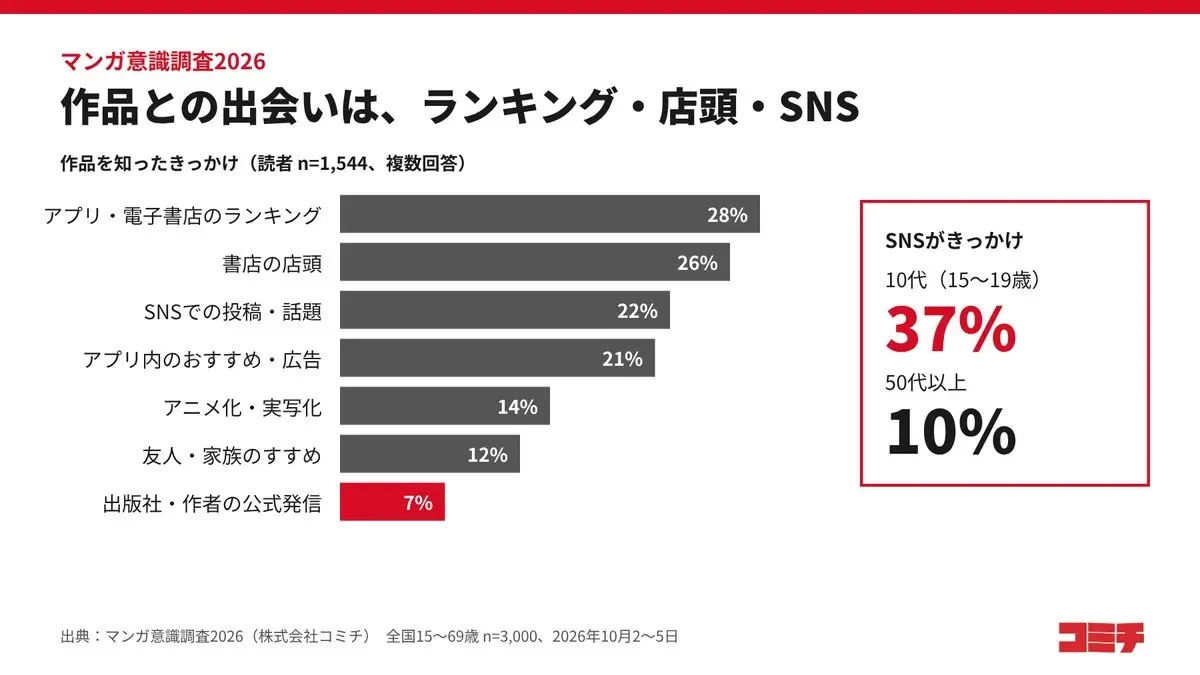
The way readers discover new titles is changing as well. The leading discovery channels were rankings on apps and e-book stores at 28%, in-store displays at physical bookstores at 26%, and social media posts and trending discussions at 22%.
Among teenagers in particular, 37% said they discovered new titles through online communities, compared with just 10% of respondents aged 50 and above. Stumbling across an intriguing manga at a bookstore still has its appeal, but a title spotted in a social media feed could just as easily become someone’s next favorite. Readers now have more entry points into manga than ever.
Generational differences also emerged in attitudes toward AI, which is becoming increasingly common in manga production.
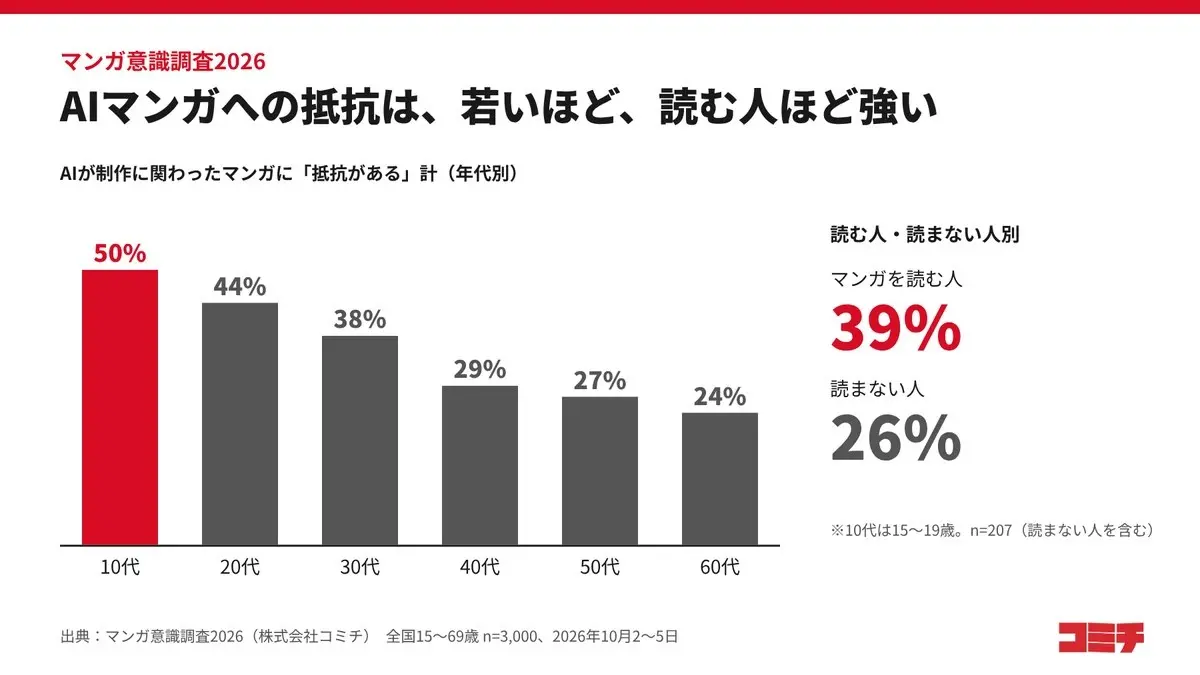
Among respondents in their sixties, 24% said they “felt uncomfortable with manga created with AI involvement.” Among teenagers, however, that figure reached 50%. Regular manga readers were also more skeptical: 39% expressed discomfort with AI being used in manga production, compared with 26% of non-readers.
The findings suggest that younger respondents and regular manga readers tend to be more cautious about AI’s role in manga creation. Some teenagers value physical books, others discover new titles through online communities, and many remain wary of manga produced with AI assistance.
Ultimately, the survey paints a far more varied picture of how younger generations engage with manga. Their relationship with the medium cannot be summed up by saying, “Young people don’t read manga anymore.”
Is manga really losing its audience? Or have the formats people use, the ways they choose new titles, and their expectations of creators simply changed with the times? When considering the future of manga culture, it may be just as important to understand how readers enjoy manga as it is to know what they are reading.
via: PR TIMES