

These days, it is perfectly normal to see people carrying plushies on their bags, bringing them along for company, and snapping photos of them at every stop. Some even cherish them like a partner or their ultimate favorite. Known as “nuikatsu” in Japan, plushie-centered fandom has become an everyday sight.
But a recent article in the Japanese magazine Shukan Shincho took a critical look at the trend, arguing that nuikatsu is essentially a “form of psychological infantilization.” From a psychoanalytic perspective, it suggested that plushies have become “transitional objects” to which some people form intense emotional attachments.
The argument did not go down well on the Japanese side of X, where plushie fans pushed back against having their personal interests judged in such sweeping terms.
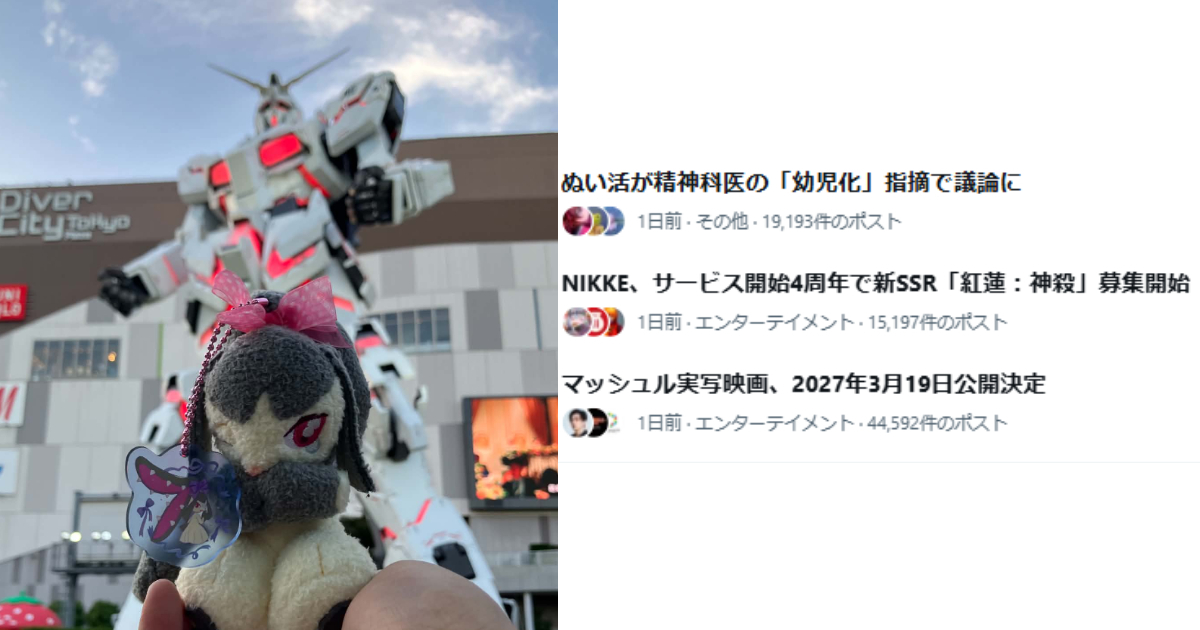
▼ The report quickly became one of the day’s biggest talking points on X in Japan.
In fact, the Shukan Shincho article was not primarily about nuikatsu. Its main focus was the perceived “infantilization” of Japanese society, with the plushie trend presented as one example.
The article noted that people now bring plushies to restaurants, tourist attractions, and all kinds of other places, take photos with them, and upload the results to social media. It argued that there is something undeniably unusual about adults remaining so deeply invested in plushie activities.
According to a survey by Tokyo Shoko Research, Ltd., plushie sales in Japan totaled 50.4 billion yen in 2021 before soaring to 84.9 billion yen last year, pointing to a rapidly expanding market.
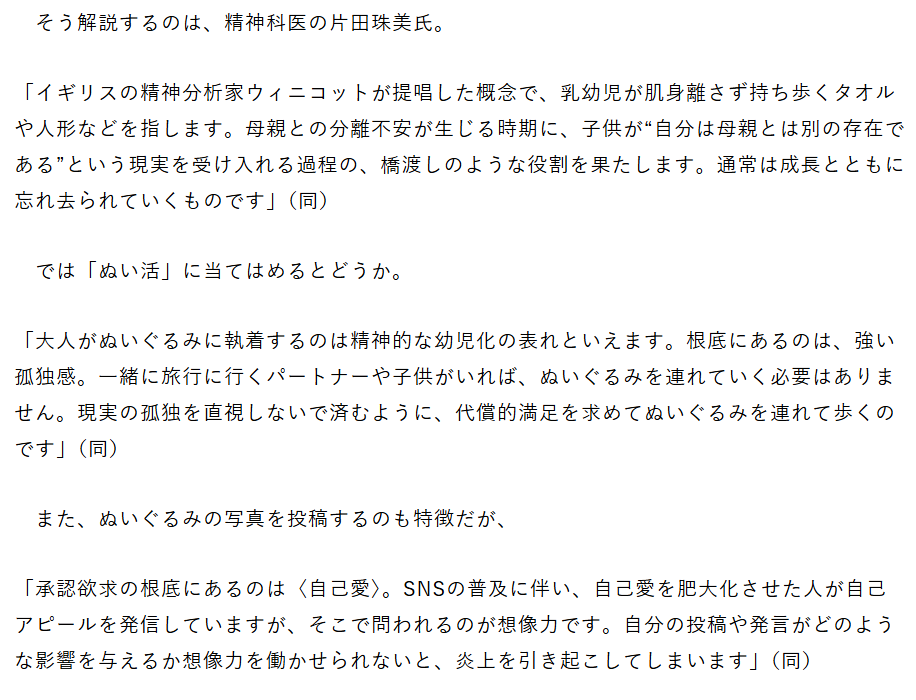
The article also cited Japanese psychiatrist Tamami Katada: “In psychoanalysis, plushies are known as ‘transitional objects.’ The concept was proposed by British psychoanalyst Donald Winnicott and refers to objects such as towels or dolls that infants and young children carry everywhere and refuse to let go of. When children begin experiencing anxiety over separation from their mothers, these objects act as a kind of bridge, gradually helping them accept the reality that ‘I am an independent individual separate from my mother.’ Generally, these objects are gradually forgotten as the child grows older.”
The article’s author then applied this concept to nuikatsu, offering the following interpretation:
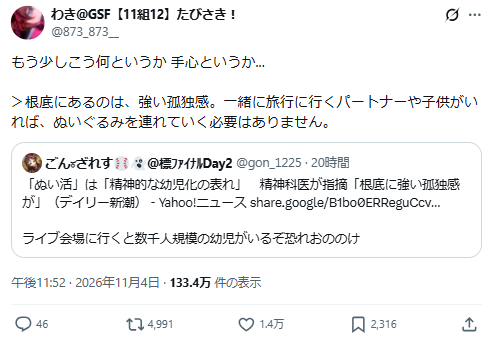
“An adult’s fixation on plushies can be seen as a form of psychological infantilization. At its root is an intense sense of loneliness. If someone had a partner or children to travel with, there would be no need to deliberately bring a plushie along. Carrying a plushie from place to place provides a substitute form of satisfaction, allowing the person to avoid confronting their loneliness in real life.”
Addressing the practice of uploading plushie photos to social media, Katada added: “The desire for validation is rooted in narcissism. As social media has become more widespread, an increasing number of people have developed inflated narcissism and use posts to present themselves to others. This is where a person’s imagination is put to the test. If they cannot imagine how their posts or comments might affect other people, they can easily trigger an online firestorm.”
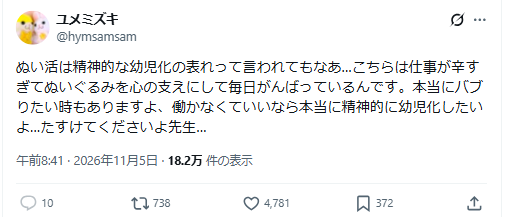
The article sparked a backlash across Japanese social media. Many users described their plushies as “an emotional lifeline that helps them recover from the daily grind” and rejected the idea that the hobby amounted to psychological infantilization. As some pointed out, if they could simply live like babies without having to work, they would not need that emotional comfort in the first place.
One passage drew particular criticism: “If someone had a partner or children to travel with, there would be no need to deliberately bring a plushie along.” Users questioned whether that judgment was unnecessarily harsh in today’s high-pressure society. Everyone has their own way of unwinding, they argued, yet the article made carrying a plushie sound like a sign of social abnormality.
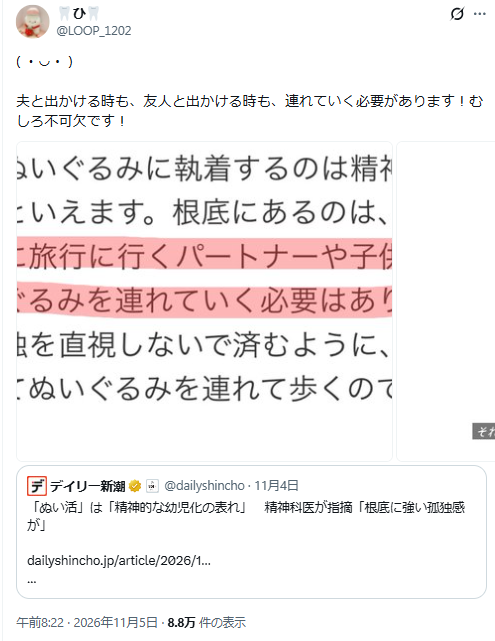
Others said they always bring plushies when going out with their husbands or friends, so the question of whether the toys are “necessary” has never even crossed their minds.
Another user criticized the implication that adults who like plushies should be treated as though a psychiatric assessment had found something wrong with them. What is so unacceptable, they asked, about simply liking cute things and wanting to share that joy?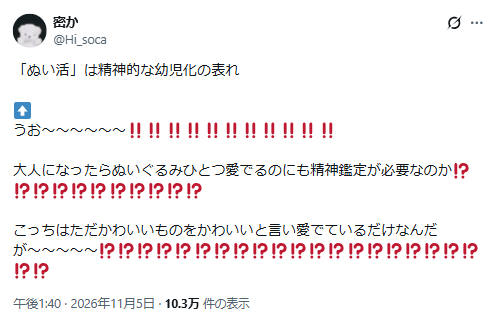
Some users also challenged the supposed opposite of “infantilization”: maturity. If someone is truly a mature adult, they argued, should they not respect other people’s interests? Plushie fans already worry about being judged when taking their favorite toys outside, and articles like this only make that pressure worse.
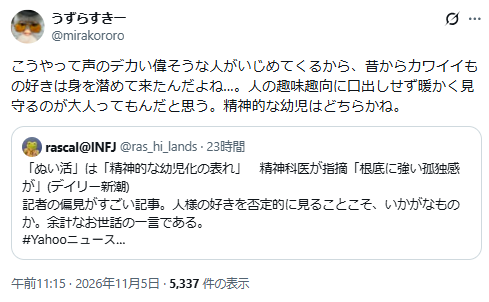
For most nuikatsu fans, the practice is simply a personal hobby that should not be dismissed. Researchers may have their own theories about whether plushies function as transitional objects or reflect infantilized behavior, but the hobby harms no one and can provide genuine emotional support. Given that, it is hardly surprising that fans found the article’s judgment difficult to accept.
Note: Financial figures and earnings forecasts should be confirmed through the company’s official announcements.
via: デイリー新潮