

When it comes to gaming, while there are always established strategies, the ways you can actually play are virtually endless.
A few years back, a Twitch streamer launched a channel called "Pi Plays Pokémon," where they used the digits of Pi (π) to correspond to button presses. Surprisingly, this caught the attention of American mathematician C. Evans Hedges, who recently published a paper titled x Plays Pokémon, for Almost-Every x. The paper delves into the mathematical question of whether Pi can actually beat Pokémon, sparking considerable interest.

The whole phenomenon kicked off in October 2021, when the incredibly bizarre "Pi Plays Pokémon" channel first appeared on Twitch. The setup was simple: each digit of Pi (0-9) was mapped to a specific Game Boy Advance button, and "Pokémon Sapphire" was automatically played at a rate of one digit per second.
The result? The protagonist couldn't even leave the starter area, yet somehow, their initial Sceptile was leveled up to a ridiculous 76. It was absurd, yet strangely compelling.
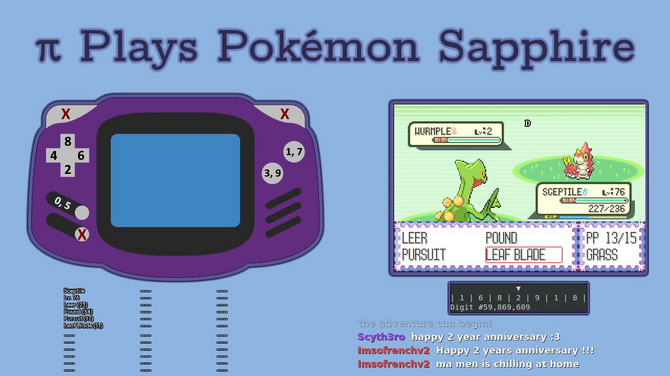
▼ The gameplay is still ongoing, and you can check out the archives on the channel.
So, the burning question remains: Can Pi truly beat Pokémon?
According to the research, the key lies in a concept called a "Disjunctive Number." The characteristic of such numbers is that any finite sequence of digits will eventually appear in its decimal expansion. Whether it's a specific number, your phone number, or any random string you can imagine, it will show up somewhere. From the perspective of Lebesgue measure, almost all real numbers are Disjunctive Numbers.

Now, let's look at video games like Pokémon. Because memory capacity is finite, the number of "states" a game can be in is also mathematically finite—this includes screens, items, stats, everything. The state changes caused by button presses are inherently deterministic.
If we assume, for a moment, that the game has no unresolvable situations like soft locks or bugs, then we can apply the "Synchronizing Word" theorem from automata theory. Simply put, this theorem states: no matter what state you start from, inputting a specific sequence of commands will always lead to the same final state. This means that, theoretically, there exists a "finite sequence of button inputs" that, regardless of the current game progress, can ultimately guide the game to a "completion" state.
And because "Disjunctive Numbers" contain all finite sequences of digits, this "game-beating input sequence" must also appear within them. In other words, any Disjunctive Number 'x' can theoretically beat a deterministic game that doesn't get stuck.
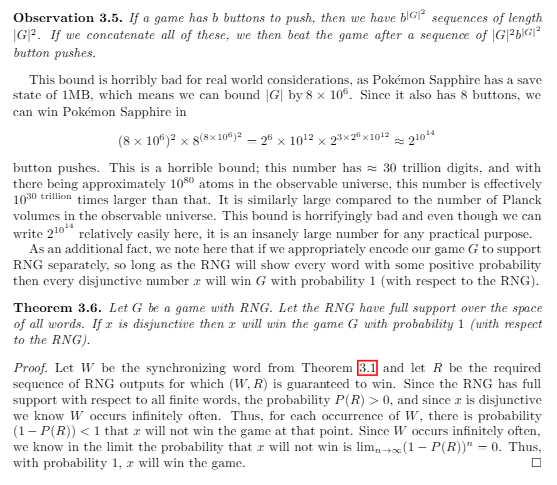
However, here's the catch: whether Pi itself is a Disjunctive Number has yet to be proven. So, the original question of "Can Pi beat Pokémon?" still doesn't have a definitive answer.
Even if it were theoretically "possible," seeing it happen in reality is virtually impossible. Pokémon's save states are finite, and there are only 8 buttons. Calculations show that the upper limit for the number of button inputs required to "guarantee a win" is approximately 2 to the power of 1014. How big is that number? Unfathomably massive.
So, the conclusion is that even if a Disjunctive Number could someday beat Pokémon, the amount of time it would take is completely incalculable.
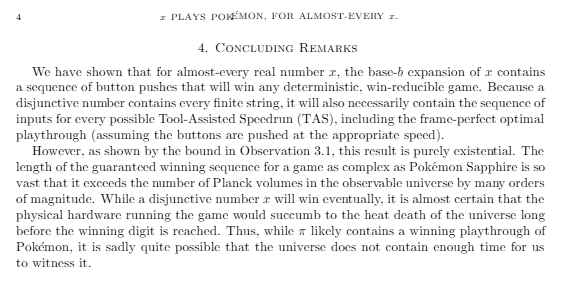
Of course, the original streaming channel's progress is still very limited, stuck in the starter town to this day. But the fact that it inspired actual mathematical research just goes to show that this unique way of playing really sparked some serious conversation!
via: itmedia