

Japan's Ministry of Justice Rehabilitation Bureau has recently teamed up with the Netflix dating reality series Badly in Love Season 2 for a promotional campaign centered on offender rehabilitation and reintegration. The collaboration, however, has sparked controversy over the backgrounds of some cast members and the way their past experiences are presented on the show.
While the Ministry has stressed that the campaign is “in no way intended to endorse crime,” criticism has continued to spread across Japanese social media, with some users arguing that the promotion risks turning past wrongdoing into something closer to a badge of honor.

Badly in Love Season 2 began streaming on Netflix on August 4. The Japanese dating reality show brings together men and women from across the country who have backgrounds in delinquent youth culture, following them as they live together and navigate romance, friendship and interpersonal conflict while confronting their pasts and attempting to move forward with their lives. Season 2 is hosted by MEGUMI, comedian Nagano and Okinawan musician Awich.

The controversial collaboration is part of a public-awareness initiative by the Ministry of Justice's Rehabilitation Bureau. Posters featuring the Season 2 cast carry slogans including “Rehabilitation, Bring It On!!” and “Getting Back on Your Feet Is Love,” and are being distributed to probation offices and other related institutions across Japan.
The Ministry says it hopes the popularity of the series will encourage more people to learn about Japan's rehabilitation and reintegration system, while also promoting the idea that society should support people who are trying to rebuild their lives.
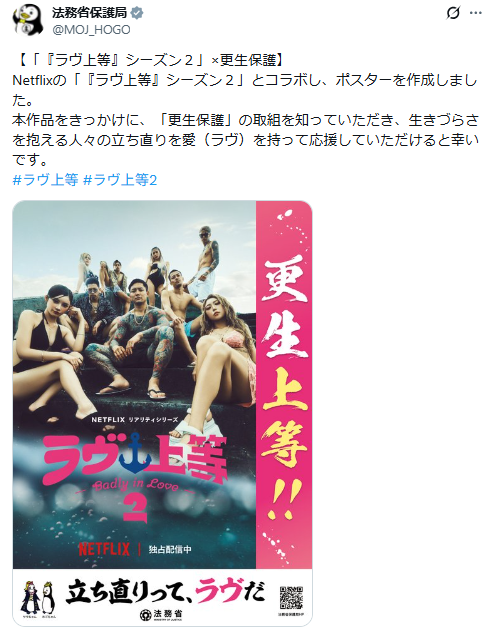
Once the posters were unveiled, however, the collaboration quickly became the subject of heated debate. Critics argued that the Ministry of Justice—an institution directly involved in crime prevention and rehabilitation—had chosen to partner with a reality show whose identity is heavily built around former delinquent culture, while using the deliberately provocative slogan “Rehabilitation, Bring It On!!” Some felt the result risked making criminal or delinquent histories look glamorous or entertaining.
For many critics, the issue is not simply whether people with criminal histories deserve the opportunity to start over. The discussion has also expanded into a broader question: when serious harm done to other people becomes part of a reality show's entertainment value, is it appropriate for a government agency to publicly endorse that production through an official campaign?
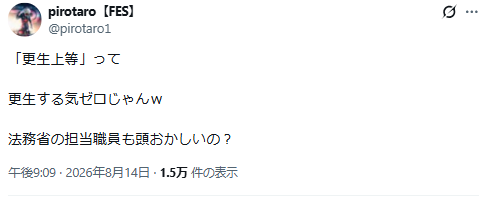

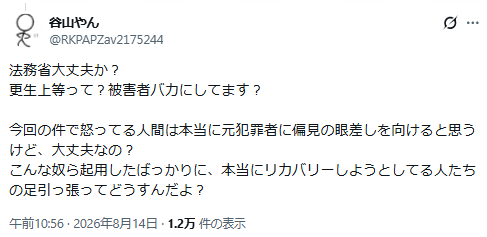
Responding to the controversy, Japan's Ministry of Justice Rehabilitation Bureau emphasized in media interviews that the collaboration is “in no way intended to endorse crime.” Instead, officials said the goal is to use the visibility of Badly in Love to raise awareness of rehabilitation and reintegration efforts. The Ministry also said it wants to communicate the message that people can change and rebuild their lives, and that there are currently no plans to alter the poster campaign's schedule.
From the Ministry's perspective, the show's theme of people confronting their pasts and trying to rebuild their lives overlaps with the core principles of rehabilitation, particularly the goal of helping people reintegrate into their communities.

That explanation has not completely quieted the criticism. Some users argue that genuine rehabilitation should involve regretting past wrongdoing, taking responsibility and making a sustained effort to rebuild one's life—not presenting a history of delinquency or criminal behavior as a boastful “war story” or a distinctive part of one's personal image. Particular criticism has been directed at moments in the series where some cast members appear to recount behavior that harmed others as though it demonstrated their toughness.
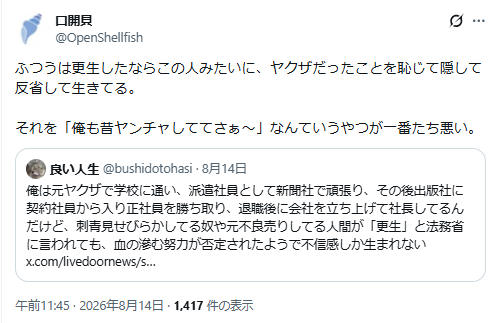
One widely shared response came from an X user who said he had once been involved with organized crime. According to his account, he later returned to his studies, worked as a temporary employee, built a career at a newspaper company, then worked his way from a contract position at a publishing company to full-time employment. After leaving the company, he started his own business and is now a company owner.
He argued that seeing people deliberately displaying their tattoos or using “I used to be a delinquent” as part of their public appeal being presented by the Ministry of Justice as examples of “rehabilitation” made him feel as though the years of effort he had put into rebuilding his own life were being dismissed. For him, the campaign inspired less confidence in the concept of rehabilitation, not more.
The partnership between Badly in Love and Japan's Ministry of Justice was originally intended to use a popular series to promote the ideas that “people can change” and that individuals deserve a chance to rebuild their lives. Instead, it has unexpectedly grown into a much broader debate over crime, rehabilitation, victims' rights and media ethics.
The controversy also highlights a difficult question for government agencies seeking to use popular culture to promote rehabilitation: how can society balance giving people who are trying to change a genuine second chance with avoiding the minimization of harm suffered by victims? In this case, that balance has proven anything but simple.