

Whenever social media revives the debate over whether Green Lantern Hal Jordan is racially prejudiced, some fans inevitably pull a famous three-panel sequence from its original context and scrutinize it in isolation. The scene comes from DC Comics’ 1970s Green Lantern/Green Arrow run, originally published across Green Lantern Vol. 2 #76–87 and #89, among other issues.
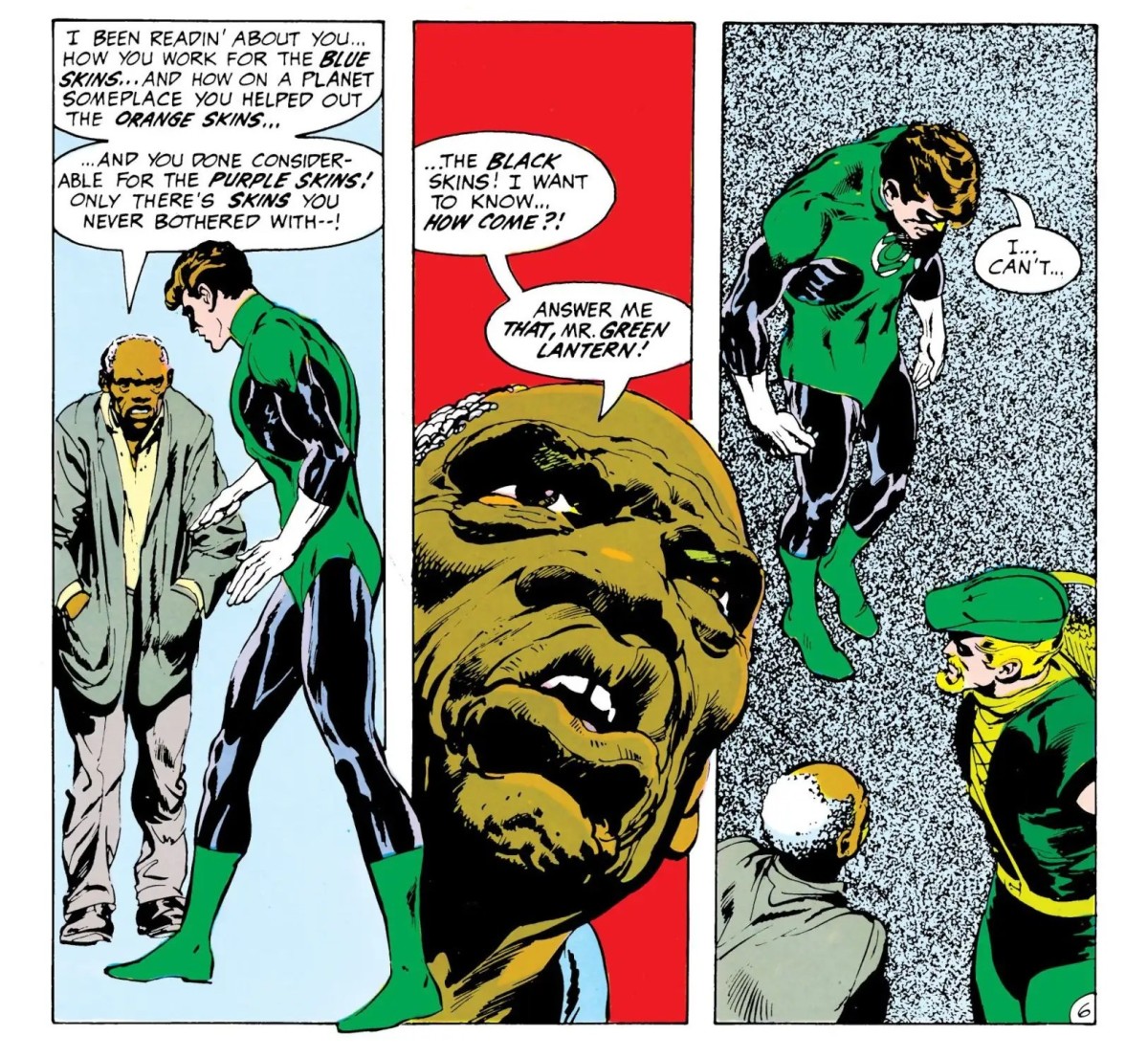
In the sequence, an elderly Black man asks Hal why he has helped aliens with “blue skins,” “orange skins” and “purple skins,” yet has never extended that same help to people with “black skins.” Hal lowers his head and answers haltingly, “I… can’t.” Those few panels have led many readers to claim that Hal is “admitting” he is a racist.
Once the full issue, writer Denny O’Neil’s creative intent and John Stewart’s later debut as another Green Lantern in Green Lantern #87 are restored to their original contexts, however, that interpretation is clearly not the most accurate one.
What Green Lantern/Green Arrow truly puts on trial is Hal’s excessive faith in law, order and authority. He knows how to address visible, recognizable violations of the law, but cannot see the structural oppression concealed beneath ostensibly legal systems. Race provides the sharpest challenge to that blind spot—but this distinction matters: the text does not portray him as someone who believes in white supremacy, hates Black people or refuses to help others because of their skin color.
A more precise reading is that Hal, at this point, is an establishment hero constrained by the blind spots of a rigid system, which can even lead him to make prejudiced judgments. The purpose of confronting him with reality is to educate him and allow him to grow, not to crudely expose him as a closeted racist.
That reading also reflects O’Neil’s own description of the character. He conceived Green Lantern as an “establishment guy,” creating a stark contrast with Green Arrow’s anti-establishment position.
▌What Is the “Black Skins” Question Really Asking?
At the beginning of Green Lantern #76, “No Evil Shall Escape My Sight!,” Hal sees people attacking an elderly man in the street. Acting on a superhero’s instinct, he immediately intervenes. Only after clashing with Green Arrow Oliver Queen and listening to his warning does Hal discover that the man he protected is a predatory landlord preparing to evict his impoverished tenants.
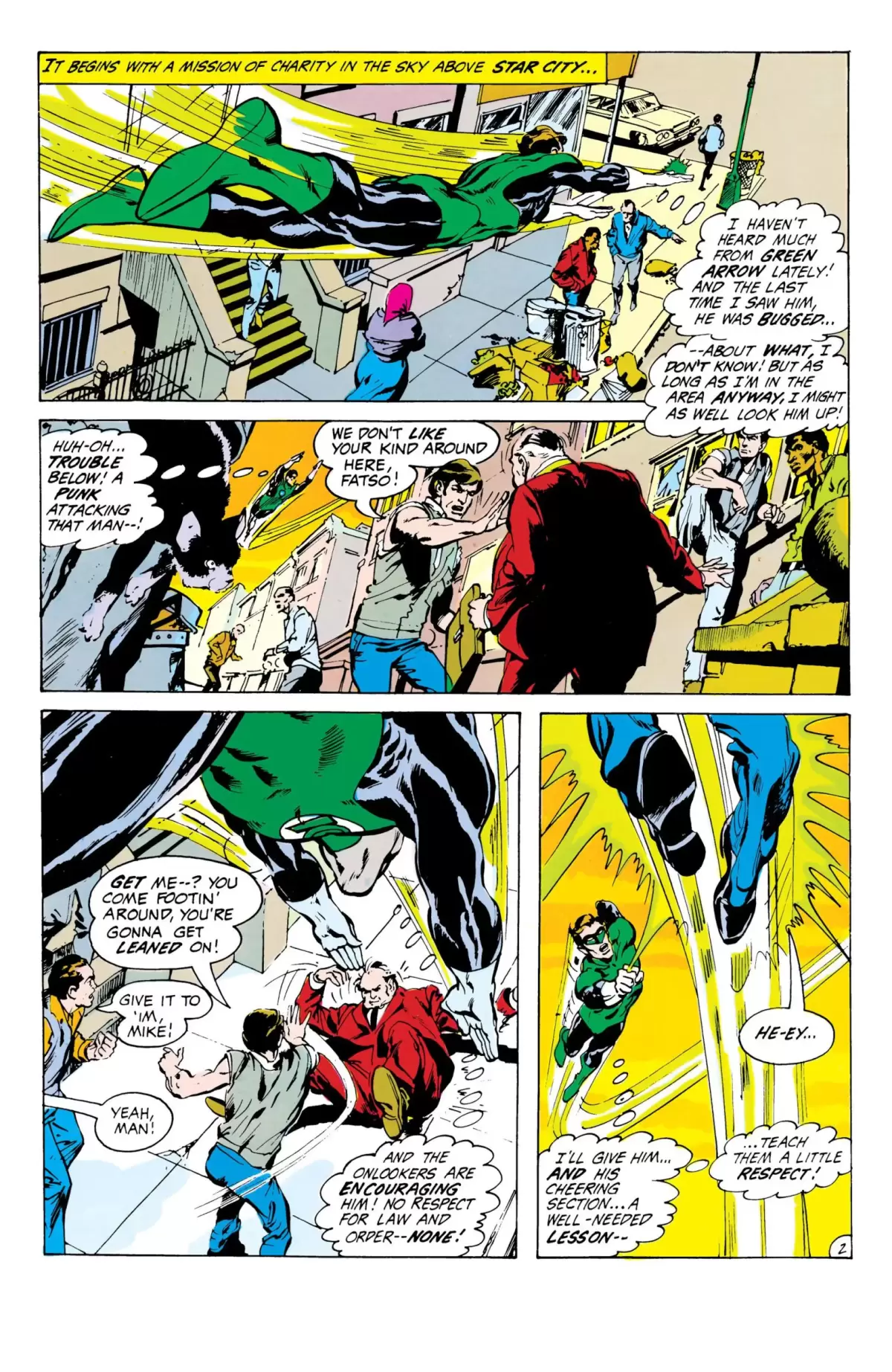
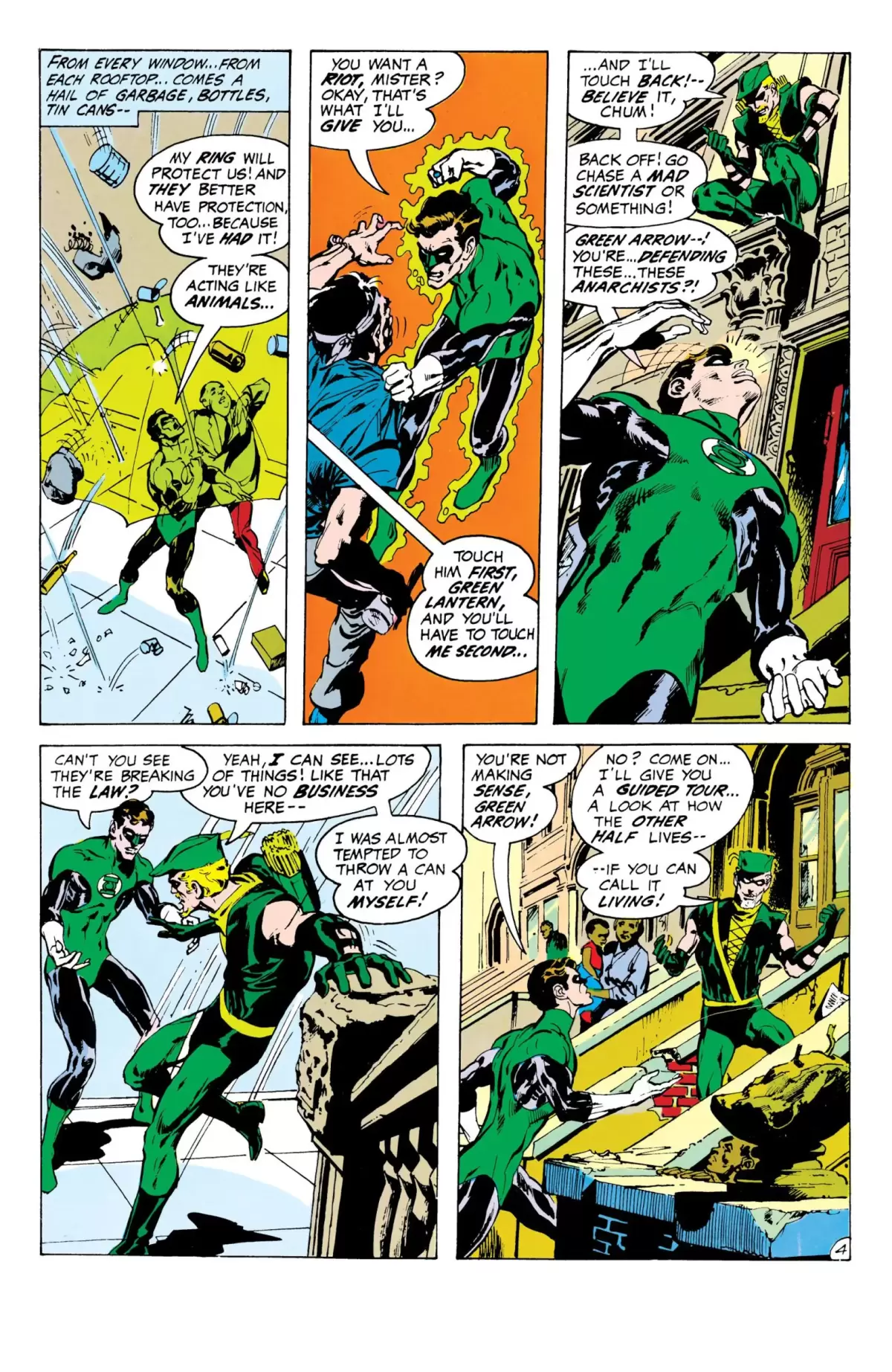 Hal has, unusually, “taken the wrong side.” His mistake does not arise from a preconceived bias against Black people. He witnesses what appears on the surface to be an act of street violence, applies the logic of a law-enforcement officer and immediately decides that the people throwing the punches must be the aggressors.
When O’Neil later reflected on this celebrated scene, he emphasized what happens after the elderly man’s anguished question: Green Lantern turns his attention toward bringing the abusive landlord to justice. This before-and-after progression is crucial both to the story and to Hal’s subsequent characterization.
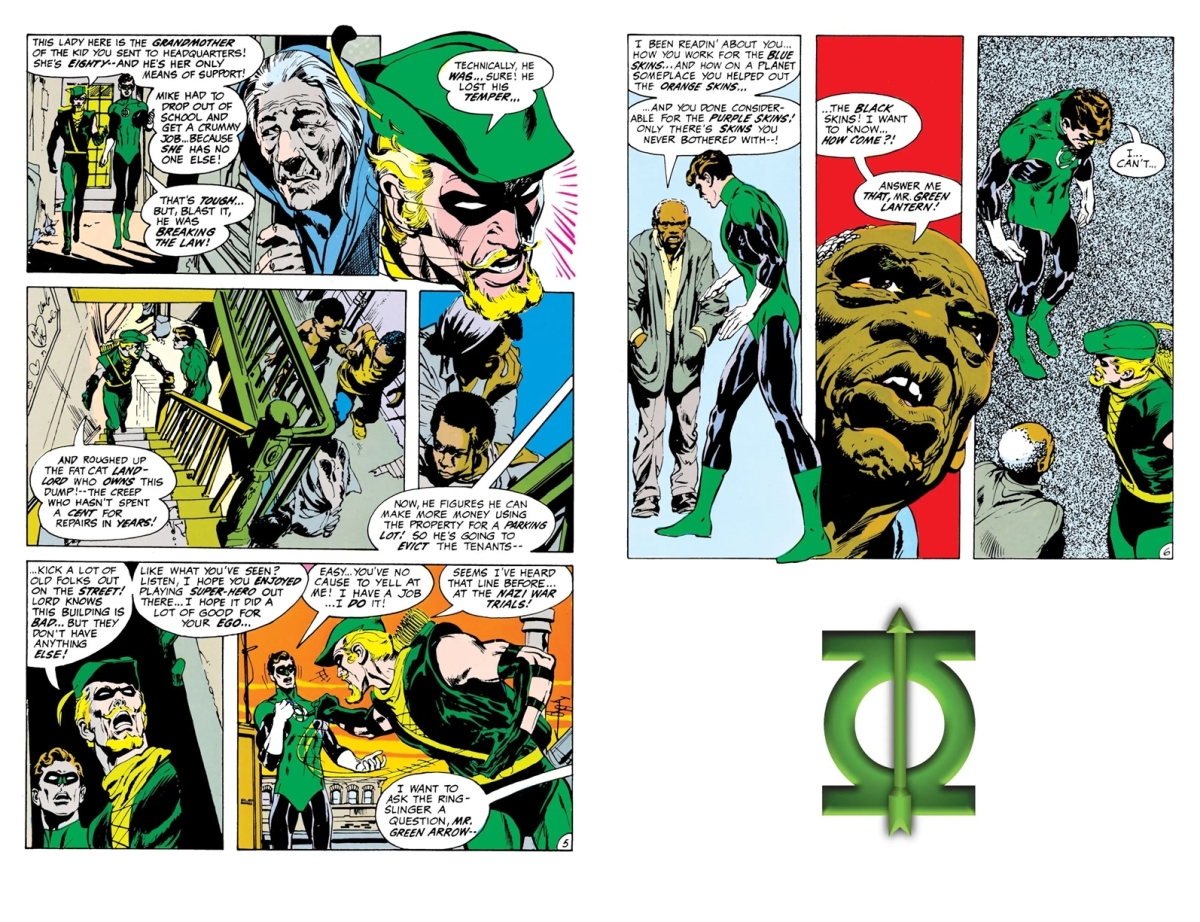
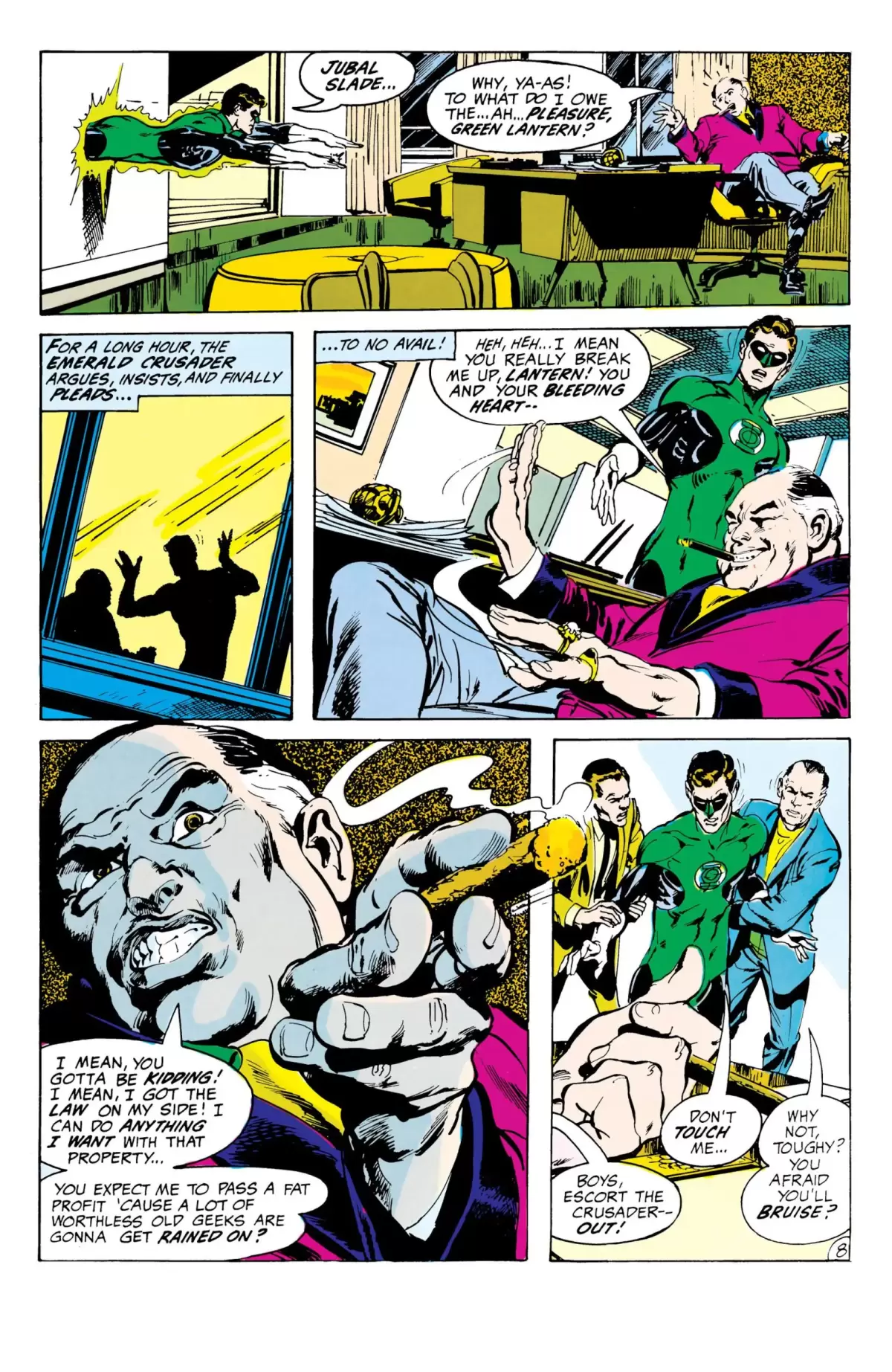
A close reading of the elderly Black man’s accusation reveals that its real subject is not the “hatred of Black people” that some fans infer from it. What he is asking is: “Why have you never ‘seen’ the real problem?”
The blue, orange and purple “skins” he mentions form an ironic contrast with Hal’s illustrious record as a cosmic hero. Hal can fly to distant galaxies and stand up for unfamiliar alien races, yet he has failed to recognize the structural oppression hidden by exploitative housing systems and poverty in his own city.
The man’s final, anguished question therefore challenges the unequal distribution of Hal’s “moral attention.” It is not forcing him to confess to a belief in racial superiority.
By the same token, the more reasonable interpretation of Hal’s “I can’t” is “I can’t justify having overlooked you”—not “I can’t deny that I discriminate against Black people,” or any other confession of racial prejudice.
If the scene were truly intended to expose Hal’s racism, the story that followed would presumably show him overcoming his prejudice against Black people themselves. The comic does precisely the opposite. Once Hal learns the wider social context, he immediately reassesses who the real oppressor is.
▌Hal’s Blind Spot Is Not Racial Prejudice, but Faith in the System
This is not an attempt to “exonerate” the character half a century later. It is entirely consistent with the ideological dialectic O’Neil originally designed for Green Lantern/Green Arrow.
O’Neil recalled that Green Lantern was not selling particularly well at the time, giving him considerable freedom to reinvent it. In his eyes, Green Lantern was fundamentally an “intergalactic cop”—an establishment figure who belonged to the system.
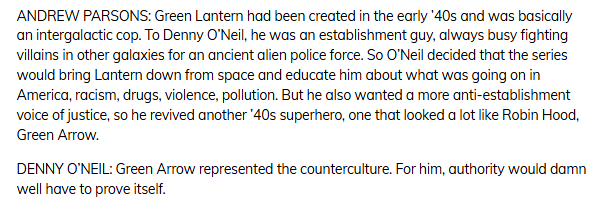 He therefore brought Hal back from space to America and forced him to confront race, drugs, violence, pollution and other problems he had never truly understood. Green Arrow Oliver Queen, meanwhile, represented the counterculture. To Oliver, authority is not automatically right; it must prove that it deserves to be obeyed.
DC later offered a similar assessment when revisiting this chapter of its history. Hal embodies the established power structure behind the Green Lantern Corps, while Oliver is the disruptive force crashing into it.
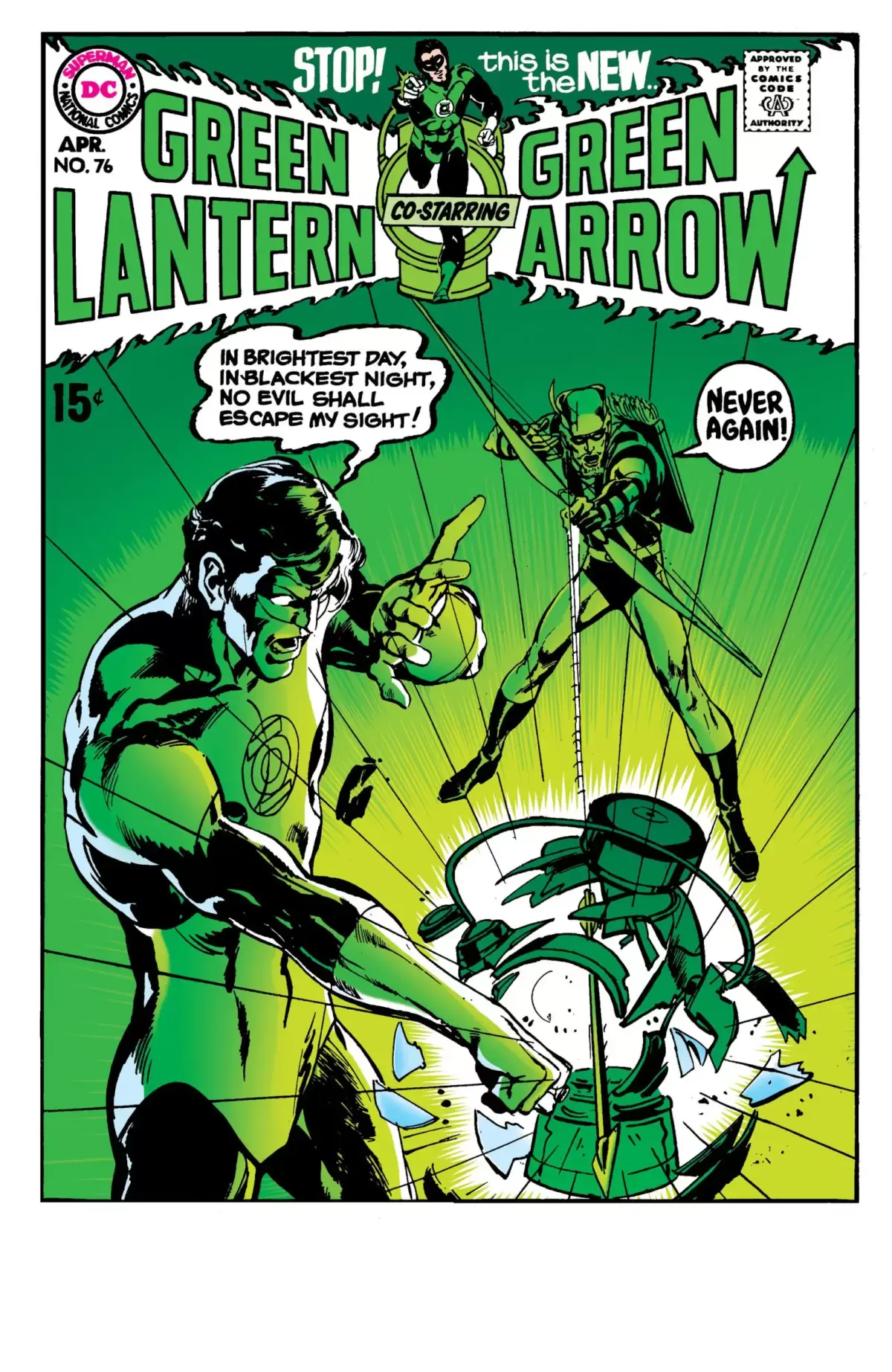
Their ideological conflict was therefore never a simplistic contest between discrimination and anti-discrimination. It pits a conservative who firmly believes that order can deliver justice against a rebel who fears that power itself can create oppression.
The second half of #76 makes this especially clear. Once Hal learns what the landlord has done, he decides to intervene. The Guardians disapprove of his involvement in an Earthly social problem and send him elsewhere, but Hal ultimately disobeys their order, returns to Earth and works with Green Arrow and the district attorney to obtain evidence against the landlord.
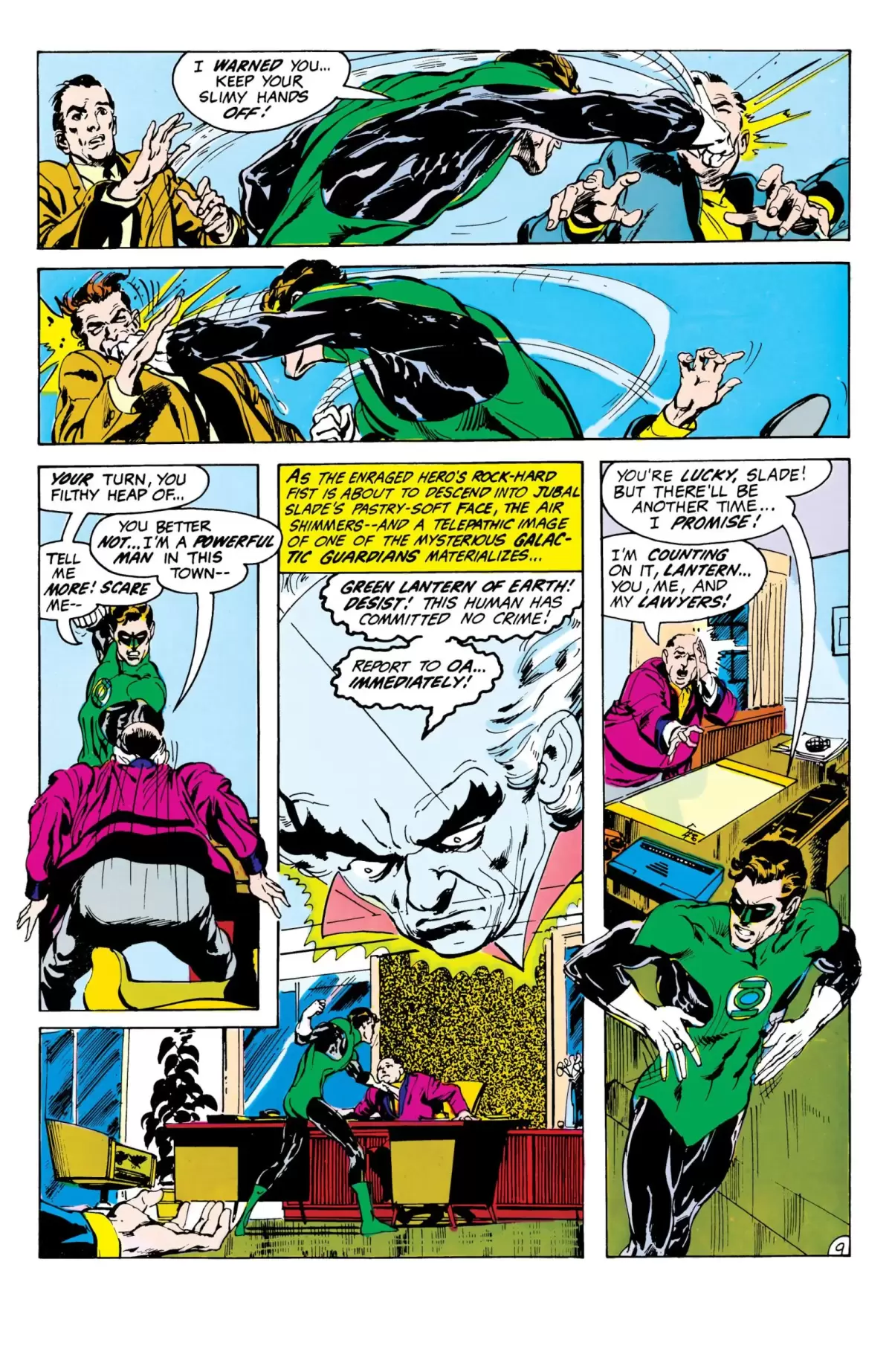
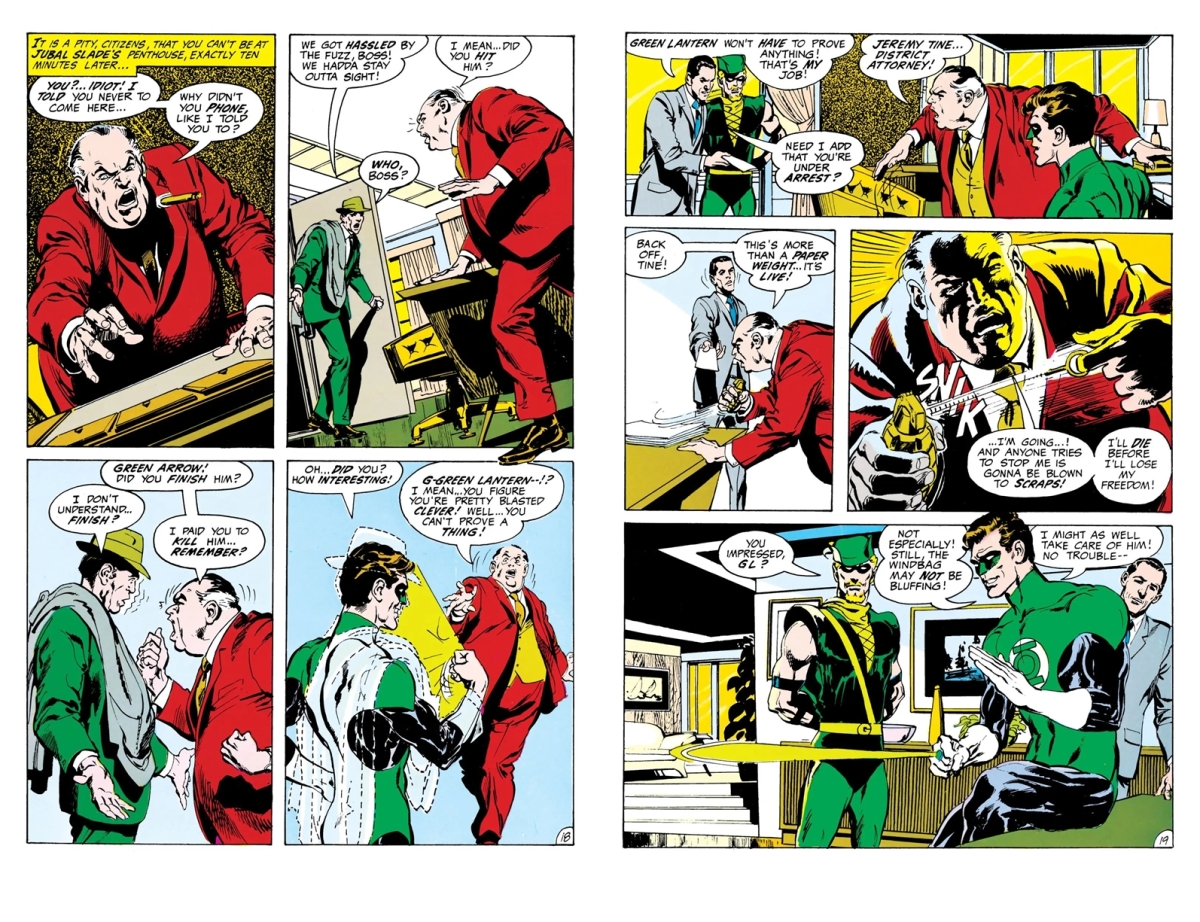 The genuine growth this issue gives Hal is his first real break from blind obedience to authority. He comes to understand that following orders and observing procedure do not necessarily amount to achieving justice.
That pattern is not confined to issues affecting Black Americans. In Green Lantern #79, when Hal and Oliver become entangled in a dispute over Native American land and logging rights, their disagreement over methods escalates into a physical fight.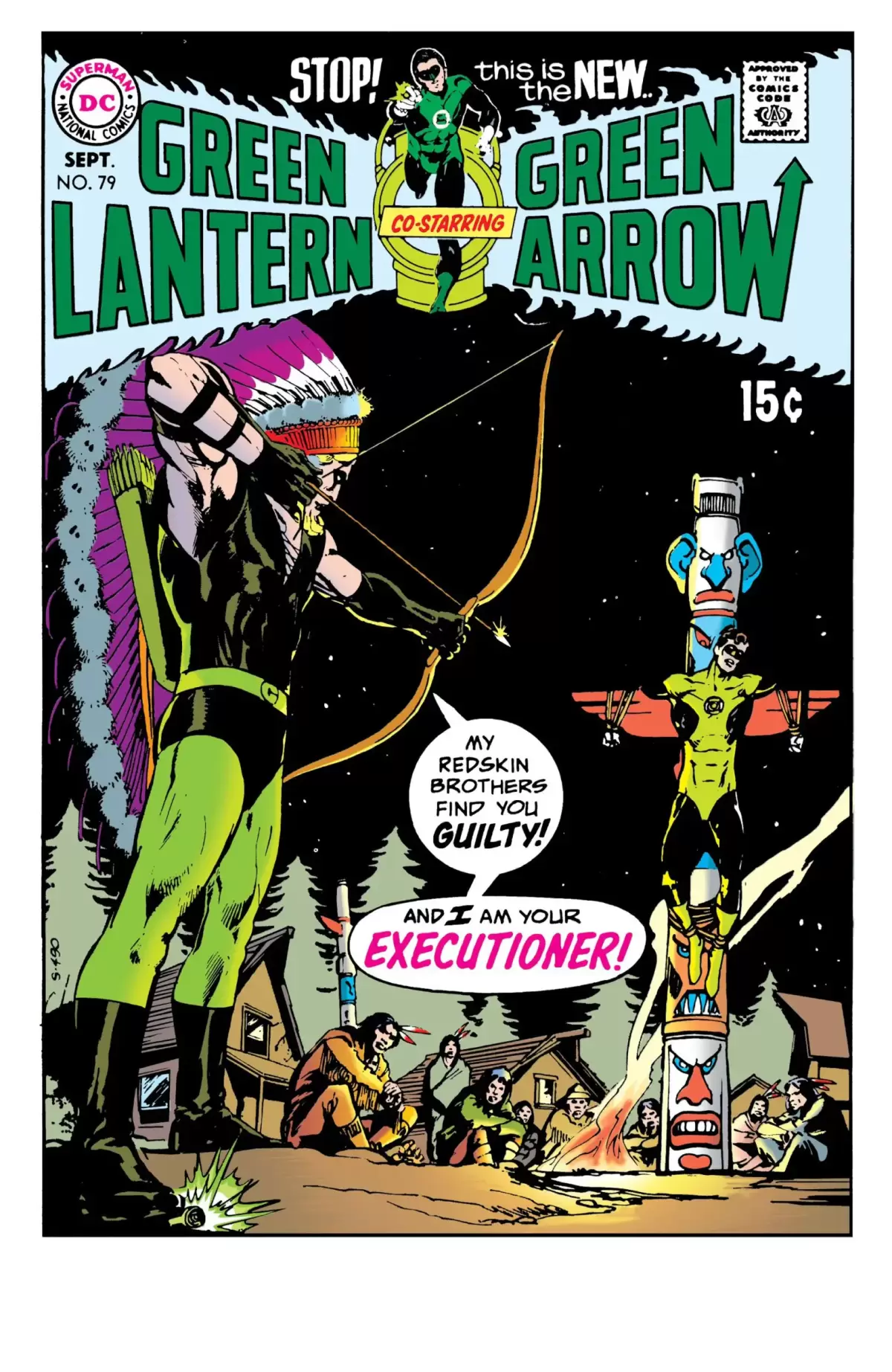
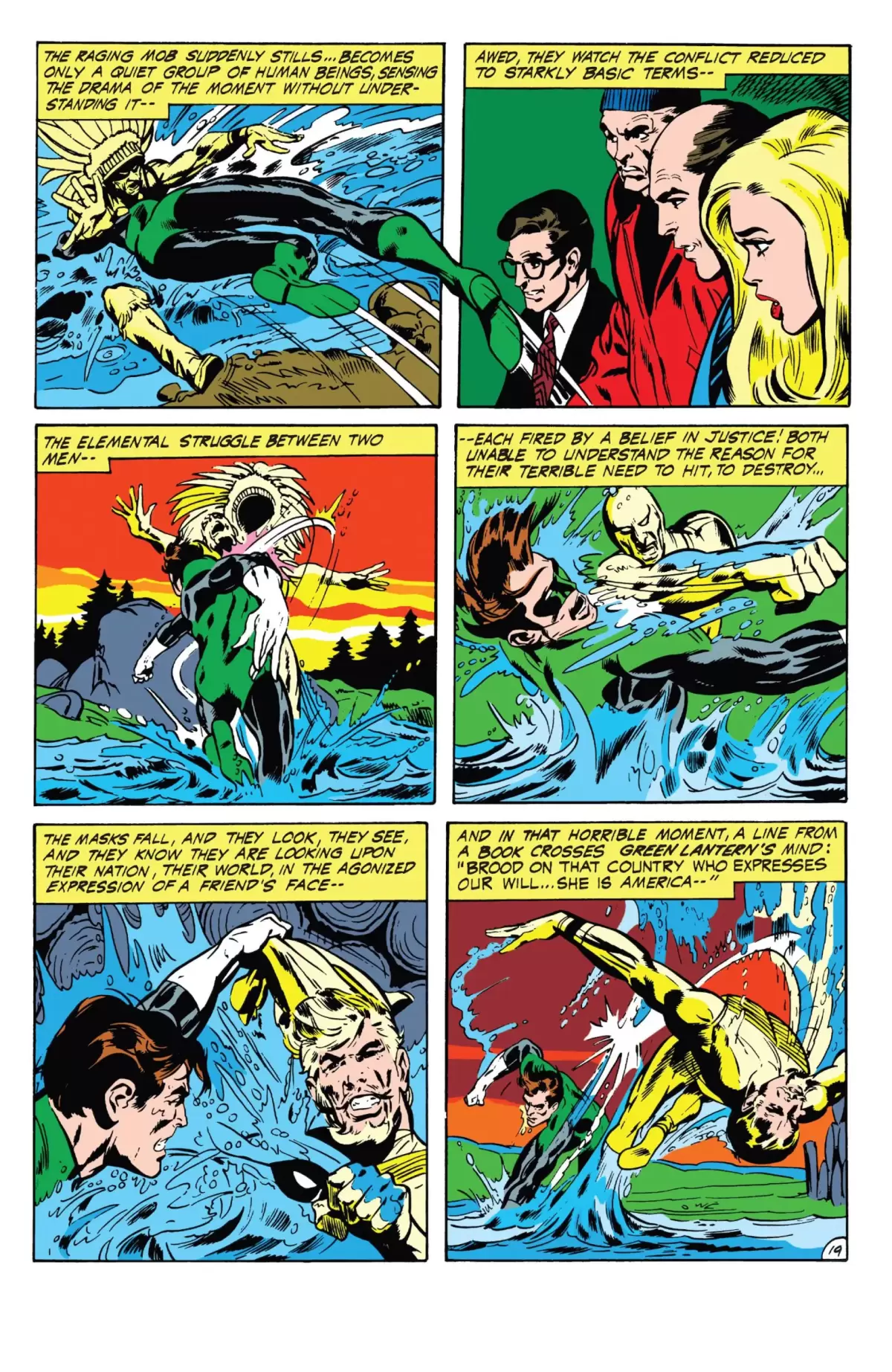
Hal again takes the “procedural route,” searching for an old treaty and attempting to establish legal ownership of the land through the existing system. Oliver, by contrast, immediately stands alongside the oppressed community and even urges the Native Americans to engage in physical resistance.
When Hal tries to restrain Oliver’s radical tactics by insisting that they must obey the law, Oliver lashes out. The two superheroes end up brawling in the camp because neither is prepared to surrender his political position.
Although the head of the logging operation is eventually arrested, the underlying land-rights dispute must still be resolved in court. This illustrates Hal’s recurring character flaw: proceduralism. He trusts evidence, lawful authority and institutions to provide answers. The problem is that his faith in them frequently leaves him too slow to recognize the power relationships behind those institutions.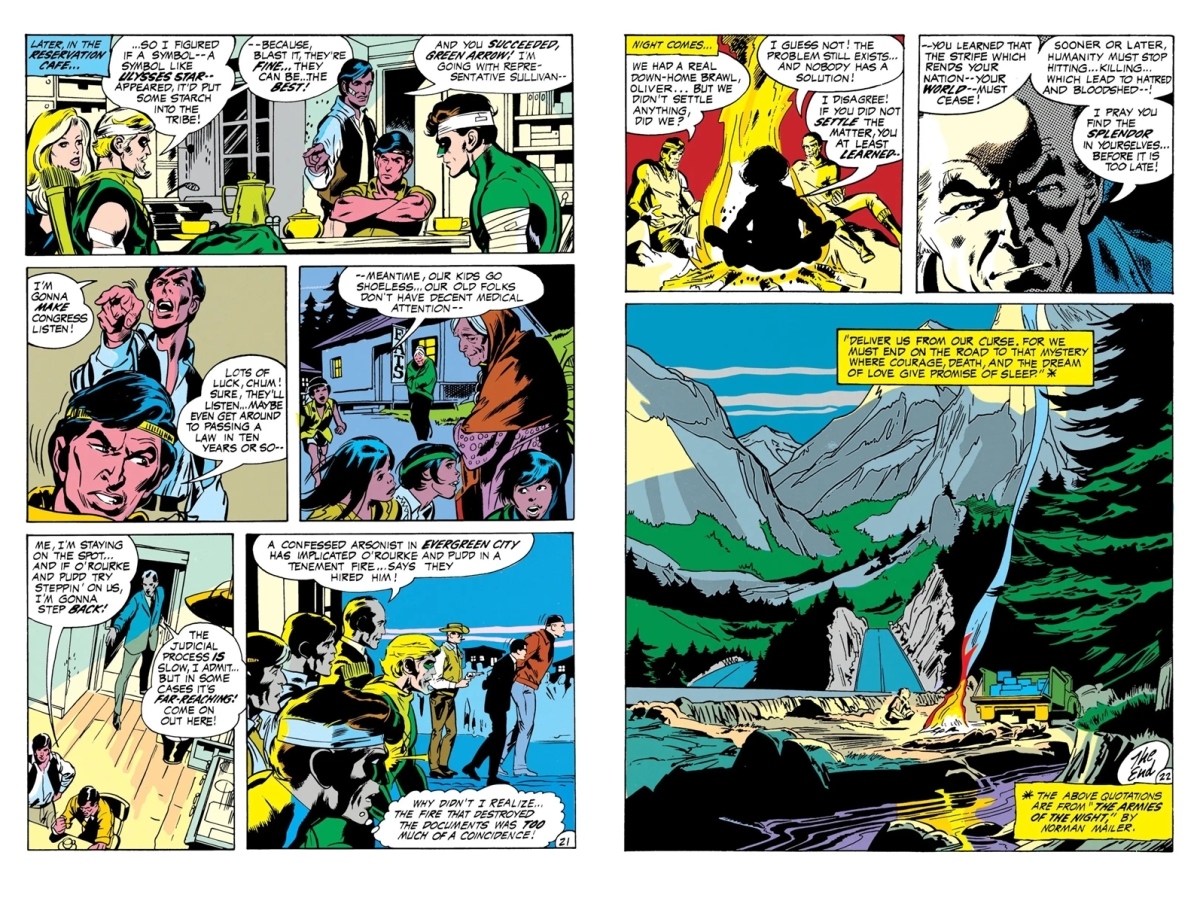
University of Rochester historian Jesse T. Moore places O’Neil’s work within the era’s New Left and the comics industry’s movement toward social realism in “The Education of Green Lantern: Culture and Ideology.”
Significantly, Moore does not reduce the story’s thesis to “Hal is an unconscious racist.” Instead, he argues that the series asks whether “justice, law, and order are exclusively the domain of the state.”
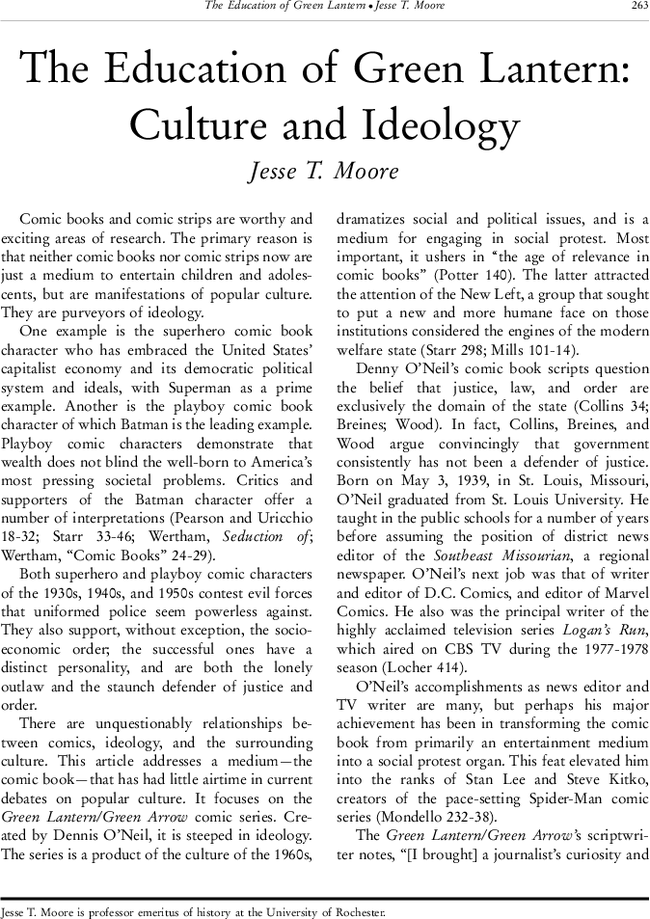
This view aligns almost perfectly with Hal’s position as the establishment figure described above. As the phrase “The Education of Green Lantern” suggests, the title itself identifies the work’s narrative core: Hal’s central challenge is to move beyond the framework of the system and receive a jarring education from the real world.
▌Why Did a Superhero Need to Be “Educated”? Green Lantern’s Blind Spot About Legality
Issue #76 was published in 1970, roughly two years after the assassination of Martin Luther King Jr. and the passage of the Fair Housing Act of 1968. By then, the concerns of the Black freedom movement in America had moved beyond the question of whether legal segregation had been abolished. Its focus increasingly included structural disparities in housing, employment, education, policing and access to local resources.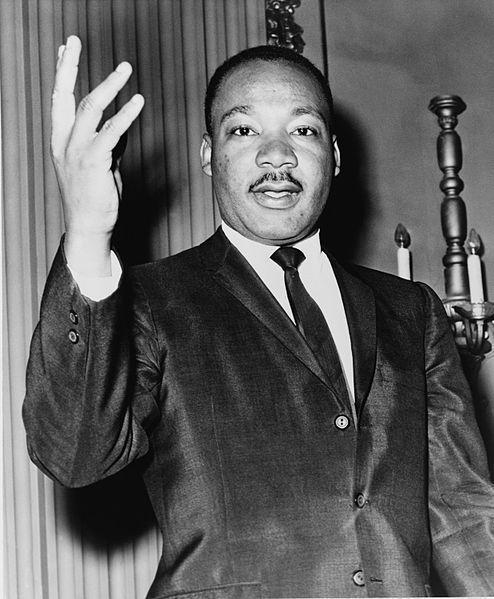
▼An interview from BackStory. Reflecting on the upheaval of American society in the 1970s, O’Neil recalls how boldly he incorporated real political trauma and civil-rights leaders into superhero stories.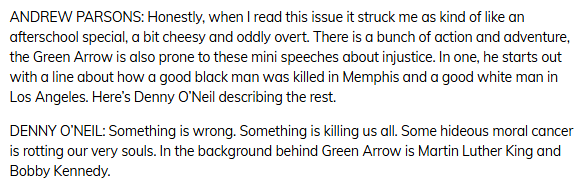
The Smithsonian’s National Museum of African American History and Culture, or NMAAHC, likewise identifies 1968 as an important turning point. Simply abolishing Jim Crow laws could not automatically produce equality and justice, while the Black Power movement placed greater emphasis on Black communities exercising control over schools, businesses, social services and local politics.
Seen in that context, it is no accident that Green Lantern #76 makes a slumlord—rather than an openly fanatical racist—its principal villain. What O’Neil’s script truly dissects is structural violence concealed beneath property, contracts and the language of “legal rights.”
This also explains why O’Neil did not have Hal voice explicit racial slurs. Instead, he repeatedly places an essentially decent, courageous and law-abiding white hero on the “wrong side.”
In interviews conducted in 1978 and 1980 by The Comics Journal founder and editor Gary Groth, O’Neil explicitly rejected the idea that Green Lantern/Green Arrow was a didactic comic offering definitive political answers.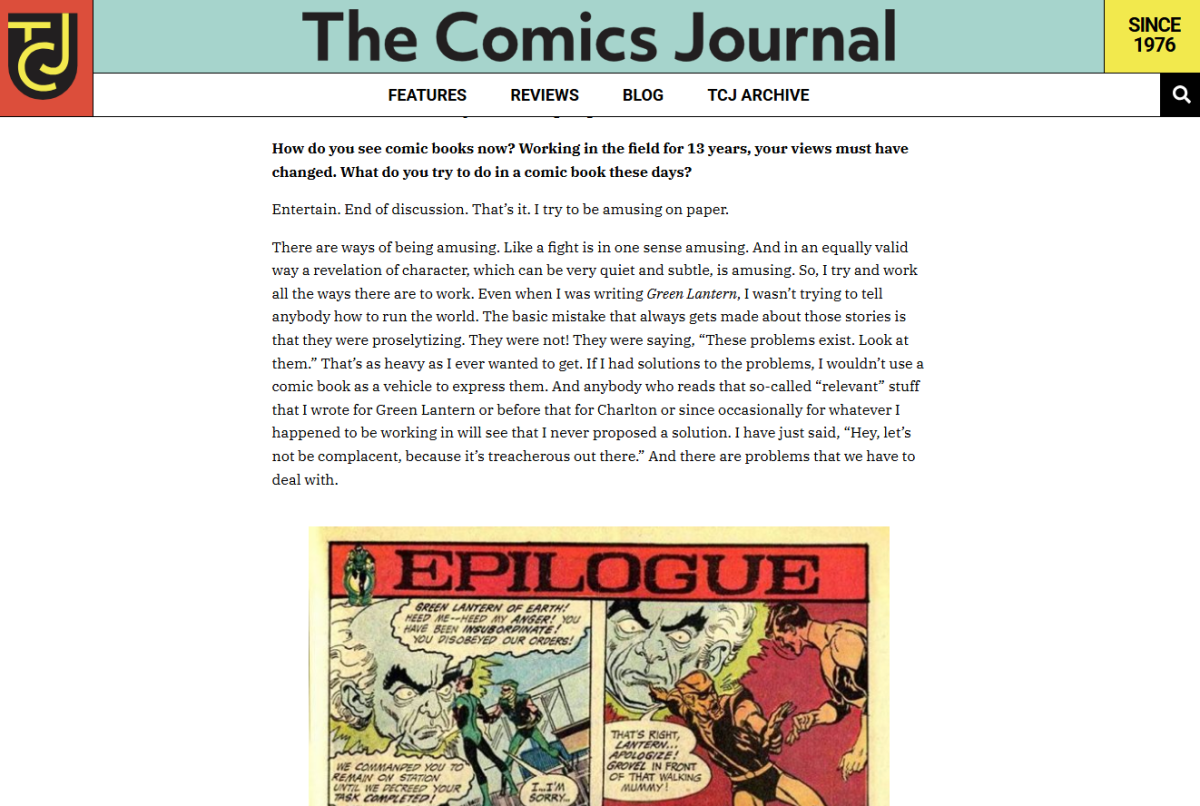
He explained that the most common misconception about this wave of “relevant” comics was the belief that their writers intended to promote some cure-all capable of saving the world. In reality, he had never attempted to provide final solutions in the stories. His purpose was simply to tell readers: “These problems exist. Look at them.”
O’Neil wanted readers—and good people like Hal, who believed themselves to be on the side of justice—not to grow complacent about the world as it existed. Reality was filled with wounds and injustices concealed beneath legal order.
If Hal is reduced to nothing more than a racist or a bigot, the story loses its most important critical force. What O’Neil needed was someone who believed himself to be righteous but remained blind to real injustice because of his excessive faith in institutions. That was one of the central experiments of what the American comics industry called its era of “relevance.”
The bold experiment quickly attracted significant attention from mainstream outlets including The New York Times, The Wall Street Journal and Newsweek. As comics historian Bradford Wright has observed, “relevance” was the term contemporary media used to describe this wave of superhero stories that had begun confronting real-world politics.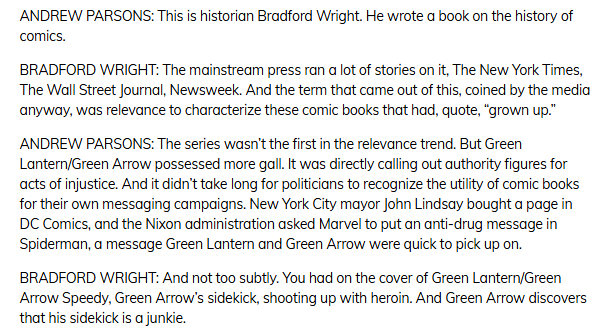
▌Not Racial Prejudice: John Stewart’s Debut
The answer to whether Hal is racially prejudiced does not rest on #76 alone. Green Lantern #87 provides further evidence.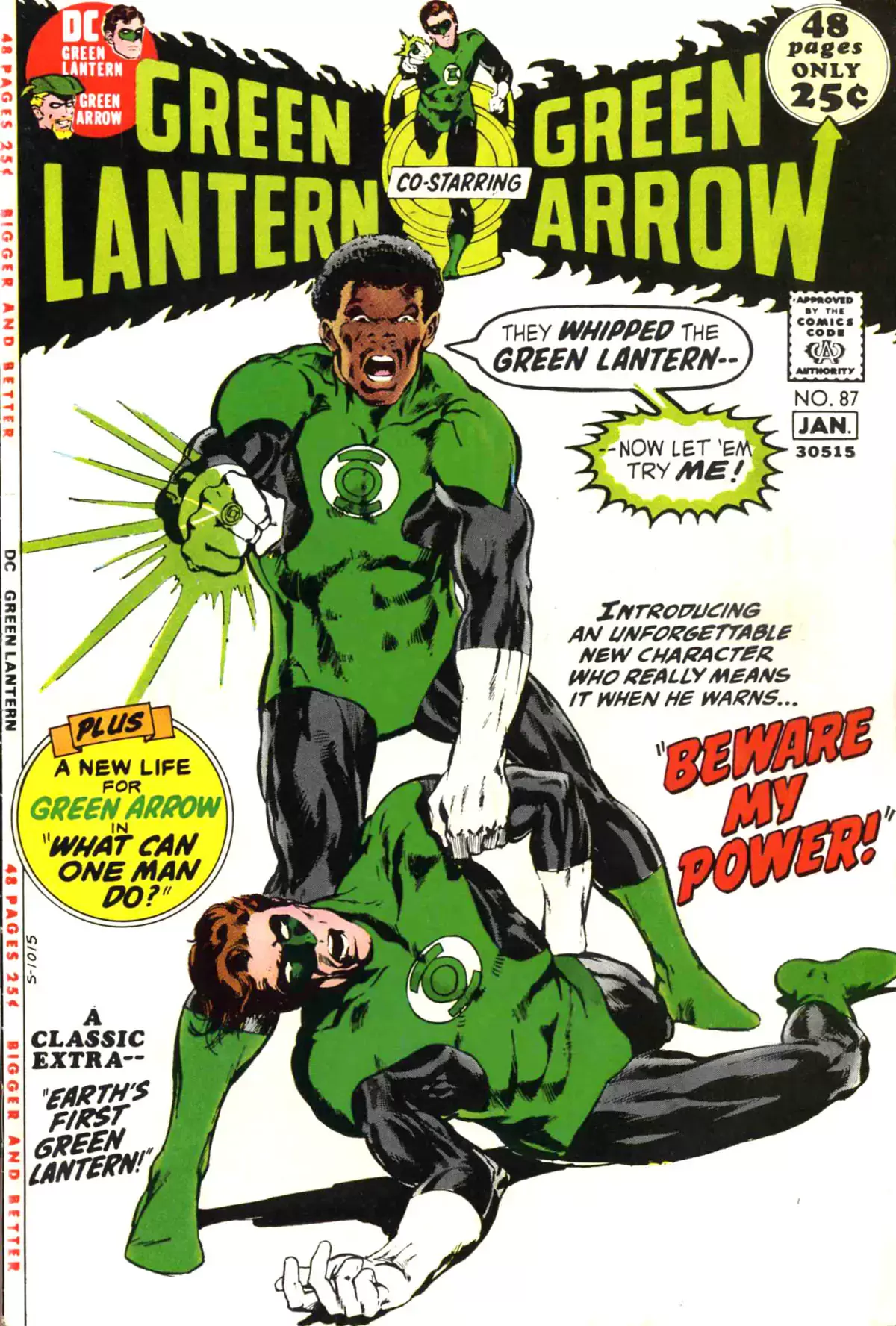
The issue formally introduces John Stewart for the first time. John sees two white police officers harassing a group of Black men playing dominoes on the sidewalk and intervenes, pointing out that they have not broken any law.
Watching nearby, Hal sees John’s attitude toward the police and authority and immediately questions whether he is suitable to receive the ring. Hal believes the young man is excessively hostile toward authority, even describing him as having “a chip on his shoulder as big as the Rock of Gibraltar.” What Hal initially questions is John’s personality and conduct—not his skin color.
For that reason, when the Guardian sharply dismisses Hal’s objection by saying, “We are not interested in your petty bigotries!” the phrase “petty bigotries” cannot automatically be interpreted as a reference to racism.
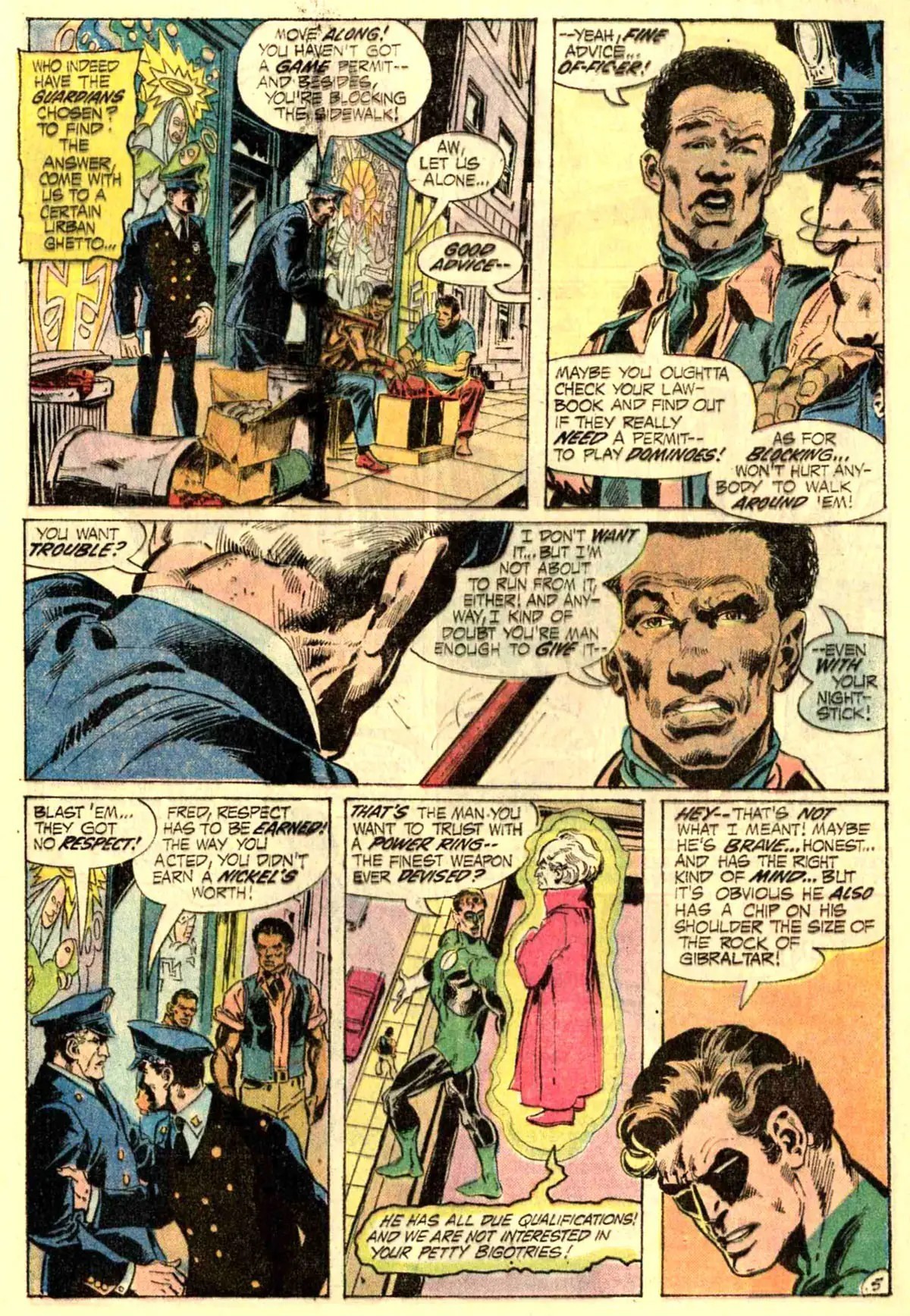
Hal has always been accustomed to obeying authority. When he sees John challenging the system, he instinctively reacts with strong disapproval. In context, the Guardian’s reference to “bigotries” concerns Hal’s narrow prejudice against people who challenge authority because their conduct conflicts with his own approach.
The person whom the story unambiguously portrays as a racist is Senator Jeremiah Clutcher. He exploits racial hostility to build political capital and even engineers a fake assassination and acts of violence in an attempt to blame the Black community.
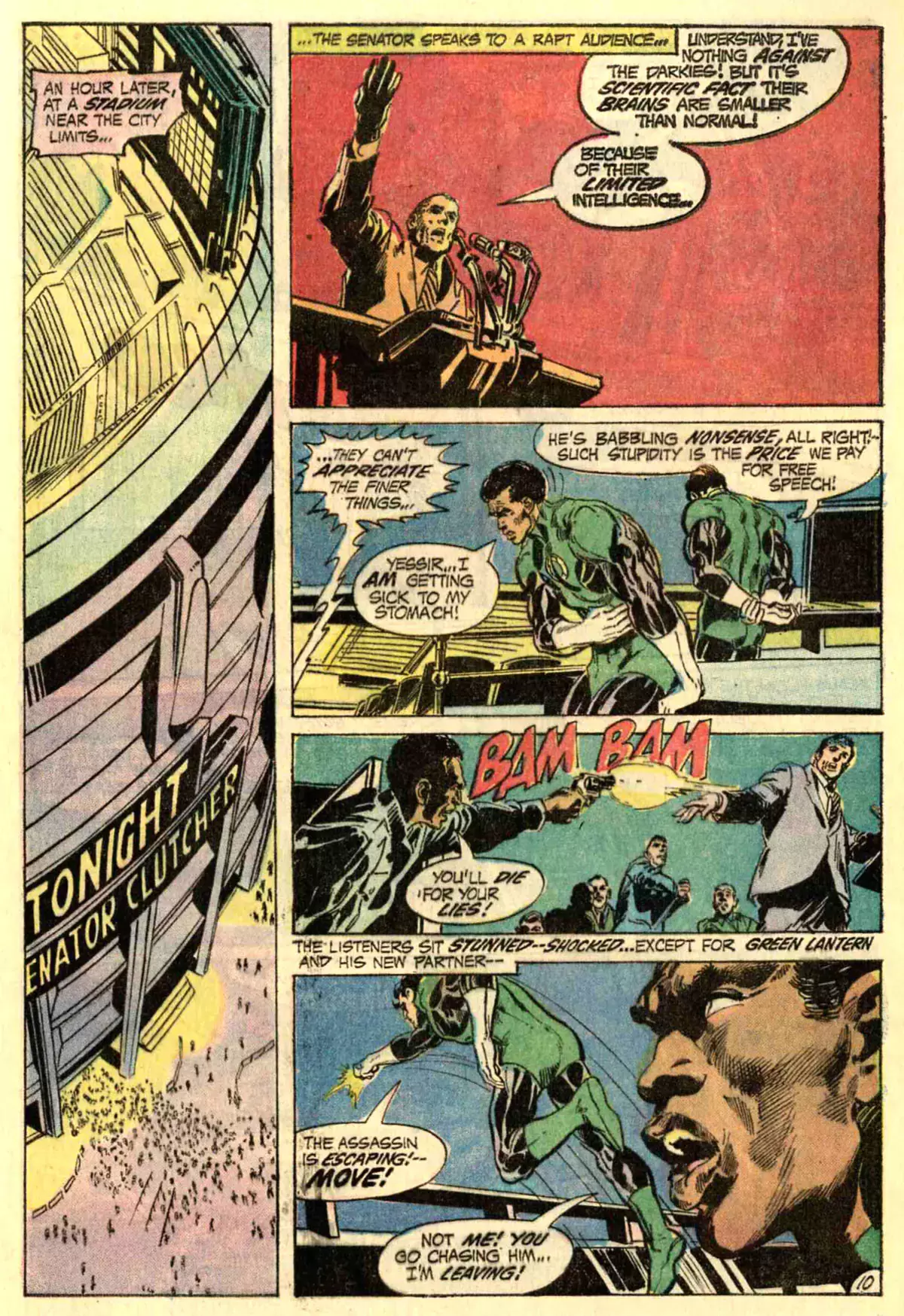
Hal initially operates according to the institutional logic that public officials must be protected. John, however, recognizes the malice behind the politician’s official status much sooner. The story ultimately proves that the Guardian was right to choose John and forces Hal to admit that he misjudged the young man.
More importantly, the second half of the story deliberately presents this clash of styles as a two-sided flaw. Hal is not the only person with shortcomings born of his establishment perspective; John is not flawless either.
Midway through Green Lantern #87, John uses the racially charged term “whitey” to address Hal. Hal eventually responds directly: “Don’t call me whitey,” invoking the principle that the person without sin should cast the first stone.
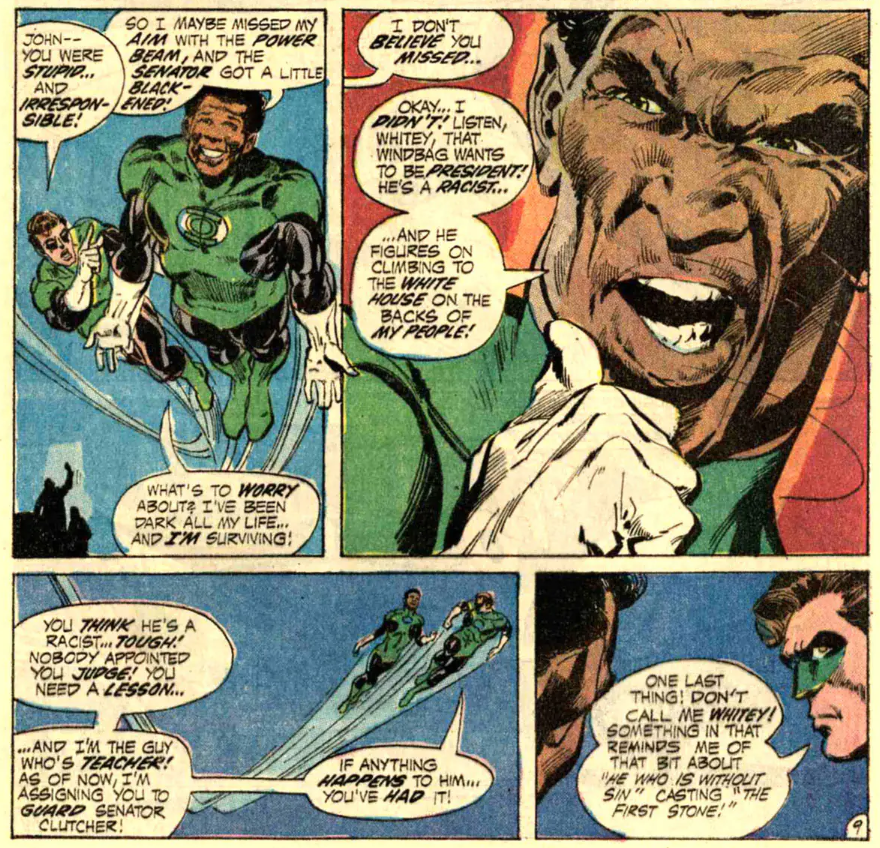
The exchange makes it clear that O’Neil did not write John as a perfect hero who permanently occupies the moral high ground. John is also abrasive and impulsive, and he deliberately uses racialized language to provoke the conservative white senior figure he believes Hal to be. Ultimately, their developing relationship was always going to involve friction between different generations and different social experiences.
In fact, the unquestionably extreme racist they jointly confront is the white senator. The politician not only openly advocates white supremacy but carefully orchestrates a “fake assassination.” He arranges for a Black gunman to attack him and orders an accomplice to kill a police officer, hoping to create the appearance of a Black uprising and inflame racial panic in support of his presidential ambitions.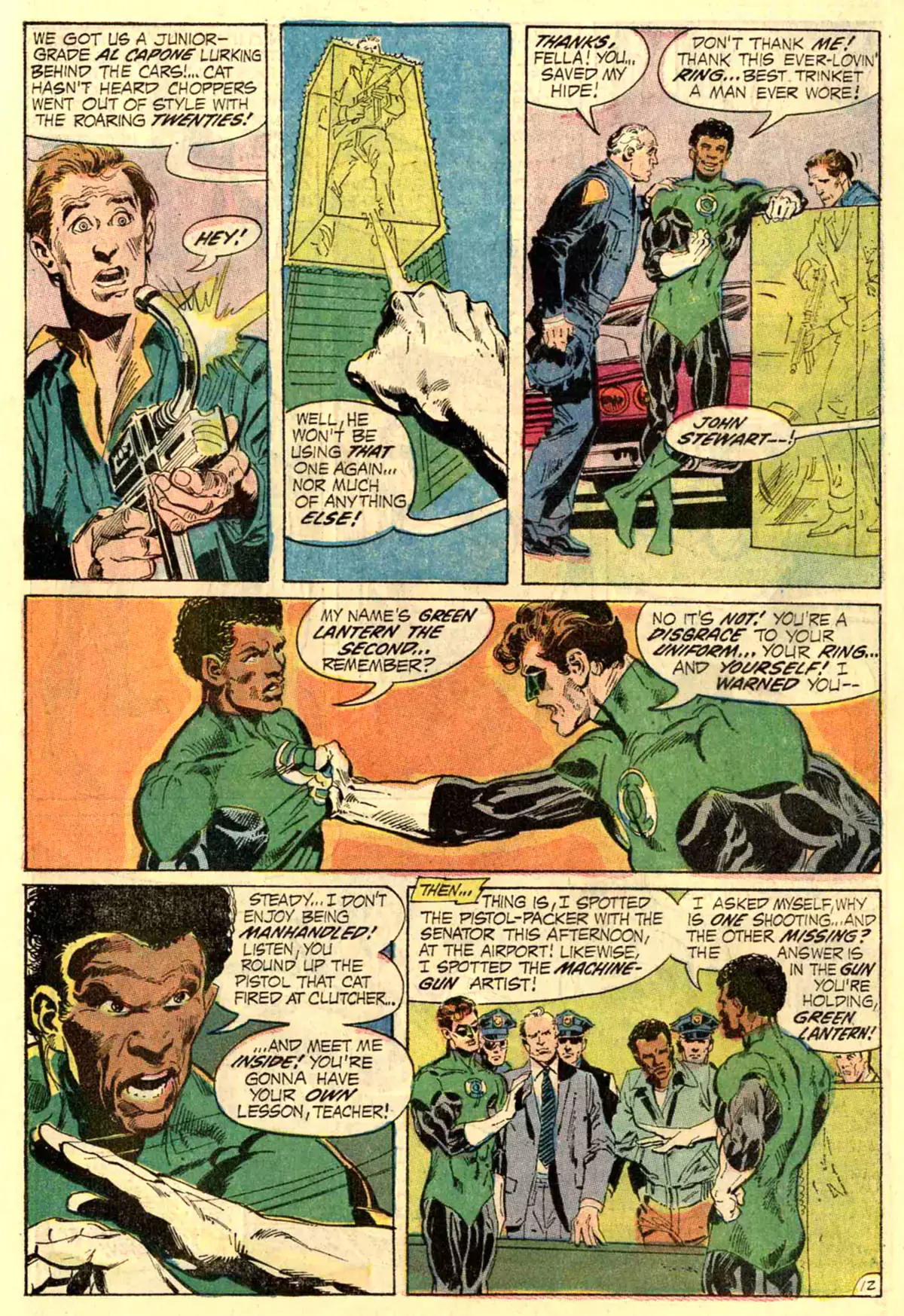
John proves the Guardian chose correctly because he immediately recognizes the corruption of power and is not blinded by the institutional prestige of the title “senator.” Hal, meanwhile, initially clings to the superficial logic that a Green Lantern must protect a threatened public official, nearly becoming an accomplice to the villain.
At the end of the story, Hal finally admits to John, “Your style turned me off!” John responds succinctly, “Style isn’t important any more than color!” This exchange, in which both men move beyond their preconceptions, is the issue’s true conclusion.
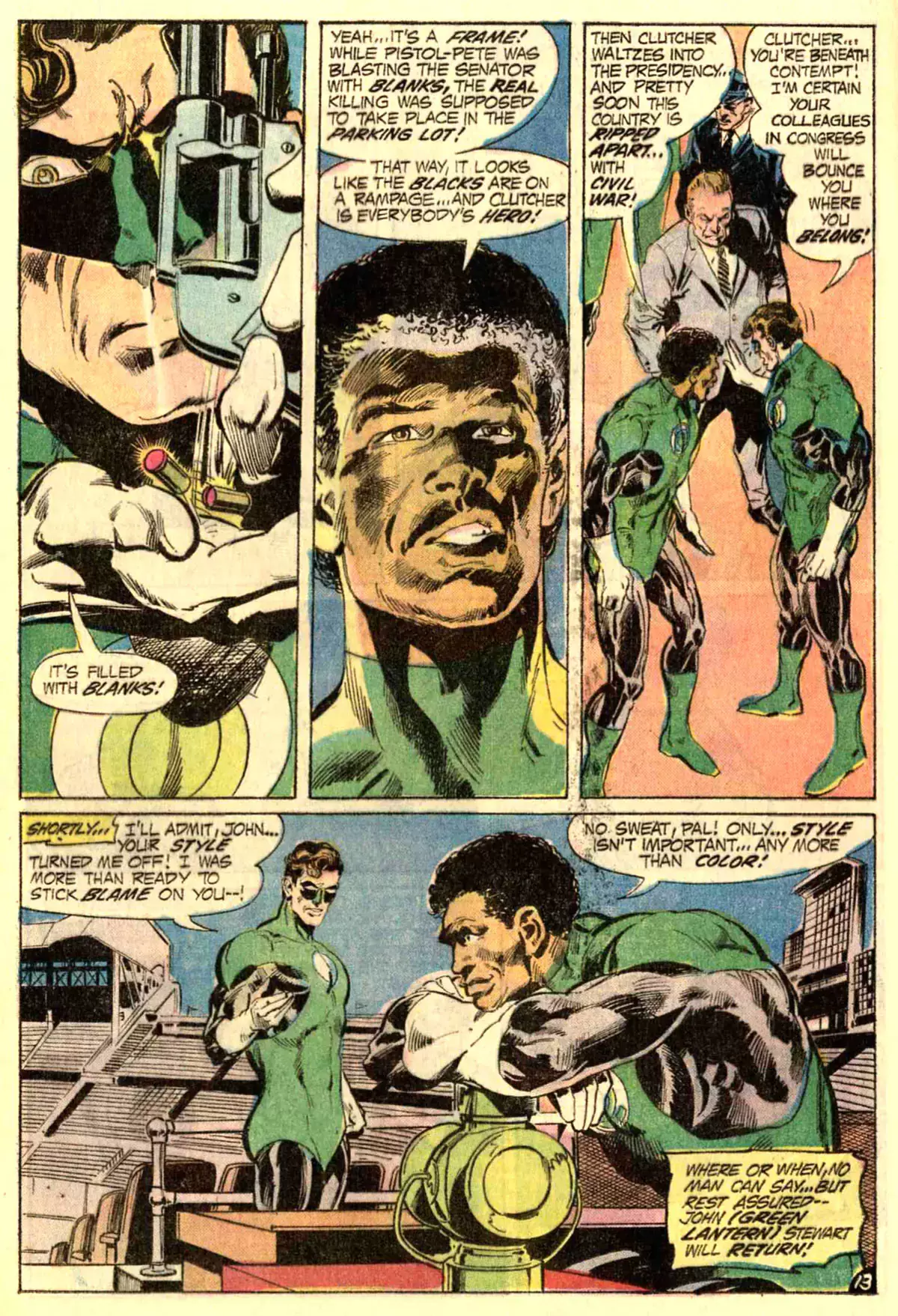
The narrative of Green Lantern #87 certainly confirms that Hal has institutional blind spots and is predisposed to judge those who resist authority. From the perspective of contemporary race studies, those blind spots are undoubtedly intertwined with his experience of life within mainstream white society. Even so, that remains fundamentally different from claiming that the original comic defined Hal as a racist.
▌The Misread Institutional Blind Spot: Who Branded the Guardian of Order a Bigot?
If the question is, “Did the original comics of the 1970s portray Hal Jordan as a racist?” the most rigorous answer remains no.
At least in the frequently cited “black skins” exchange from Green Lantern #76, the real subjects are class distance, institutional blindness and faith in the appearance of legality—not conscious or unconscious racial hostility.
By #87, the story does not expose some hidden racial prejudice in Hal. Instead, it further demonstrates that his preconceptions are unrelated to skin color. They arise from his instinctive rejection of rebels and his rigid, establishment-minded obedience to authority.
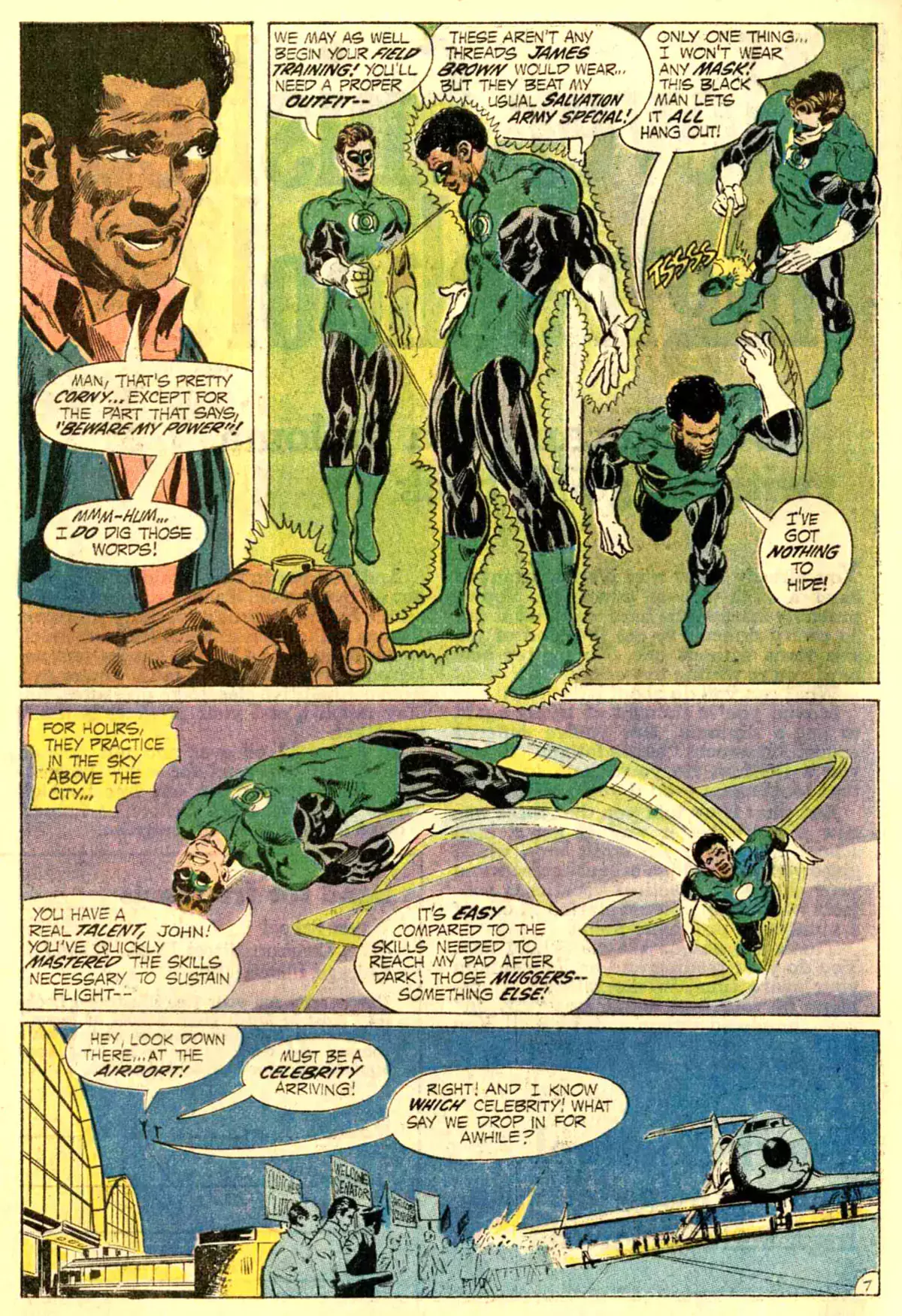
This distinction matters because O’Neil did not need Hal to serve as an opposing “villain.” He created a hero who had not yet learned to see the real world. Just as Batman can become trapped in the obsession of vigilantism and Superman can drift into excessive idealism, Hal Jordan’s defining flaw is his blind dependence on “lawful order.”
Green Arrow’s challenge only carries weight if Hal sincerely believes in law, order and the Guardians. The elderly Black man’s question—“What about us?”—is devastating only because Hal genuinely believes he has been protecting all humanity. Hal’s mistake is not that he considers Black people unworthy of salvation. It is that he naively believes faithfully carrying out the assignments given by his superiors is equivalent to practicing justice. That is the central reason #76 remains so powerful today.
Yet when this historical understanding is applied to the recent controversy surrounding Hal Jordan in HBO’s Lanterns, it becomes clear how severely contemporary discussion has flattened the issue.
Writers Vanessa Baden-Kelly and Justin Britt-Gibson said during an interview with The Ringer-Verse that they deliberately incorporated race and generational succession into the relationship between Hal and John Stewart.
Baden-Kelly framed Hal as a “60-year-old white man from the South” and argued that his microaggressions reflect certain “racist tendencies.” The two writers also revealed that the political moment in 2024 when Joe Biden withdrew from the presidential race and Kamala Harris succeeded him as the Democratic nominee intensified their thinking about whether an older generation is willing to step aside for the next one.
The tendency to label Hal was pushed even further by another statement after the series premiered. Frankey Smith, co-host of the official DC Studios Showcase podcast, wrote on her personal Threads account: “I hate to tell you, but Hal is indeed a little bit racist.” When readers challenged her, she went on to agree with other users who cited early comics to argue that canonically, Hal has always had a racist side.
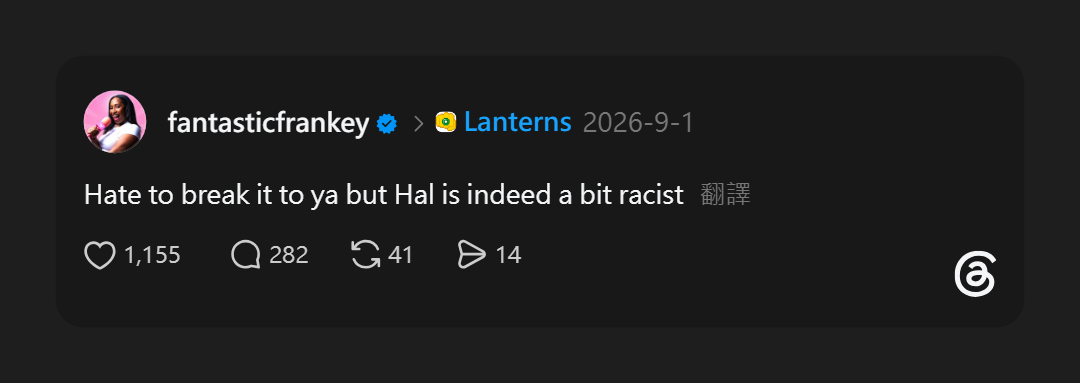
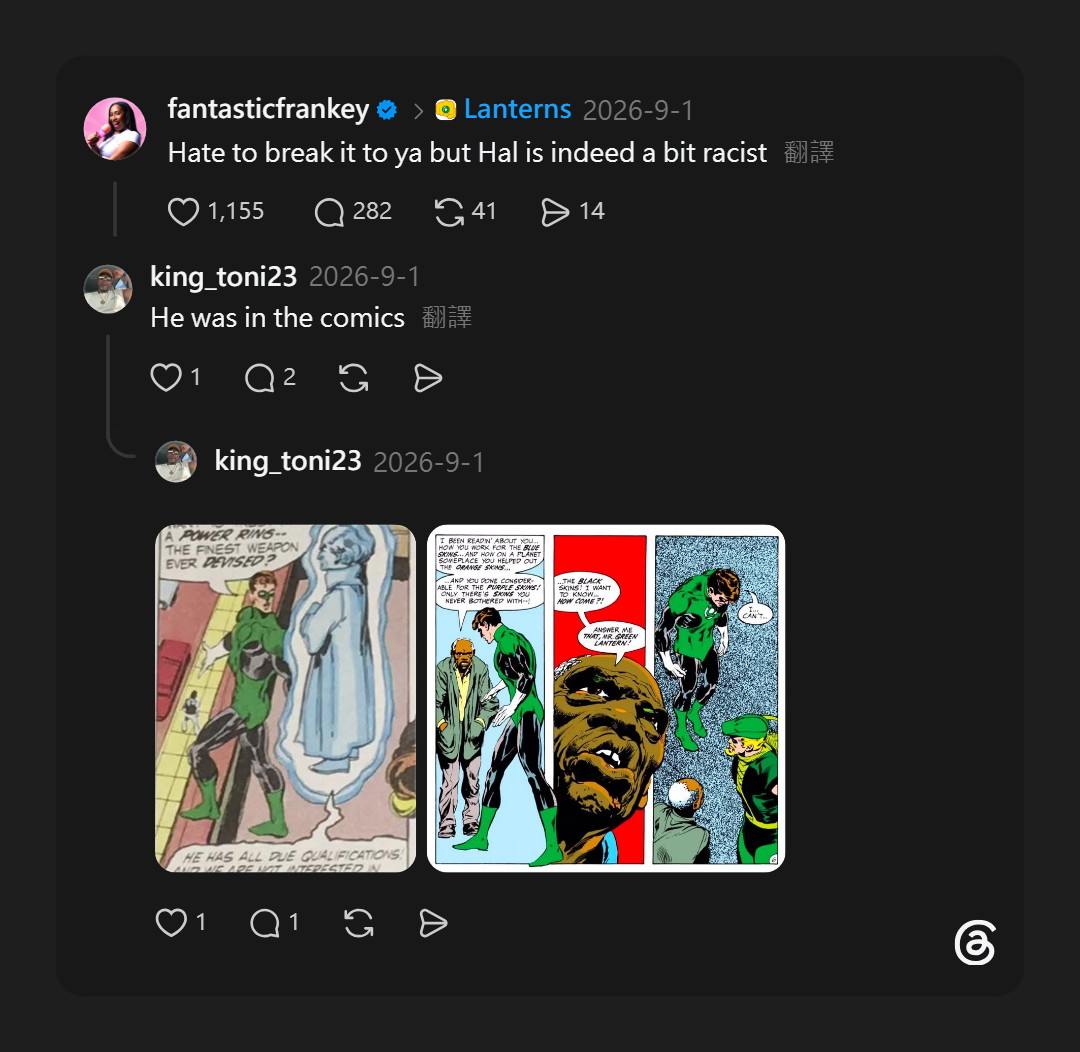
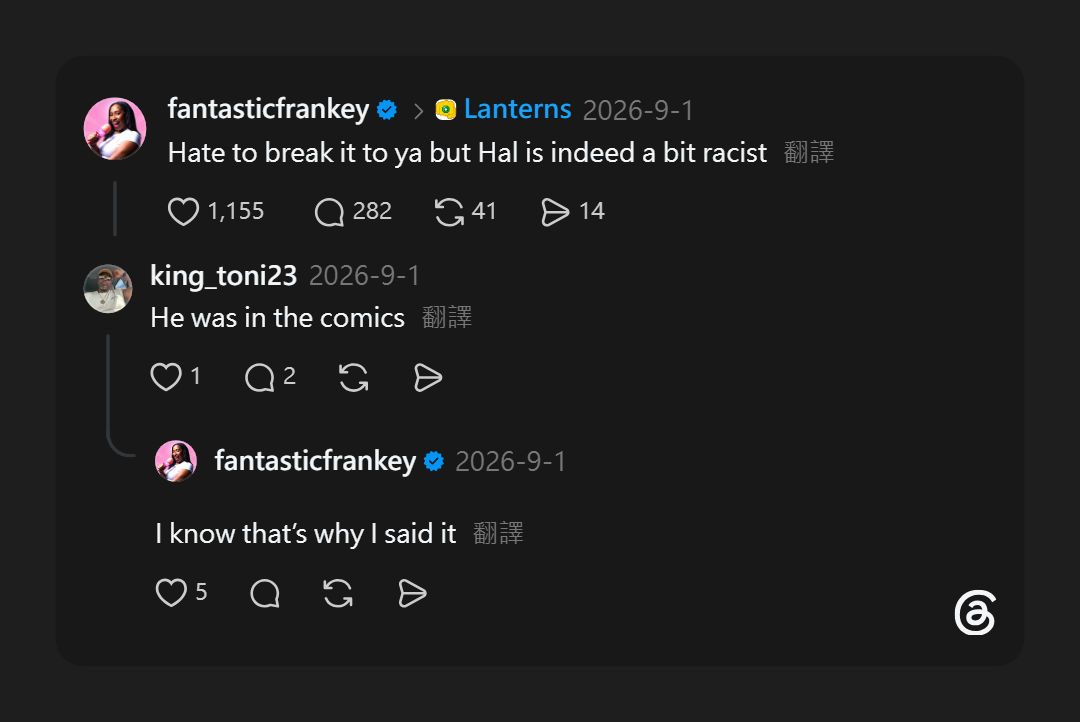 As the textual analysis above demonstrates, however, that argument does not withstand scrutiny. What Hal displays in the story is never racial prejudice directed at skin color or a pattern of “microaggressions,” but blind faith in a rigid system. O’Neil, who wrote the original story, had no intention of portraying him as a racist.
Indeed, O’Neil provided a clear answer himself in an interview originally published in 2011. To him, Green Lantern was a cop—“a guy who was completely just and honest and honorable, but who did nonetheless represent authority.” Precisely because Hal embodied the unshakable establishment, the story needed the anarchistic Green Arrow to speak for the people in the streets.
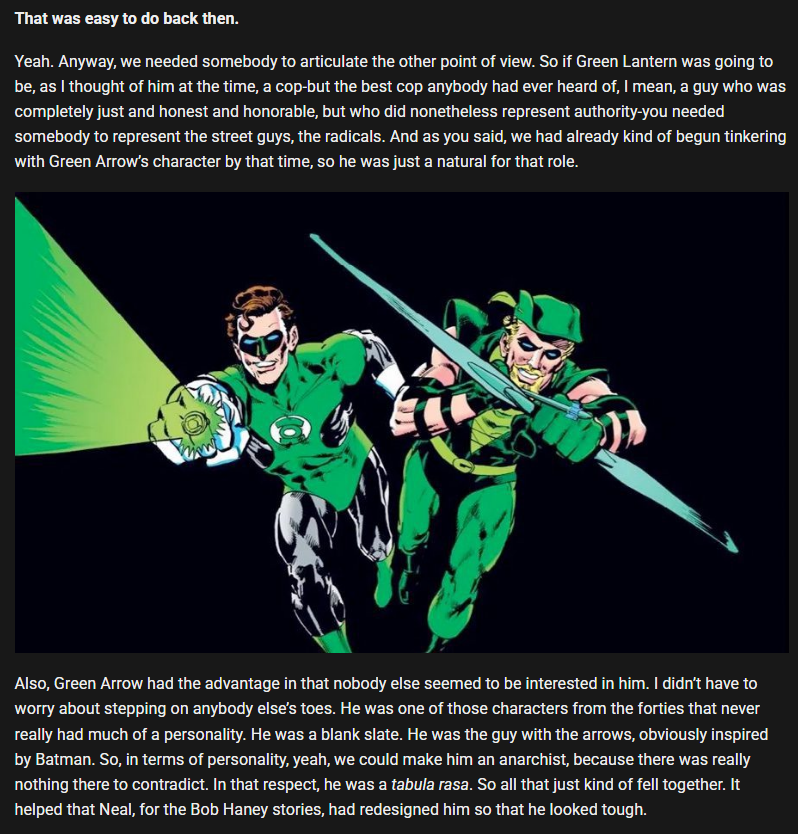
This statement from the character’s creator dismantles the claim that Hal was “canonically racist.” It is also essential to clarify that although Smith co-hosts an official DC program, she made the comment on her personal social media account and is not a writer on the series. Rather than treating it as “DC’s official position,” the remark is better understood as a reflection of a careless contemporary tendency: as the series reinterprets Hal, even people who work with DC have begun misreading the surface of the classic comic, reducing Hal’s complex institutional blind spot to a cheap label of hatred and using it to support the simplistic argument that “he was always a little racist.”
This is precisely why contemporary comics and screen adaptations have no need to diminish Hal into a “racist white senior hero” designed for audiences to condemn. The 2026 Lanterns series has unquestionably reconstructed John Stewart’s original comic-book background and his relationship with Hal. An adaptation is free to rearrange their political positions and life experiences. But if its creators still intend to inherit the intellectual legacy of O’Neil and Neal Adams, then the most dramatically compelling Hal Jordan is a man who sincerely believes in order—and, for that very reason, recognizes far too slowly the harm that order itself can cause.
Let him make mistakes. Let victims confront him. Let him reconsider reality and ultimately choose to defy the authority he once trusted without question. That process of awakening is far more profound than crudely branding him a “racist,” and it is the only approach that truly honors the great character arc of Green Lantern/Green Arrow.
via: The Comics Journal Forces of Geek Wiley Online Library BackStory Archive - New American History