

Fuji Television announced through its official website on November 5 that it has established an experimental facility for generative AI applications, dubbed AI Sandbox, at Wangan Studio and is gradually moving toward full-scale implementation.
The technology is already being used on several currently airing dramas, including Emergency Room 24 Hours. According to the broadcaster, generative AI has reduced working hours by as much as 70% to 80% in certain production processes compared with conventional methods. The move has sparked discussion online, with some viewers in Japan voicing strong opposition to the use of AI in television dramas.
Fuji Television aims to have a comprehensive system in place by October 2027, allowing all of its in-house dramas to use AI technology flexibly according to each production’s content and individual scenes. As part of a corporate reorganization in July 2026, the broadcaster established a new AI Center within its Digital Strategy Office. AI Sandbox officially began operating in September, bringing together drama production staff, technical teams, and AI companies to test a range of applications.
For Emergency Room 24 Hours, the production team used generative AI before filming to visualize how completed scenes might look, allowing staff to review and share the intended creative direction in advance.
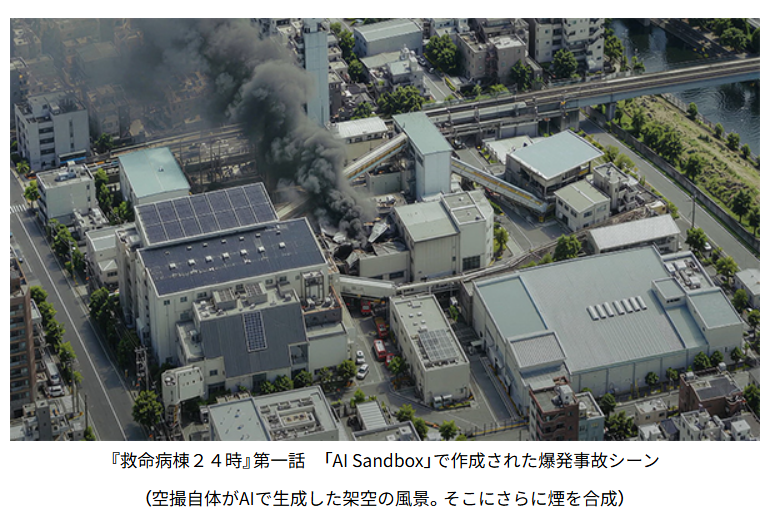
AI has also been used for visual processing in medical scenes and the production of accident footage that would be difficult to recreate through live-action filming alone. The explosion sequence in the first episode of Season 6, which premiered in October, incorporated AI-generated aerial footage of a fictional location, with smoke effects added afterward.
Beginning with the October 2026 programming season, Fuji Television plans to designate at least one drama per quarter as an AI-focused production. By October 2027, the broadcaster aims to establish a full production framework capable of using AI across all of its in-house dramas when appropriate for the project or scene.
Looking further ahead, Fuji Television says it wants the entire Fuji Media Holdings Group to develop AI capabilities on par with Japan’s leading technology vendors by fiscal 2029.
The announcement triggered sharp backlash among social media users in Japan. Some argued that declining ratings for many J-dramas are the result of changing viewing habits, not a lack of elaborate scenes that would be difficult to film. They said AI would not automatically make dramas more entertaining and could instead leave audiences feeling that broadcasters were cutting corners.
Others called the approach disrespectful to actors who put considerable effort into their performances. They questioned whether AI would improve production quality at all, arguing that the real objective was simply to cut costs.
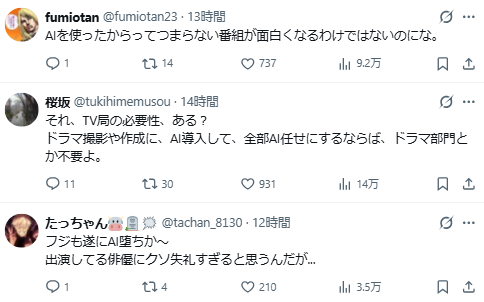
Many commenters said they would rather see natural performances than the flood of cheaply produced AI content now appearing online, which some described as uncomfortable to watch.

Fuji Television has already put the initiative into motion. The company says AI is not intended to replace actors or production crews, but to reduce labor demands and shorten production time.
Even so, for many viewers, the idea of bringing AI into live-action drama production still creates an unsettling sense that something human may be missing.
via: フジテレビ