

The date was March 22, 1996. On this day, CAPCOM launched a brand-new PlayStation game, a 3D action-adventure title. At the time, CAPCOM didn't have high hopes for this original new work, expecting to sell around 150,000 copies, and then another 150,000 copies after porting it to the SEGA SATURN platform, for a total sales volume of about 300,000 copies.
Unexpectedly, one year after its release, the game sold over 1 million copies, much to CAPCOM's delight. They immediately instructed their employees to diligently begin development on a sequel. This game, which was never expected to succeed but became a huge dark horse, was "BIO HAZARD" (バイオハザード, known as "Resident Evil" in Europe and America, as the term BIO HAZARD was already used by a band of the same name), which is known as "Resident Evil" in Taiwan.
When "Resident Evil" is mentioned, most people instinctively think of Shinji Mikami. Indeed, when it comes to the genesis of the work, Shinji Mikami's efforts are undeniably indispensable. However, there are many stories to tell before that. To suggest that we were fortunate enough to witness the birth of this great series solely through Shinji Mikami's efforts would be to deify him too much, as Shinji Mikami was merely a young man who had only been with the company for three years before he became involved with "Resident Evil."
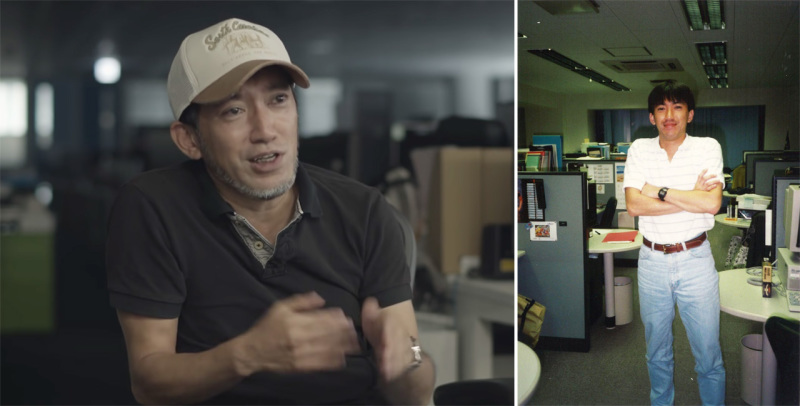
▼Shinji Mikami. The image on the right shows him two or three years after joining CAPCOM. Image credit:en-japan
Great works are rarely achieved overnight; they usually emerge naturally after much effort has accumulated and a opportune moment arises. "Resident Evil" is certainly no exception.
The Horror Film "Sweet Home" Gamified by CAPCOM
Before "Resident Evil," we must first understand a work called "Sweet Home" (スウィートホーム). There are many works with the same title, but here we are referring to the film released in January 1989, directed and written by renowned Japanese director Kiyoshi Kurosawa, and executive produced by the famous late actor and director Juzo Itami (who also appeared in the film).
▼The VHS cover of "Sweet Home." This work has not been released on DVD due to copyright issues. Image credit:livedoor

This film is a supernatural horror movie. The story follows a muralist named Ichiro Mamiya, whose Western-style mansion in the mountains has been abandoned for over thirty years. Legend has it that the place is cursed, and anyone who enters dies a violent death, so no one dares to approach it. One day, a TV producer named Kazuo negotiates with local agency staff, claiming he wants to film an interview for a program. The local staff, knowing the Mamiya mansion is dangerous, secretly plan to use the TV crew's visit as an opportunity to test whether the mansion's legends are true. If the crew emerges unharmed, they could then exploit it as a tourist attraction to make money. Thus, TV producer Kazuo obtains the keys to the Mamiya mansion, and the group proceeds to the Western-style house to prepare for filming. Little do they know, this is the beginning of a series of terrifying events.
▼The story takes place in a mysterious mansion deep within the mountains and dense forests. Image credit:bilibili

▼A TV crew ventures into the mansion. Image credit:bilibili

"Sweet Home" is a supernatural horror film centered around a television crew's experiences after entering a legendary mansion. In this film, horror is primarily conveyed through strange phenomena, vengeful spirit possessions, and terrifying shadows, rather than an abundance of monstrous creatures tearing apart living beings. However, the various human body melting and dissolving effects featured in the film truly resemble those of monsters. Almost no weapons appear in the film; instead, it emphasizes an element: "the power of the heart," which can also be described as willpower. This powerful intention is used to make vengeful spirits retreat.
▼The special effects from back then are now somewhat outdated. Image credit:bilibili

▼The person whose upper and lower body were burned and severed – perhaps crawling zombies drew inspiration from this. Image credit:bilibili

The film's production cost was approximately 1 billion Japanese Yen, with box office revenue of about 500 million Japanese Yen. From a commercial perspective, this film certainly cannot be called a success. However, interestingly, in December of the same year, CAPCOM surprisingly released a game with the same title, an adaptation of "Sweet Home," and it was an RPG.
CAPCOM's Master Producer Skillfully Adapts, a Rare Horror RPG Game on the FC
The person responsible for adapting "Sweet Home" into a game was Tokuro Fujiwara, one of CAPCOM's key producers. He, like Yoshiki Okamoto, initially worked at KONAMI. In 1983, he moved to CAPCOM with Yoshiki Okamoto, where he produced highly acclaimed classic arcade games such as "Commando" (Senjō no Ōkami) and "Ghosts 'n Goblins" (Makaimura).
▼Tokuro Fujiwara. Image credit:en-japan

Tokuro Fujiwara, skilled in arcade game development, despite being keenly aware of the hardware limitations of home consoles, still wanted to develop a home platform game without arcade elements like "score counting" or "health bars." It was at this opportune moment that the film "Sweet Home" emerged. After internal discussions, the decision was made to proceed with the game adaptation of this film.
▼CAPCOM's "Sweet Home" game promotional poster. Image credit:Pinterest

▼CAPCOM's original promotional video for the "Sweet Home" game:
Film director Kiyoshi Kurosawa agreed that Tokuro Fujiwara did not necessarily have to make the game strictly adhere to the original work. Thus, Fujiwara attempted to integrate his own ideas with the professional knowledge he gained from watching the film and observing on set. He created a unique RPG that captured the horror atmosphere of the original film and required flexible allocation of items and routes.
Veteran players who have experienced this game would likely agree that it was incredibly challenging at the time. Firstly, the entirely Japanese interface with no Kanji was enough to deter many. Secondly, the difficulty was exceptionally high. Once a character accidentally died in the game, they could not be revived. This also meant that you would lose any unique items held by that character. Furthermore, each character had limited inventory slots for items. And unfortunately, accidental character deaths were quite common, not necessarily even at the hands of monsters. The game featured numerous sudden traps, accidental falls into pits, poisoning, and other perilous situations. It was very easy to find yourself in a predicament with just one misstep.
▼ The game adaptation of Sweet Home is presented as an RPG, with considerable effort put into its visual presentation. Image credit:YouTube

▼ Skillfully utilizing each character's unique items and limited inventory slots is key to completing the game. Image credit:YouTube

Within Sweet Home, we can observe many subtle elements that bear a striking resemblance to numerous aspects and features later seen in Resident Evil. For instance, item distribution, the exchange of items using limited inventory slots, scattered items and fragmented information on notes, a limited number of healing items, sudden traps, and the multiple ending system, among others.
▼ This animation always appeared when opening a door with a key, an element later retained by Resident Evil. Image credit:Let's Play

▼ The in-game graphics were considered quite refined for their time, and the atmosphere was perfectly captured. Image credit:

▼ Such exquisite presentation on the Famicom back then was truly rare. Image credit:3 Walled Muser

Sweet Home's reception at the time was considered decent. Its unique strength lay in its excellent atmospheric control, including the music and the terrifying presentation of monsters and other visuals. However, because it followed a survival-oriented path, it differed from the mainstream RPGs of the era. Especially since CAPCOM itself had just released the Famicom RPG "Destiny of an Emperor" that May. And the following year, 1990, saw ENIX's "Dragon Quest IV" in February and SQUARE's "Final Fantasy III" in April. Not to mention that in the very month of its release, KONAMI also had "Castlevania III: Dracula's Curse" and "Double Dragon II: The Revenge". Sandwiched between these titles, it was naturally difficult for it to achieve outstanding performance.
The Perfect 3D Sweet Home, Passing the Torch to Beloved Disciple Shinji Mikami
However, Tokuro Fujiwara's efforts were certainly not in vain; they would simply manifest in a different way. As the saying goes, 'One generation plants the trees, another gets the shade'. In 1990, Shinji Mikami graduated from Doshisha University in Kyoto and joined CAPCOM. Initially, he didn't make much of an impact, and the projects he participated in weren't major titles (However, I personally quite enjoyed the SNES version of "Aladdin" that he worked on; it had a great gameplay atmosphere). As a new recruit, his morale was high, and he eagerly hoped to create his own game. But he was constantly pressured to come up with proposals, only to have them rejected, leaving him feeling frustrated. He even considered resigning at one point to pursue more interesting projects at another company.
▼ A chart illustrating Shinji Mikami's career trajectory and fluctuations. Image credit:en-japan

In 1992, Shinji Mikami first witnessed the power of 3D polygons used in game development from the work of a former colleague who had already left, and was deeply amazed. Just as he was seriously considering leaving the company, Tokuro Fujiwara, his superior and mentor, stopped him. Fujiwara also mentioned "Sweet Home" to Mikami, who stated that he knew and loved the game.
Although Tokuro Fujiwara was Shinji Mikami's superior, he was only four years older. The more experienced Fujiwara saw Mikami's potential but knew he needed refinement. Fujiwara often assigned him tasks, such as brainstorming over a dozen game proposals a day, immediately rejecting any that weren't up to par. This often kept Mikami busy until the middle of the night. Fujiwara's strictness put Mikami under immense pressure, but he persevered. At this time, Tokuro Fujiwara had an idea he wanted to challenge himself to realize again, and he brought it up with Shinji Mikami for discussion – it was the remake of "Sweet Home".
At the time, CAPCOM had no experience in developing 3D games, but the next-generation console war, ignited by manufacturers like SONY and SEGA, was about to begin in the industry. CAPCOM would inevitably have to release something to keep up with the trend. Tokuro Fujiwara then recalled "Sweet Home" from back then, noting many aspects that couldn't be achieved due to hardware limitations. This was the perfect opportunity to try and materialize that concept. Shinji Mikami, who had been trained by him for a long time, was right there, so Fujiwara discussed with him, intending to entrust this remake project to Mikami.
▼At the time, the game even featured real actors portraying game characters and filmed related videos, which was considered a pioneering move back then. Image credit:YouTube
After confirming Shinji Mikami's willingness, Tokuro Fujiwara gave him instructions to create a "3D game based on the theme of Sweet Home." However, the difficulties were just beginning. As most of the company's resources were allocated to Street Fighter at the time, the initial team involved in the project, including Shinji Mikami, consisted of only a little over twenty people, gradually increasing to about eighty later on.
Another difficulty arose during development: the original game was themed around Sweet Home, including the main setting, the mansion. Unexpectedly, there were issues with the movie rights, and CAPCOM could no longer use them. Out of necessity, the entire story and characters had to be completely overhauled (Kenichi Iwao was responsible for this at the time). However, elements like the already completed mansion were naturally too valuable to discard. This is why the architectural differences in the game are so significant, as the mansion was originally created for a different project.
Resident Evil truly bears many traces of Sweet Home, incorporating several classic elements such as opening doors, zombies turning their heads, limited item allocation, scattered documents and items, using items to solve various mechanisms and obstacles, occasional team splitting, multiple endings, and so on. Additionally, Shinji Mikami's own ideas were integrated, including combat with firearms and knives, jump scare elements (the classic dog jumping through the window), puzzles, and more.
▼The classic head-turn. Image credit:tumblr

▼Many people surely felt a strong impact from this scene back then. Image credit:kotaku

▼This original boulder-rolling trap actually also came from Sweet Home. Image credit:YouTube

▼Compared to the photo above, the rolling sensation is quite similar, isn't it! Image credit:Let's Play

Although initial game sales were only around 100,000 units, over time, driven by player word-of-mouth, the game became a long-seller for an entire year, becoming another million-selling title within the company. CAPCOM was naturally overjoyed and actively began development on sequels. As the producer, Shinji Mikami began to attract widespread attention, being dubbed the "Father of Resident Evil" (though he personally disliked this title). Tokuro Fujiwara, however, coincidentally left the company after 13 years of service in 1996, the same year the game was released.
▼The original "Resident Evil" debuted as a remake on the Nintendo GameCube console in 2002. Image credit:Leaked News

▼After Tokuro Fujiwara left CAPCOM in 1996, he founded his own company, "Whoopee Camp," and served as producer for multiple games, with his latest work being "Ghosts 'n Goblins Resurrection." Image credit:ファミ通 Image credit:CAPCOM

If it weren't for Tokuro Fujiwara's efforts on "Sweet Home" at the time, his unwavering commitment to the remake project, and his keen eye for talent in promoting Shinji Mikami and rigorously training him, perhaps today we would not have witnessed the birth of the great "Resident Evil" series. Shinji Mikami might have even left the company midway, and it would have been impossible for him to later promote Hideki Kamiya as the producer for "Resident Evil 2," creating another peak. The true father of "Resident Evil" should, in fact, be credited to Tokuro Fujiwara!