

Becoming a streamer or YouTuber has become a dream for countless young people today. With dedication and effort, the barrier to entry is lower than ever, especially in this age of ubiquitous smartphones where anyone can manage their social media presence anytime, anywhere.
Recently, a Japanese high school girl from the YouTube channel "Single Mother's Only Child JK" (母子家庭ひとりっこJK) announced her decision to withdraw from her current school. The reason? Her school implemented a new rule: "No profiting from social media platforms." This, coupled with a previous incident where she faced restriction and suspension for working part-time without permission, led her to proactively transfer to a correspondence high school. She emphasized that her studies will remain her top priority, and she will continue both her part-time job and YouTube activities. Her decision has ignited a fierce debate online.
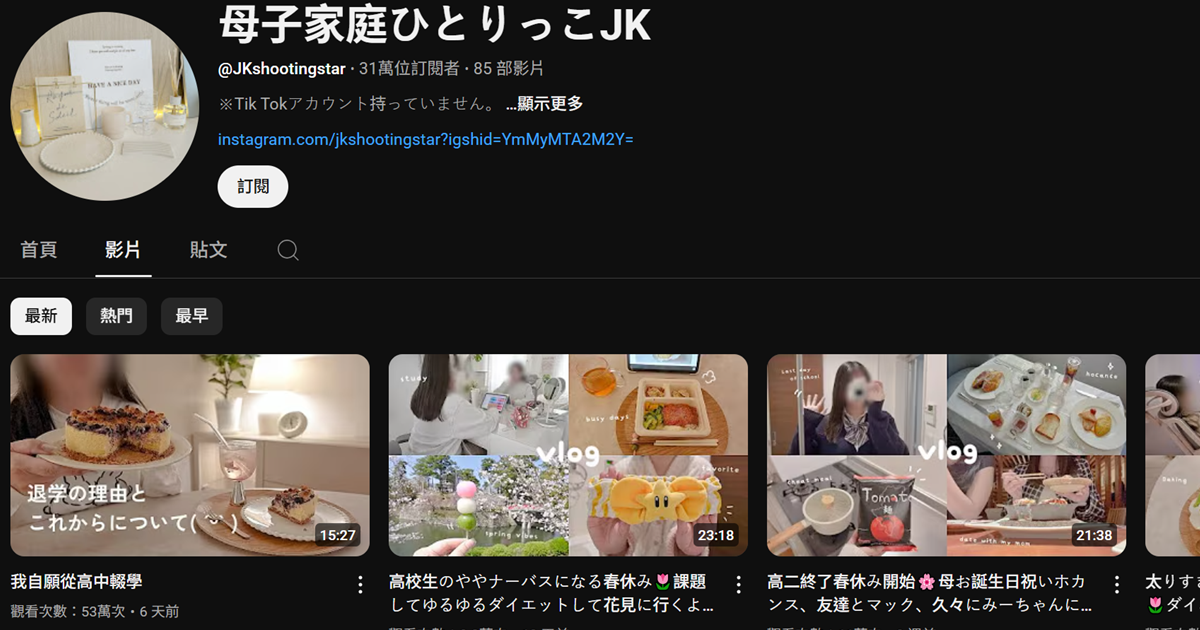
In her video announcing the withdrawal, the "Single Mother's Only Child JK" revealed that she had actually "decided to drop out in her second year of high school." According to her, her previous high school required students to apply for and receive school approval before taking on any part-time work. While she formally applied and received permission in her first year, she noted that the school's standards were often vague, and many of her classmates simply worked without applying.
This year, the school introduced a new regulation: "Prohibiting earning money through social media." Although this rule wasn't specifically aimed at her, it was reportedly enacted after other students filmed themselves in uniform, revealing their faces, and uploaded the content to social media, leading to school-related disputes. Initially, she considered pausing her YouTube activities to comply with the new rule. However, an incident where a classmate was reported for secretly working part-time, resulting in school restriction and suspension, made her question the school's approach.
When she discussed the situation with her mother, her mom casually responded, "That's great! Why not just drop out?" And so, she transferred to a correspondence high school that accepts third-year students. She stressed that despite changing schools and continuing her part-time work and YouTube channel, "I will still remember that I am a student, and academics will always be my first priority."
News outlets picked up the story, and it quickly went viral on X (formerly Twitter), sparking a polarized debate among netizens regarding her choice and the school's actions. Some argued that the school's handling was excessive and out of touch with modern times, while others maintained that the school was justified in its stance to maintain overall order and ensure student safety.
The incident fueled intense discussion, with many criticizing the school's overly conservative rules: "Times are changing, but schools can't keep up. Earning money is a skill too." "It's the same as earning money, but part-time jobs are okay, while making videos isn't? Is that reasonable?" "This girl has 310,000 subscribers; she can already be independent. There's nothing wrong with dropping out."
Conversely, some netizens expressed understanding for the school's position: "If students cause trouble, netizens will attack the school. Of course, the school has to protect itself." "Prohibiting monetization is to avoid risks; the school did nothing wrong." "The 'sushi licking incident' caused a huge stir before, so it's normal for schools to be cautious."
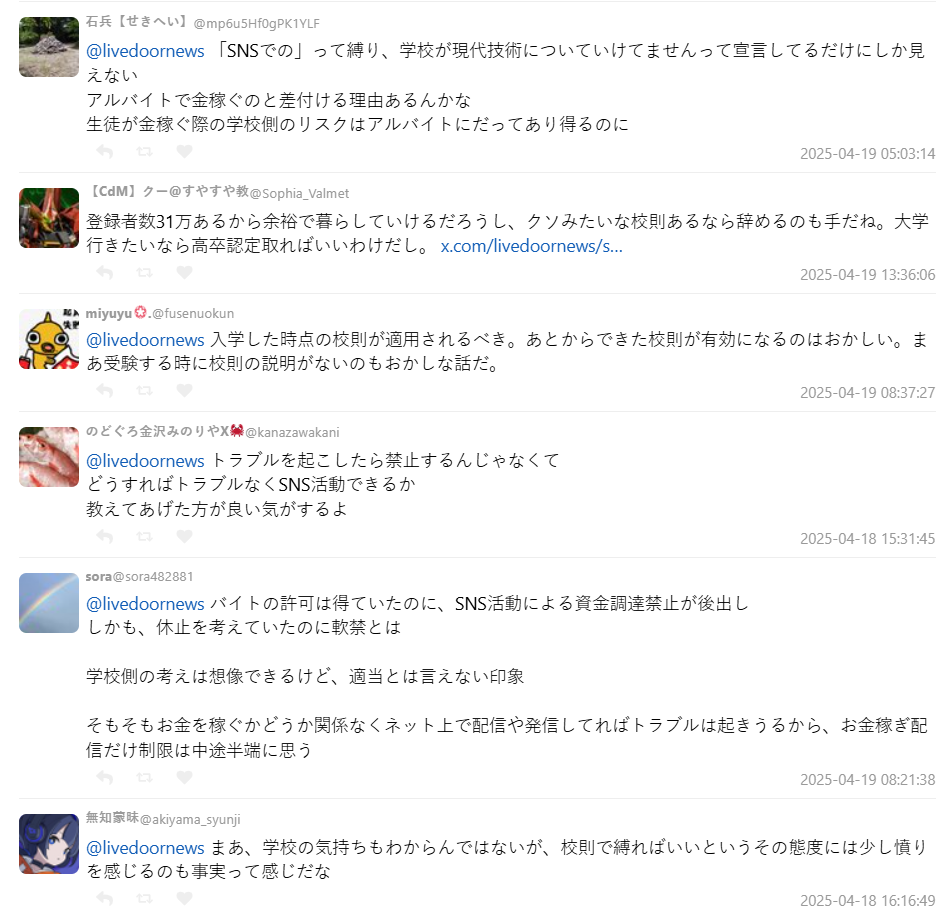
Other netizens offered neutral perspectives, suggesting that applying the new rule retroactively to existing students might be unreasonable, or that schools should educate students on proper social media use rather than imposing a blanket ban.
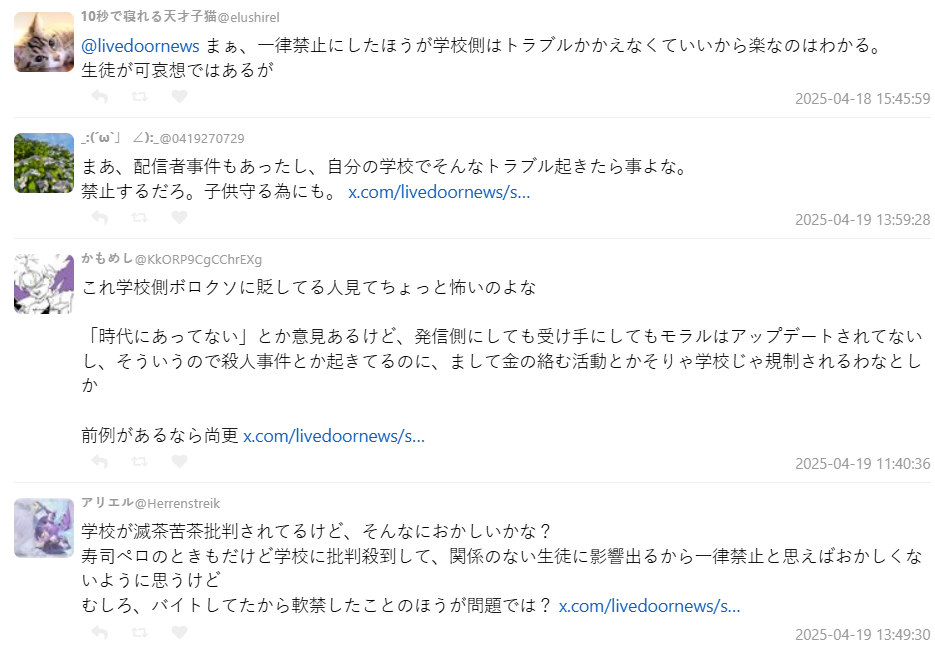
This incident highlights the clash of values facing modern education in the digital age. On one hand, there's a need to maintain campus order and student safety; on the other, there's a need to acknowledge students' self-development and creative rights in the online generation. How to strike this balance is a question society must increasingly consider as more young people venture into social media entrepreneurship.
via: togetter