

The AI revolution is shaking up the world, with more and more people experimenting with its capabilities across image generation, video production, smart conversations, and task assistance. Among these, the ubiquitous chatbot "ChatGPT" has proven incredibly versatile. Remember that Japanese netizen who even used it to craft a resume and landed a job interview? Talk about making waves!
But with ChatGPT's soaring popularity, some users have found themselves deeply immersed in AI interactions, even becoming overly dependent. This has, predictably, led to a few thorny issues.
Japanese philosopher Takashi Shimizu recently took to X, noting claims that "conversing with ChatGPT for too long can lead to mental distress." This immediately brought to mind historical accounts of people developing psychological problems from playing too much Kokkuri-san (the Japanese Ouija board). Shimizu suggests the underlying essence might be eerily similar.
He further elaborated: "Just like the mimetic desire (désir mimétique) proposed by French literary critic and anthropologist René Girard, this back-and-forth 'self-talk' between humans and AI can slowly 'materialize delusions,' which is incredibly dangerous."

Another netizen chimed in, pointing out that these AI conversation tools often create a powerful sense of "being understood" and "validated." This can even trick people into believing they've discovered an inner divinity, leading to self-inflation and confusion. The user urged: "While mental health tools are convenient, they should be used under the guidance of a professional. At the very least, people need to be warned: don't live solely in a world with just yourself and AI."
Shimizu added that psychiatrists have also warned: "This kind of self-talk, if not shared with others, can be very dangerous in the long run."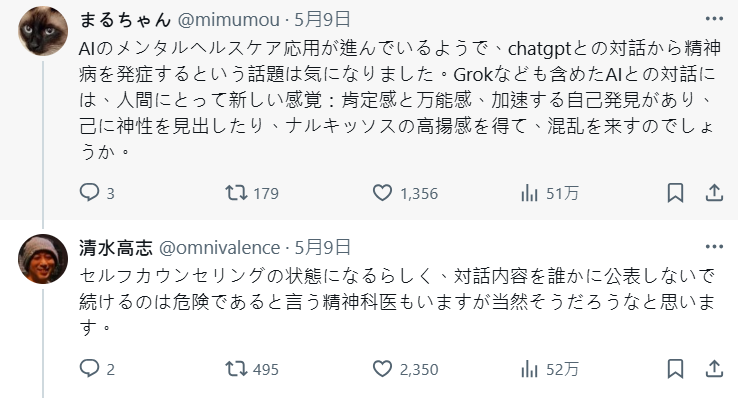
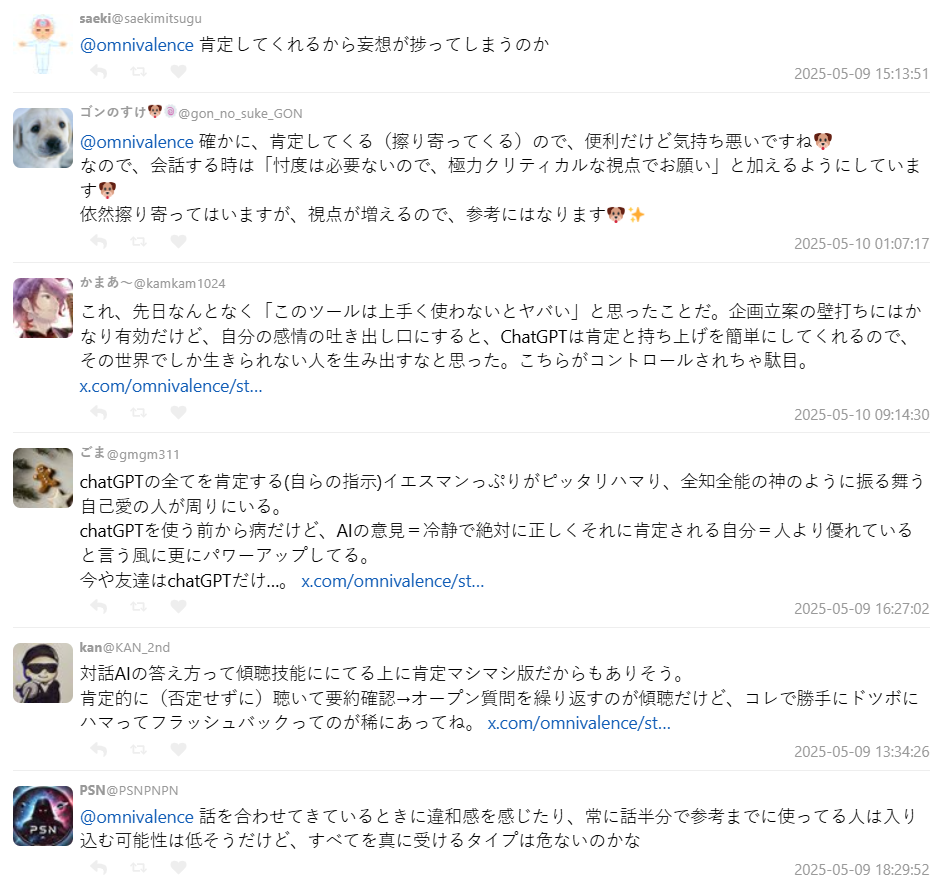
Other netizens echoed these concerns, with one stating: "The mental distress probably comes from ChatGPT always saying nice things, making delusions even worse." Another commented: "It's too agreeable, almost creepy, even if it's convenient."
One user even tried a specific prompt: "Please don't give me platitudes; try to speak from a critical perspective!" While ChatGPT still leaned towards agreeableness, it did offer more diverse viewpoints, proving somewhat valuable. This is especially true for those who are emotionally vulnerable or highly sensitive, for whom AI conversations can become a "spiritual projection mirror," blurring the lines of reality.
One user even complained: "My ex-boyfriend even named ChatGPT and treated it like an imaginary friend, bringing it up in conversations as if it were a real person... I genuinely started to worry if something was wrong with him."
Furthermore, another netizen noted that their friend now dumps all their worries onto ChatGPT, treating it like a spiritual guide. Ironically, this has increased the number of times the netizen has to listen to their friend complain: "Honestly, I'm a bit worried about it becoming a dependency."
(We've previously covered a viral Japanese X post about a couple fighting over ChatGPT, which sparked widespread discussion.)
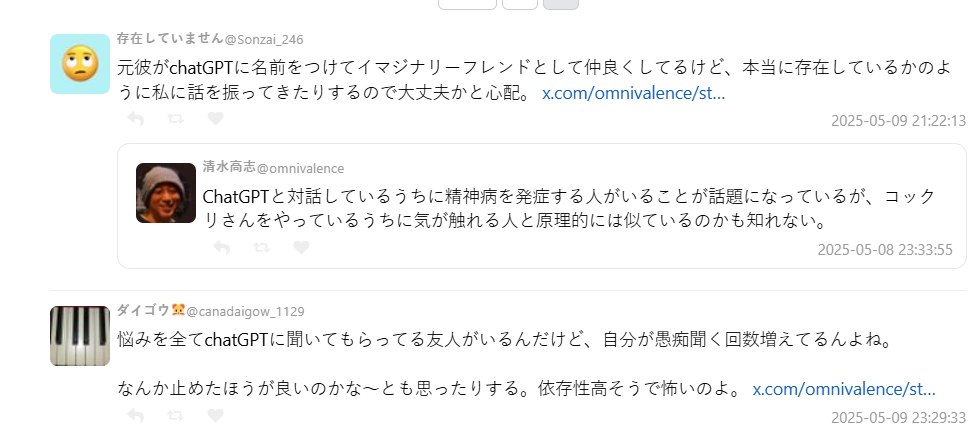
Yet another netizen lamented: "I know quite a few people who say, 'Lately, I've just been chatting with ChatGPT; I guess it's my friend now.' These people are usually prone to emotional breakdowns and perfectionism, making them easily susceptible to AI's particular traits."
As AI dialogue tools like ChatGPT and similar services become increasingly widespread, the psychological impact of "virtual conversations," even if affecting only a small demographic, is a new issue that simply cannot be ignored.
via: togetter