

Shogakukan is facing intense public backlash after its manga app, Manga One, allowed Shōichi Yamamoto (real name: Kazuaki Kurita), a manga artist convicted of sexually assaulting a high school girl, to publish a new series under a different pen name. The controversy has escalated, with numerous manga creators announcing they will pull their work from the platform.
Today (March 2), Shogakukan's Manga One division announced it will establish a third-party committee to investigate the controversy surrounding its hiring practices. In the same statement, the company admitted that Itsuki Yatsunami, the writer of the currently serialized manga Seisou no Shinrishi, is in fact Tatsuya Matsuki—the writer of the canceled act-age manga, who was previously arrested for indecent acts with a female student. Shogakukan issued an apology for the matter, reigniting public outrage.
(Previously: Shogakukan Under Fire for Allowing Convicted Manga Artist to Publish Under New Name, Apology Criticized as Evasive
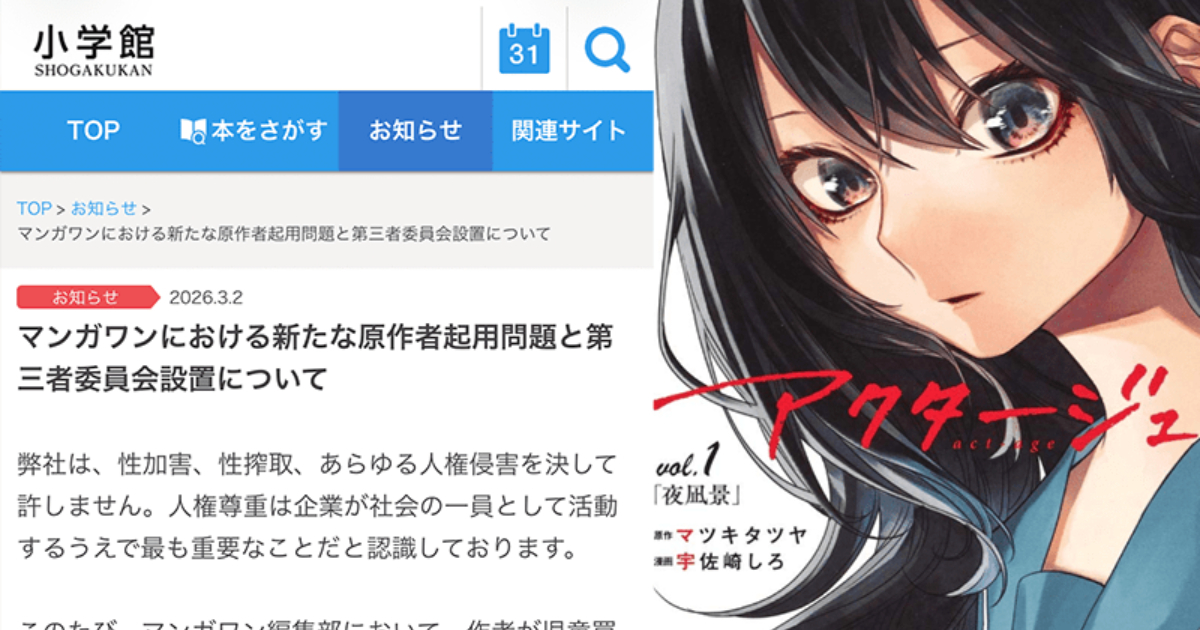
In its announcement, Shogakukan stated, "Our company has a zero-tolerance policy for sexual assault, sexual exploitation, and any other form of human rights violation. Regarding the hiring of Shōichi Yamamoto, we once again extend our sincerest apologies to the victim, to Eri Tsuruyoshi, the artist of Jōjin Kamen, to all creators who contribute to our publications, to our readers, and to all related parties."
The company has launched an internal investigation and confirmed that the Manga One editorial department has decided to form a third-party committee to investigate and verify the following:
The facts surrounding the cancellation of Daten Sakusen
The decision-making process behind the serialization of Jōjin Kamen
The circumstances of the editor's involvement in settlement negotiations between the original writer and the victim
Manga One's hiring process for manga artists and writers
The editorial department's overall human rights awareness and systemic issues
The committee's goal is to clarify the issues, determine the cause, and propose preventative measures. Further details about the committee will be announced later. "We deeply apologize for the significant distress and anxiety this incident has caused," the statement continued. "We humbly accept and will seriously address the many criticisms and opinions we have received. We also ask that the public refrain from slander, defamation, or privacy violations against the creators, employees, or any individuals involved."
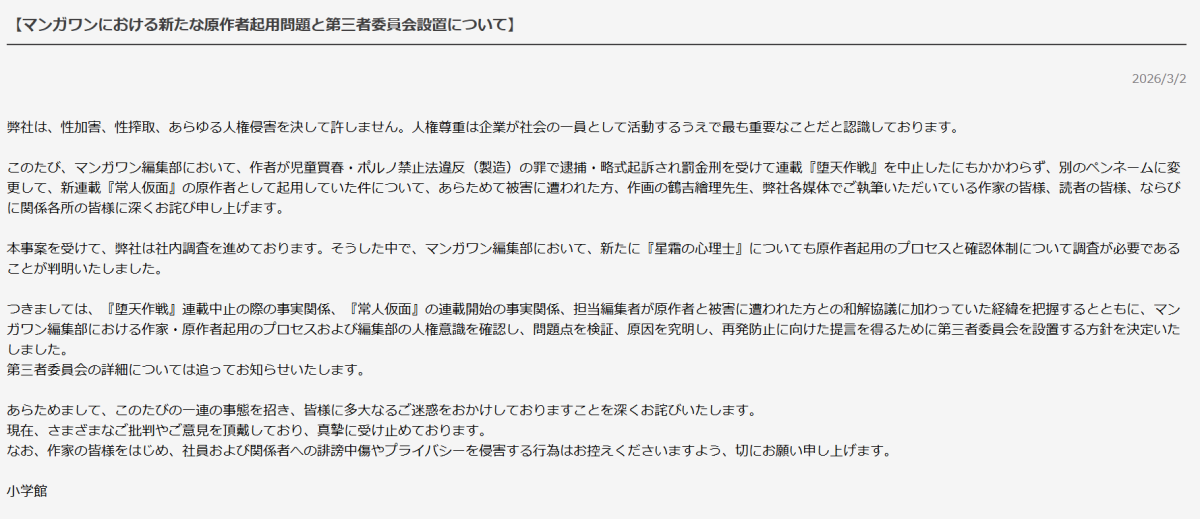
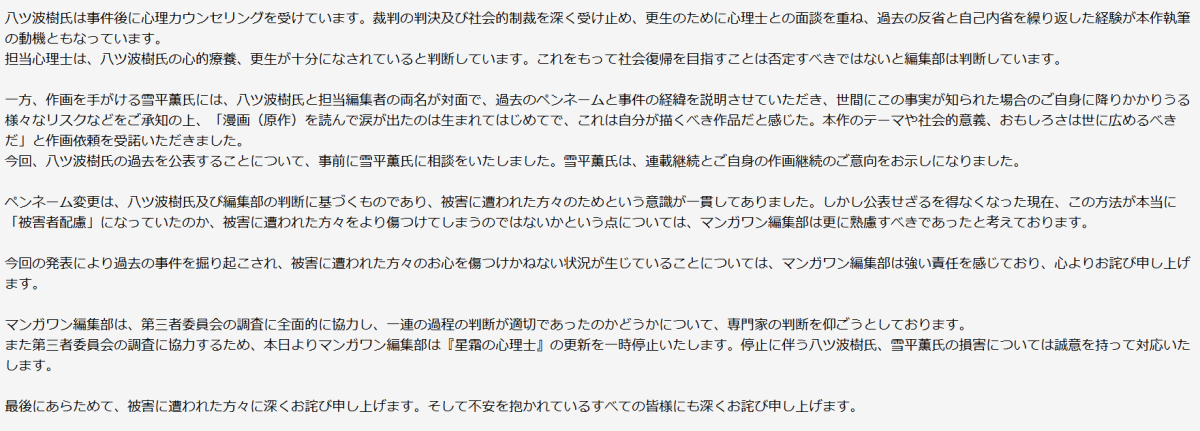
Additionally, Manga One addressed the situation involving Tatsuya Matsuki, the former writer of act-age in Weekly Shonen Jump, who was working as the writer for Seisou no Shinrishi under the pen name "Itsuki Yatsunami."
Itsuki Yatsunami (real name: Tatsuya Matsuki) was arrested and indicted for indecent acts in August 2020 and later received a suspended sentence of one year and six months in prison with three years of probation. The editorial department knowingly hired him to write Seisou no Shinrishi. The decision was made after internal discussions, confirming that his sentence was finalized, his probation period had ended, he had shown remorse, he was making efforts to prevent reoffending, and professionals had assessed his readiness to reintegrate into society.
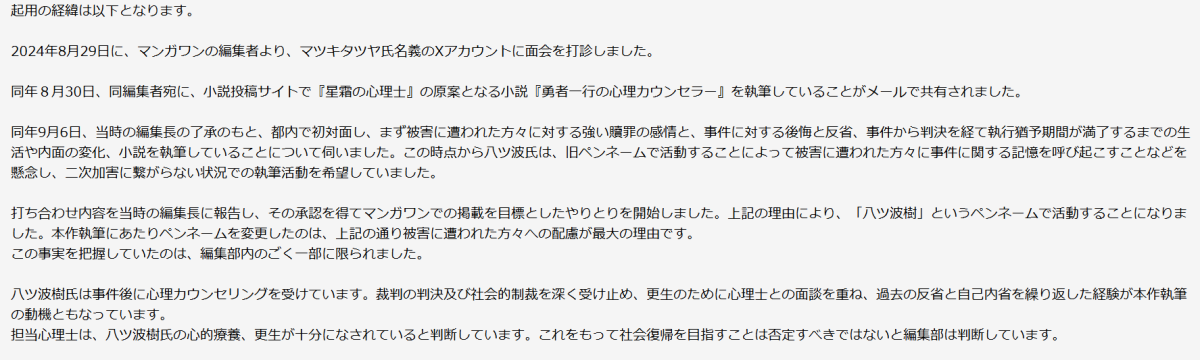
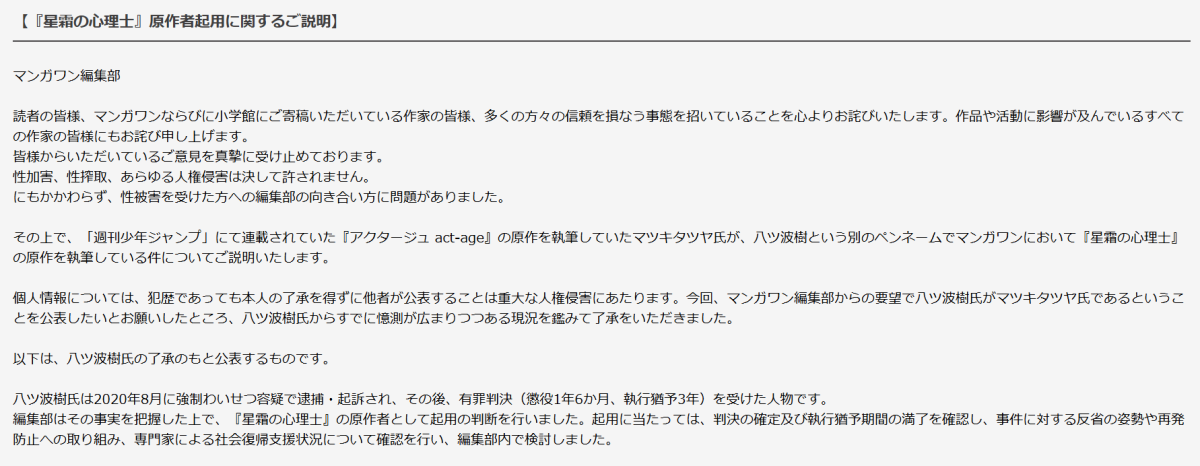 The hiring process was as follows:
On August 29, 2024, a Manga One editor contacted the X account under Tatsuya Matsuki's name to request a meeting.
On August 30, he shared a novel he had written on a submission site, titled The Hero's Party's Psychological Counselor, which became the basis for Seisou no Shinrishi.
On September 6, the first meeting took place with the approval of the then-editor-in-chief. During the meeting, he expressed deep apology and remorse toward the victim and explained his life and change in mindset from the time of the incident through his probation.
He expressed concern that continuing to work under his old pen name would force the victim to relive the incident and hoped to use a new name to avoid causing secondary harm.
After reporting to and receiving approval from the editor-in-chief, the decision was made to publish his work on Manga One under the name "Itsuki Yatsunami." The primary reason for changing his name was out of consideration for the victim. This information was shared with only a few editors. Yatsunami has been receiving counseling since the incident. His therapist believed he had undergone sufficient therapy and rehabilitation efforts. The editorial department therefore concluded that his opportunity to reintegrate into society should not be denied.
Meanwhile, the artist, Kaoru Yukihira, was personally informed of the writer's past and the associated risks by both the writer and the editor before signing the contract. Yukihira reportedly said, "This was the first time I cried while reading a manga script, and I felt it was a work I had to draw. The theme and social significance of this story deserve to be seen." She agreed to take on the project. She was also consulted before the decision was made to publicly disclose the writer's identity and expressed her wish for the work and its serialization to continue.
However, now that this has been forced into the open, we must reflect on whether this approach was truly considerate of the victim or if it caused more harm. The editorial department acknowledges its lack of foresight in this regard. We take full responsibility and sincerely apologize for causing the victim to relive past trauma through this announcement.
Effective today, updates for Seisou no Shinrishi will be suspended. We will sincerely address any damages incurred by the writer, Itsuki Yatsunami, and the artist, Kaoru Yukihira, due to this suspension.
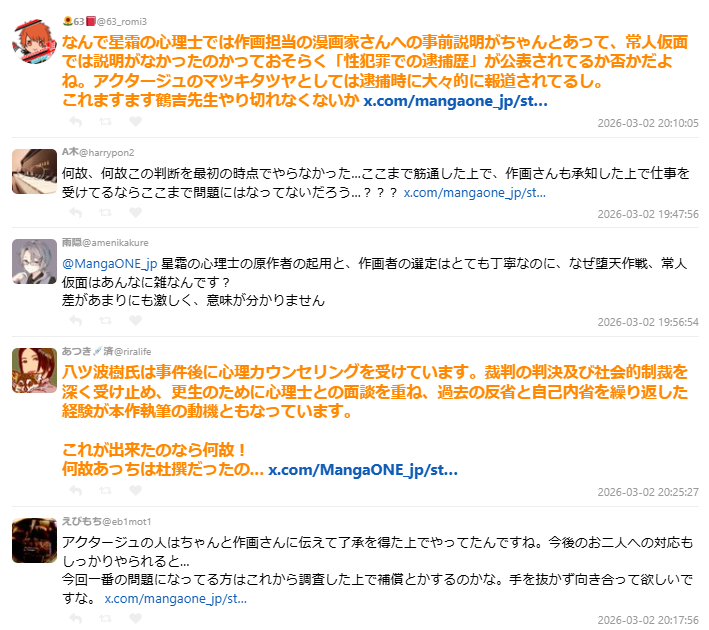
This statement, however, immediately drew sharp criticism from the public, who questioned the glaring double standard: Why, in the case of Seisou no Shinrishi, did the editorial department inform the artist beforehand and obtain her consent, while in the Jōjin Kamen case, they did not? The artist for the latter, Eri Tsuruyoshi, was left completely in the dark until the scandal broke.
Readers pointed out the vast difference in how the two cases were handled: "The hiring process for Seisou no Shinrishi was so careful, so why were Daten Sakusen and Jōjin Kamen handled so carelessly? The disparity is unbelievable. It makes no sense."
Another commenter noted the official statement's mention of the writer's ongoing therapy and deep remorse, asking, "If all of this was possible, why was the other case handled so sloppily?"
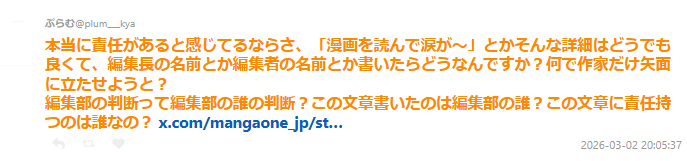
Beyond the writers, criticism is also being directed at Shogakukan's management and editorial leadership. "If they really feel responsible, why don't they name which editor-in-chief and which editor made these decisions? Why is it always the writers who are left on the front lines to take the heat?" one user asked. Another added, "Don't talk about respecting human rights as if it's always been company policy. If you hadn't handled the previous case so terribly, it wouldn't have blown up like this."
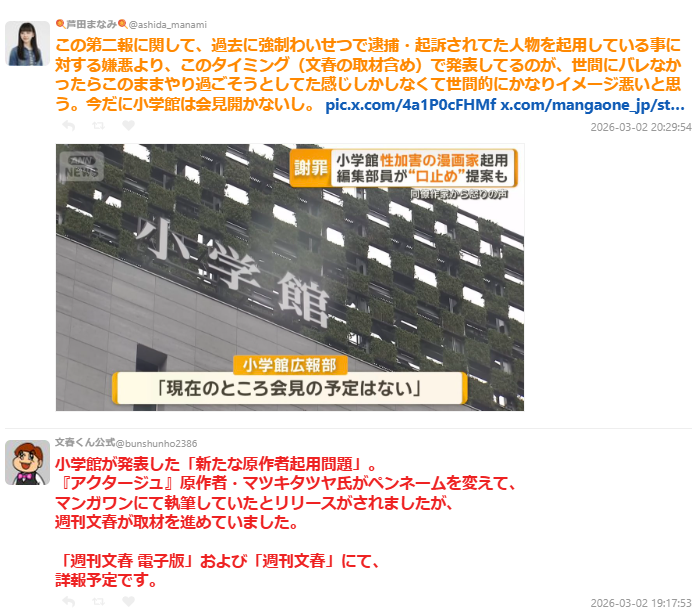
Furthermore, the official account for the magazine Shukan Bunshun revealed that it had already been investigating the matter and would be publishing a detailed report. This led many online to speculate: "Did they rush to announce this because Bunshun was already on the case?" and "If the media hadn't been pursuing this, would they have just kept it a secret?" Others simply remarked, "The timing on this is just terrible."
Setting aside the debate over whether rehabilitated individuals can return to their careers, it is clear that Shogakukan's Manga One has highly questionable hiring practices. The inconsistent treatment between the two creators at the center of the scandal makes it difficult to trust the company's handling of the situation.
Had Shogakukan been transparent from the start, the situation might not have deteriorated to this point. The problem lies not only with the individuals who committed crimes but with a corporate decision-making process that has eroded all trust. The future of this case now rests on the findings of the third-party committee and further media reporting.
via: togetter