

Written by Rifujin na Magonote and illustrated by Shirotaka, the light novel series Mushoku Tensei has remained hugely popular since its anime adaptation began airing. Its third season, which premiered this July, has drawn even more fans to the fantasy saga.
A recent post on Japan’s X sparked a debate over the polygamous relationships depicted in the anime. The user joked that polygamy might sound like a dream when you are young, but as you get older, the idea of having several wives starts to look like living hell. The post quickly gained traction and kicked off a surprisingly lively discussion.

The user behind the discussion, サバヲ, said the thought occurred to him while watching Mushoku Tensei. Polygamy might seem appealing to a teenager, he wrote, but becoming a middle-aged man completely changed his perspective: “Having several wives sounds like living hell. Why would anyone want to add more demons to the house?”
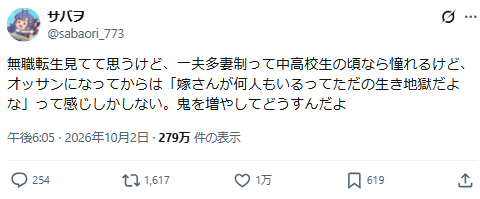
The comment struck a chord on X, with users weighing in from the perspectives of daily life, family dynamics, finances, and even historical polygamous societies. The question at the heart of the debate: just how exhausting would it be to keep several wives happy at once?
Many argued that the frightening part would not simply be supporting multiple wives, but constantly managing everyone’s feelings. The mere thought of showing each partner enough care, consideration, and reliability as a provider was enough for some users to declare the whole arrangement impossible.

Others compared it to the “bomb” system in the dating sim Tokimeki Memorial, where neglecting characters causes resentment to build until everything blows up. If keeping one relationship from exploding is already hard enough, who has the energy to juggle several?

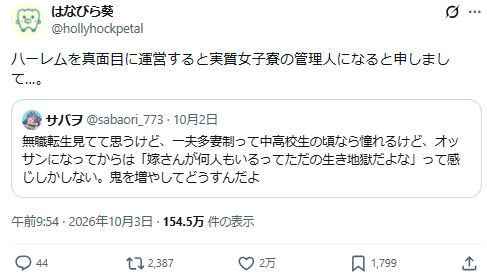
One user joked that anyone seriously trying to run a harem would not spend much time enjoying married life. Instead, the husband would effectively become a “women’s dorm manager.”
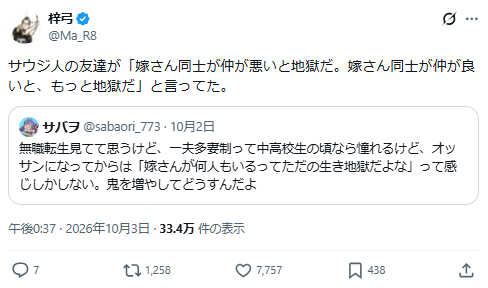
Another comment that drew considerable attention came from a user quoting a friend from Saudi Arabia: “If your wives hate one another, it’s hell. If they get along well, it’s even worse.” The reasoning was simple: if the wives are close and encounter a shared problem, they may unite against the husband, turning every disagreement into a one-versus-many showdown.
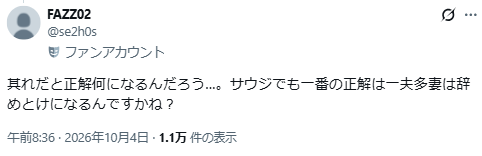
Other users joked that the wives would eventually gang up and pummel the husband together. Some concluded that the best answer might simply be not to pursue polygamy in the first place.

The discussion also moved beyond Mushoku Tensei, with users adding historical and cultural context.
One commenter cited The Tale of Genji, noting that husbands in traditional societies had to consider the status and family background of each wife while ensuring none of them lost face. For members of the elite, marriage also involved political alliances and family interests. Mishandling those relationships could mean losing the support of an influential clan.
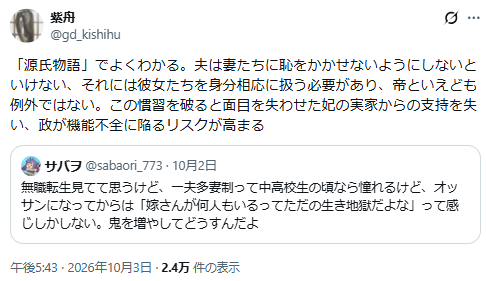
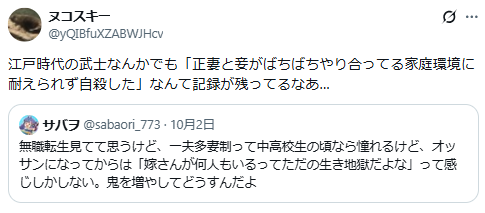
Some users even pointed to historical records from the Edo period describing samurai who took their own lives after being unable to endure years of conflict between their wives and concubines. In other words, polygamy has never been as simple as merely “having more wives.”
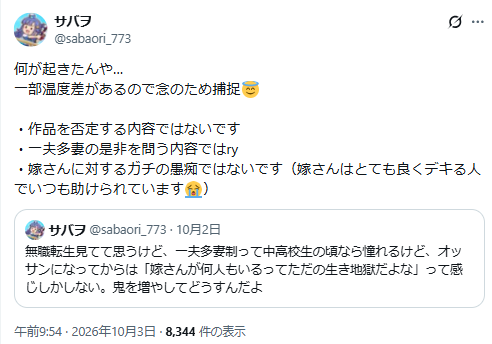
The original poster later realized the conversation had become far more serious than expected and clarified that he was not criticizing Mushoku Tensei, debating whether polygamy was right or wrong, or genuinely complaining about his own wife. He emphasized that his wife was “wonderful,” that she regularly supported him, and that the original post was only meant as a lighthearted joke.
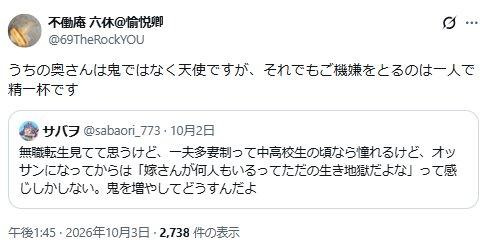
Other users argued that Rudy can maintain relationships with multiple wives largely because Sylphie, Roxy, and the others are exceptionally understanding. Without that, the arrangement would be nearly impossible to imagine. As one user put it, “My wife isn’t a demon—she’s an angel. But keeping even one person happy already takes everything I’ve got.”
What began as a conversation about young people fantasizing about polygamy ultimately expanded into a debate about household management, financial responsibility, extended-family relationships, history, and culture. For many users, the real challenge was never whether someone could marry multiple people, but whether they could give every partner a good life while also handling the complicated web of in-laws behind them.
If even people from Saudi Arabia, where polygamy remains permitted, find the arrangement exhausting, perhaps the real thing is nowhere near as glamorous as fantasy makes it look.
via: X@sabaori_773