

Recent financial reports from Japanese anime companies, released over the past couple of weeks, are painting a grim picture for many. Firms like KADOKAWA, Pony Canyon, the TBS Group, ABC Animation, and even Studio KAI—the animation studio behind Uma Musume Pretty Derby—are all reporting losses or significant profit declines.
On the flip side, industry giants like [[OBJ_7324]]Toho and Toei Animation are posting massive gains in their latest earnings reports, signaling a widening gap between the industry's heavyweights and the rest of the pack. While the overall market size appears to be growing on the surface, the reality is that the industry is facing immense internal pressure. Has the growth phase, dubbed the "streaming bubble," finally come to an end? Is the anime industry gearing up for a major strategic pivot?
Japanese media outlet ITmedia analyzed these corporate earnings reports to break down the structural shifts currently rocking the industry.

A closer look at the financial statements of the struggling companies reveals a common structural problem plaguing the entire industry: "Production costs are skyrocketing, and monetization methods can't keep up." Personnel and production costs at animation studios continue to climb due to several factors:
Chronic labor shortages
A continuous increase in the number of anime productions
Rising outsourcing fees
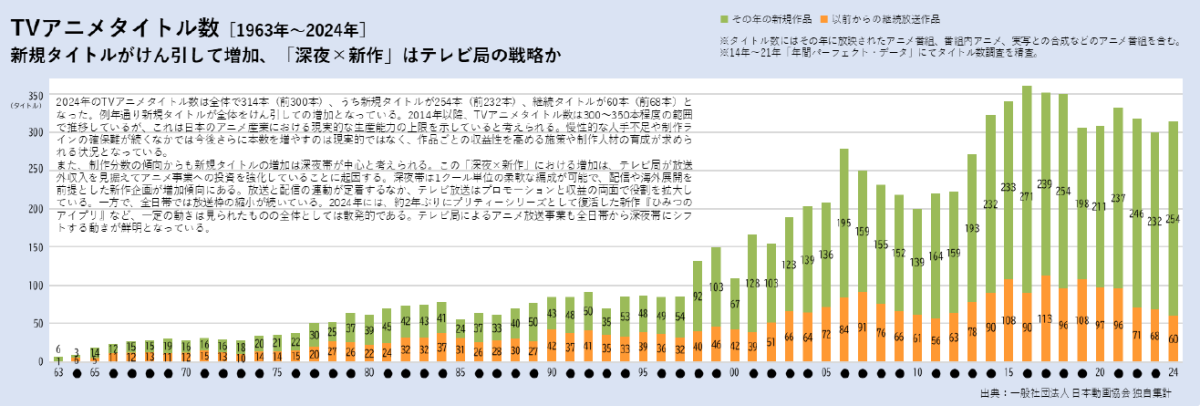
According to the Association of Japanese Animations' "Anime Industry Report 2025," the number of TV anime series produced annually has ballooned from around 100 in the early 2000s to approximately 300 today. A 2025 survey by Teikoku Databank also noted that while the anime industry's revenue has hit an all-time high, production companies are trapped in a "busy but broke" predicament, leading to a rise in bankruptcies, shutdowns, and dissolutions.
▼ The number of TV anime productions has soared in recent years.
Of course, rising costs aren't entirely a bad thing, as they may indicate that working conditions and pay for animators are slowly improving. The real problem is: "How do we recoup these increased costs?"
For the past few years, streaming platforms like Netflix and Crunchyroll have been steadily increasing their licensing fees. For some projects, streaming rights could cover as much as 80% of the production budget, even leading to cases like MAPPA's Chainsaw Man, where the animation studio funded 100% of the project to retain full control of the rights.
But the situation has changed. Broadly speaking, the amount platforms are willing to pay has hit a ceiling. As production costs rise, companies must find new ways to recover their investment. In the past, higher acquisition prices from streaming services could cover the gap, but that well has run dry. Now, the difference must be made up through secondary revenue streams like overseas licensing, merchandise, and live events.
▼ MAPPA's Chainsaw Man is a rare example of a project fully funded by the animation studio itself.

This new reality favors companies skilled in IP management, who can turn their properties into major business ventures. For those who aren't, costs will only continue to climb, pushing the break-even point further and further away. Furthermore, the disparity in negotiating power with streaming platforms is widening the revenue gap between companies. Studios with hot properties can command high prices, while those without popular IPs struggle to secure favorable licensing terms.
▼ The popular figure skating anime Medalist, exclusively licensed by Disney+, demonstrates how a show's appeal can translate into significant bargaining power with streaming platforms.

KADOKAWA recently reported a staggering 51.3% drop in operating profit, with its anime and video division posting a loss of 465 million yen. The company candidly admitted to an "over-reliance on 'Shōsetsuka ni Narō' & isekai themes."
While that sounds plausible, the real issue is that their "winning formula has failed." KADOKAWA's business model was once incredibly successful:
Simultaneously release a large volume of titles
Target the core otaku demographic
Recoup costs through a cross-media strategy involving anime, manga, novels, and merchandise
The engine driving this model was the "isekai" (another world) genre. But now, this mass-production approach has reached a saturation point. It's not that isekai is dead; the problem is that everyone is making it. Streaming platforms still love isekai for its stable, built-in audience. The issue is an oversupply that splinters the fanbase, reduces the audience for each individual title, and lowers the hit rate, directly impacting KADOKAWA's signature cross-media strategy.

So, why are Toho and Toei Animation still thriving? Compared to KADOKAWA, they present a completely different picture.
Toho Animation announced record-breaking results for the fiscal year ending February 2026, with revenue of 360.6 billion yen and an operating profit of 67.8 billion yen. Toho's real strength lies in "treating IP as a core business," not just a one-off product. They've even successfully applied this model to live-action properties like Godzilla.

Toei Animation, meanwhile, holds two overwhelming advantages:
1. Unmatched skill in long-term IP management, with franchises like GeGeGe no Kitaro, Digimon, One Piece, Dragon Ball, and Pretty Cure running strong for 20 to 40 years or more.
2. Astonishing production capacity
Toei is still expanding. In addition to growing its Osaka studio, the company is developing its base in the Philippines and even planning a studio in Vietnam, with the goal of nearly doubling its overall production capacity. They recognize that relying on Tokyo alone is not enough and are expanding to Osaka and overseas. By investing resources in their strongest areas, they are making sound strategic decisions.

A new sentiment is emerging within the Japanese anime industry: "Instead of constantly increasing the number of titles, we should produce fewer shows and increase the profitability of each one." Even Japan's Ministry of Economy, Trade and Industry (METI) believes that anime production is nearing its capacity limit. In reality, however, with animation industries now developing across Asia, a reduction in domestic production could simply lead to more work being outsourced abroad. The challenge isn't about "cutting production" but about finding the right balance between quantity and quality.

Despite the recent poor financial reports from some companies, this doesn't mean Japanese anime is in decline. Even in the current environment, some companies continue to achieve outstanding results. Those that make the right choices will continue to grow.
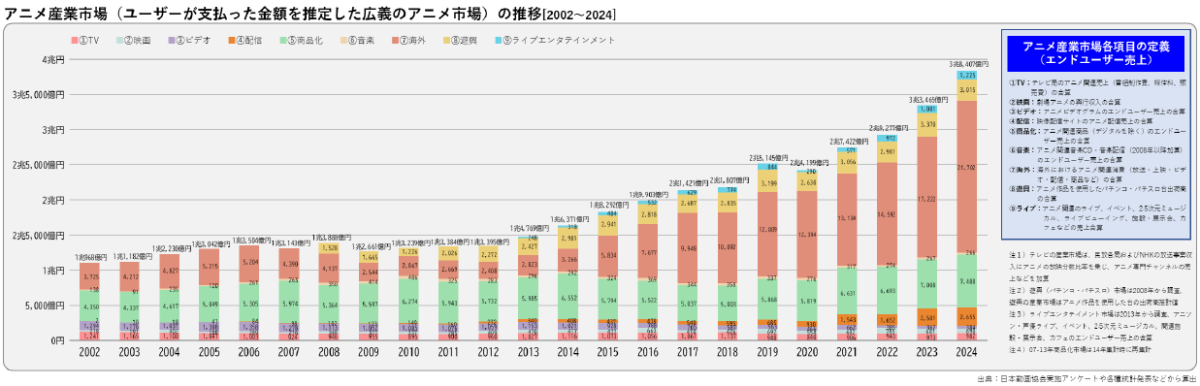
More importantly, fan passion hasn't faded, and the anime market continues to expand. According to the "Anime Industry Report 2025," rapid growth in overseas markets has pushed the broader Japanese anime industry's market size to 3.8407 trillion yen, nearing the 4 trillion yen mark.
What's really happening is that the golden era of "make an anime and a streaming platform will buy it" is over. The competition is no longer just about production capabilities. The new battleground is defined by:
IP management skills
The ability to expand into overseas markets
Licensing and merchandise development capabilities
Long-term capital management
The integration of production and project planning
The Japanese anime industry isn't heading for a recession. It's entering an endurance race that will test the fundamental strength and business acumen of every company in the game.
Note: Financial figures and earnings forecasts should be confirmed through the company’s official announcements.
via: itmedia